






























Reporting on Value: Dashboards that CFOs Actually Care About

CFOs care about value, not activity. Dashboards that resonate with finance leaders translate operational performance into financial impact, risk control, and investment return. This article explains how value-focused dashboards work, why most fail, and how organisations can design governance-grade reporting that links strategy, CX, and delivery to measurable enterprise value. What is value-based reporting for…


Benefits Management Training for Project Leaders

This article explains how benefits management training equips project leaders to translate strategy into measurable outcomes. It clarifies governance, accountability, and value tracking across portfolios. The result is stronger investment decisions, improved delivery confidence, and sustained benefits realisation beyond project closure. What is benefits management training for project leaders? Benefits management training is a structured…

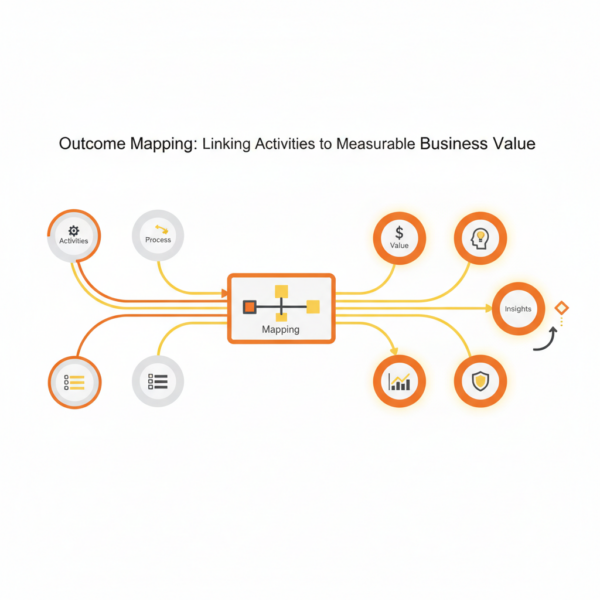
Outcome Mapping: Linking Activities to Measurable Business Value

Outcome mapping is a structured governance method that connects activities and investments to measurable business value. It replaces activity-based reporting with evidence-based accountability. For executives, outcome mapping enables clearer prioritisation, stronger value realisation, and defensible investment decisions by tracing how strategy, capability, and execution drive financial and customer outcomes. What is outcome mapping in a…

Establishing a Value Management Office (VMO): Beyond the PMO

A Value Management Office (VMO) is a governance function designed to ensure strategy translates into measurable value. Unlike a traditional PMO, which focuses on delivery discipline, a VMO governs outcomes. It aligns investment decisions, benefits realisation, and accountability across portfolios. For executive teams facing transformation fatigue, constrained budgets, and rising scrutiny, a VMO provides a…

Portfolio Optimisation: Preventing Value Leakage in Major Programs

Portfolio optimisation is a governance discipline that prevents value leakage by ensuring major programs remain aligned to strategic intent, economic value, and delivery capacity. When applied rigorously, it improves investment decisions, stops low-value initiatives early, and protects benefits through execution. For large organisations, portfolio optimisation is a primary control for capital efficiency, risk reduction, and…

Solving the Information Paradox: Getting Value from IT Investments

Summary Organisations invest heavily in IT but struggle to prove business value. This information paradox occurs when data, governance, and decision rights fail to connect technology spend to outcomes. Solving it requires value management, strong governance, and decision-grade information. Executives who address the paradox improve investment confidence, reduce waste, and convert IT from a cost…

Strategy on a Page: Aligning Vision with Executable Outcomes

A Strategy on a Page translates executive vision into a single, governed framework that links ambition to execution. It clarifies priorities, aligns decision making, and enables value tracking across the enterprise. When applied with strong governance and value management, it reduces strategy drift, accelerates delivery, and improves measurable outcomes across portfolios, teams, and customer initiatives.…

Implementing the NSW Government Benefits Realisation Management Framework

SummaryThe NSW Government Benefits Realisation Management Framework provides a structured method to ensure public investments deliver measurable value. Effective implementation requires strong governance, clear benefit ownership, disciplined measurement, and integration with strategy and funding decisions. Agencies that embed the framework early improve accountability, reduce value leakage, and demonstrate outcomes aligned to policy intent and community…

Pragmatic Innovation: Adopting New Tech Without Breaking the Bank

Pragmatic innovation enables SMEs to adopt new technology in stages, align spend to outcomes, and avoid disruption. The approach focuses on proven use cases, modular investment, and measurable value. When executed well, cost effective technology adoption improves productivity, customer experience, and decision quality without overextending capital or operational capacity. Definition What is pragmatic innovation in…