




















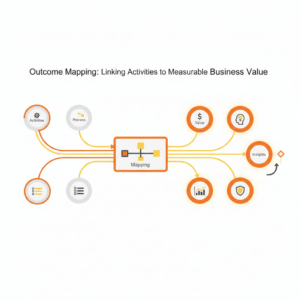
Outcome mapping is a structured governance method that connects activities and investments to measurable business value. It replaces activity-based reporting with evidence-based accountability. For executives, outcome mapping enables clearer prioritisation, stronger value realisation, and defensible investment decisions by tracing how strategy, capability, and execution drive financial and customer outcomes.
What is outcome mapping in a business context?
Outcome mapping is a value management discipline that explicitly links activities, outputs, outcomes, and business impacts. Activities describe what teams do. Outputs describe what is produced. Outcomes describe changes in behaviour, performance, or capability. Impacts describe measurable business value such as revenue growth, cost reduction, risk mitigation, or customer trust.
In enterprise environments, outcome mapping acts as a governance bridge between strategy and delivery. It ensures that initiatives remain anchored to executive intent and measurable value rather than local optimisation or delivery volume. This discipline is widely used in public sector evaluation frameworks and is increasingly adopted in regulated and customer-critical industries¹.
Why do organisations struggle to link activities to value?
Most organisations measure effort, not effect. Dashboards track projects delivered, interactions handled, or features released. These indicators are operationally useful but insufficient for executive decision-making. They do not explain whether the organisation is becoming more efficient, safer, or more trusted.
The underlying issue is structural. Strategy, delivery, finance, and measurement operate in parallel rather than as a closed value loop. Without an agreed outcome logic, teams default to proxy metrics that are easy to collect but weakly correlated with business results².
How does outcome mapping work step by step?
Outcome mapping starts with a clear definition of intended business value. This includes financial outcomes, risk thresholds, and customer or employee impacts. These impacts are decomposed into observable outcomes such as reduced customer effort, faster resolution, or improved compliance adherence.
Each outcome is then linked to enabling outputs and the specific activities required to produce them. The logic is explicit and testable. Assumptions are documented. Measures are assigned at each level, with stronger measures applied as proximity to business value increases³.
This structure allows leaders to test whether activities plausibly drive outcomes and whether outcomes plausibly drive value.
How is outcome mapping different from OKRs and KPIs?
OKRs and KPIs define targets. Outcome mapping defines causality. A KPI may state that call handling time should reduce by 10 percent. Outcome mapping explains why this matters, what behavioural change is expected, and how that change contributes to cost efficiency or customer retention.
Outcome mapping complements performance frameworks by providing a value narrative that survives organisational change. It also supports benefits realisation management standards such as ISO 21508 by making value pathways explicit rather than assumed⁴.
Where is outcome mapping applied in large organisations?
Outcome mapping is commonly applied in strategy execution, CX transformation, digital investment governance, and regulatory change. In customer operations, it is used to connect service design, communications, and automation initiatives to outcomes such as reduced failure demand or improved trust.
In practice, organisations often operationalise outcome mapping through integrated insight platforms such as Customer Science Insights, which align research evidence, operational data, and value hypotheses into a single decision framework.
What risks arise when outcome mapping is done poorly?
Poorly designed outcome maps become static artefacts. Risks include vague outcome definitions, weak measures, and untested assumptions. Another common failure is overloading maps with too many outcomes, which dilutes accountability.
Governance discipline is essential. Outcome maps must be reviewed as living instruments and challenged with evidence. Independent evaluation functions and cross-functional sponsorship reduce confirmation bias and protect integrity⁵.
How is business value measured and validated?
Measurement focuses on contribution, not attribution. Outcome mapping accepts that complex systems rarely allow single-cause attribution. Instead, it tests whether changes in outcomes are directionally and temporally consistent with interventions.
Validated measures include financial indicators, operational risk metrics, and longitudinal customer measures. Triangulation across data sources is considered best practice in evaluation science and is endorsed by government guidance on program evaluation⁶.
What are the next steps for executives adopting outcome mapping?
Executives should begin by selecting one material value challenge and mapping it end to end. Ownership must sit at the enterprise level, not within delivery teams. Measurement capability should be assessed early.
Many organisations accelerate maturity through specialist value management consulting that embeds outcome mapping into governance, investment assurance, and performance cycles.
What evidence supports outcome mapping as a governance practice?
Outcome mapping aligns with established evaluation theory and benefits realisation standards. Studies show that organisations with explicit value logic models demonstrate higher investment discipline and lower initiative failure rates⁷. Public sector adoption has also improved transparency and auditability in complex programs⁸.
FAQ
What problem does outcome mapping solve?
It solves the inability to explain how activities translate into measurable business value.
Is outcome mapping only for large transformations?
No. It is effective for any initiative where value must be justified and tracked over time.
How does Customer Science support outcome mapping?
Customer Science provides platforms, research, and advisory services that operationalise outcome mapping across CX, communications, and value governance.
What tools support outcome mapping in practice?
Insight platforms, evaluation frameworks, and structured knowledge systems such as Knowledge Quest enable consistent outcome logic and evidence reuse.
Can outcome mapping be automated?
Parts of measurement and insight synthesis can be automated using AI-enabled communications and analytics solutions.
Sources
- OECD. Better Criteria for Better Evaluation. 2020. https://doi.org/10.1787/ecd3c3b6-en
- Kaplan RS, Norton DP. The Execution Premium. Harvard Business School Press. 2008.
- Weiss CH. Theory-Based Evaluation. New Directions for Evaluation. 1997. https://doi.org/10.1002/ev.1086
- ISO 21508:2018. Earned Value Management in Project and Programme Management. ISO.
- Rossi PH, Lipsey MW, Henry GT. Evaluation. Sage Publications. 2019.
- Australian Government. Evaluation Toolkit. Department of Finance. 2021.
- Flyvbjerg B. Survival of the Unfittest. Oxford Review of Economic Policy. 2009. https://doi.org/10.1093/oxrep/grp024
- UK HM Treasury. The Green Book. 2022. https://www.gov.uk/government/publications/the-green-book-appraisal-and-evaluation-in-central-government