
Low-Carbon Journey Patterns
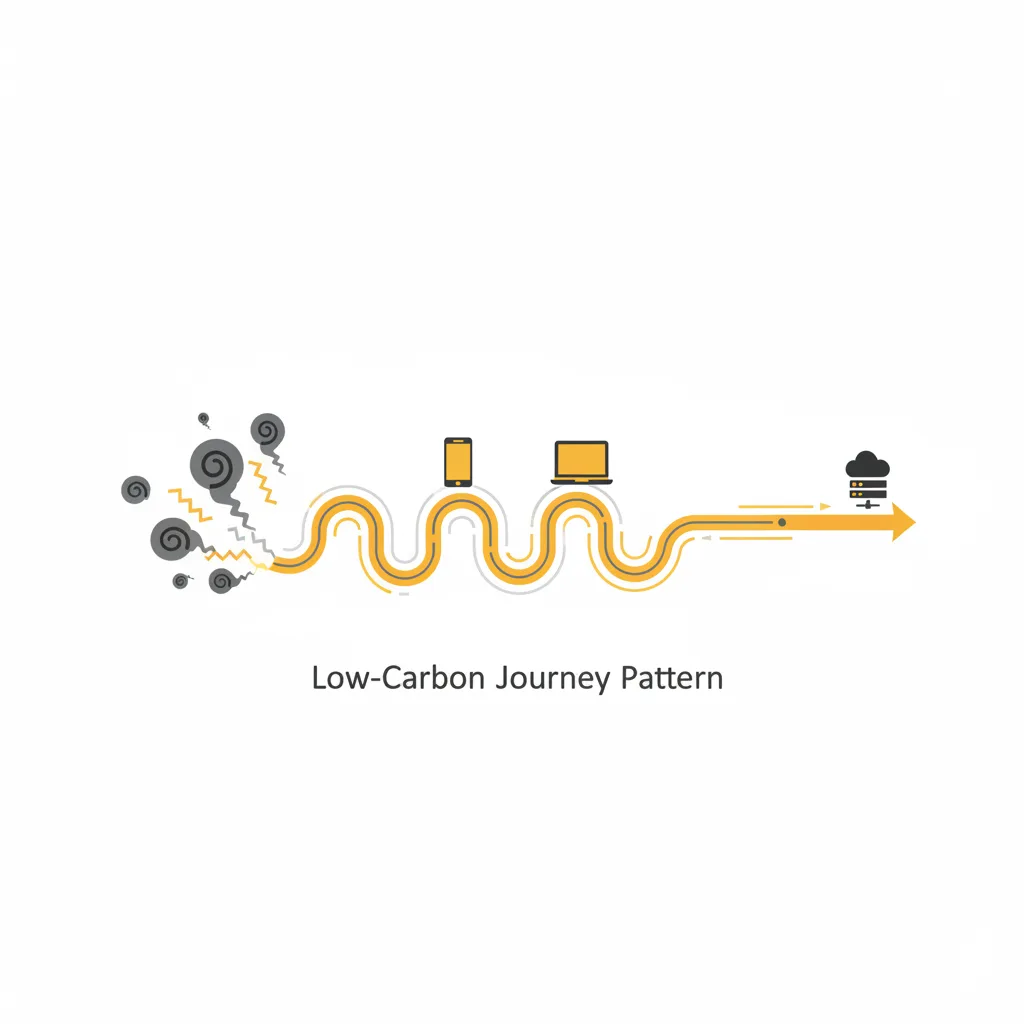
What are “low-carbon journey patterns” and why should CX leaders care?
CX teams design journey patterns to guide customers through tasks such as paying a bill, getting support, or filing a claim. Low-carbon journey patterns optimise these journeys for minimal greenhouse gas emissions without sacrificing experience quality. This approach treats carbon as a first-class design constraint alongside cost, effort, and satisfaction. The imperative is material. Data centres consumed about 460 TWh of electricity in 2022, and credible scenarios place demand above 1,000 TWh by 2026 as AI workloads scale.¹ Customer channels that look “digital and clean” can still drive emissions if compute, content, and orchestration are inefficient. The goal is not austerity. The goal is service excellence with fewer grams of CO₂e per interaction, measured and managed across the lifecycle using accepted Scope 1, 2, and 3 accounting.²
How does digital CX contribute to enterprise emissions today?
Digital CX draws on multiple systems that each carry an energy and carbon profile. Web and app front ends fetch and render content. Integration layers call CRM, billing, and logistics. Contact centres route requests and enable agents. Each component runs in facilities powered by grids with variable carbon intensity. The broader ICT sector represented about 1.4 percent of global greenhouse gas emissions in 2020 and about 4 percent of global electricity use, with trends shaped by efficiency gains and rising demand.³ AI adds new load as inference is embedded into search, chat, and decisioning. The International Energy Agency has flagged data centre electricity demand as a fast-rising share of global consumption as AI adoption accelerates.⁴ Good CX can still be high carbon if pages are heavy, models are oversized, or calls bounce between channels.
What is the design mechanism behind low-carbon journey patterns?
Service designers embed carbon awareness into the definition of “happy paths.” A low-carbon pattern reduces the computational and physical steps a customer and the enterprise must take to reach resolution. Teams start by mapping the journey and tagging each step with estimated energy, data transfer, and compute intensity. They then apply principles from the Web Sustainability Guidelines to remove unnecessary requests, compress media, and cache smartly.⁵ Designers and engineers add carbon-aware controls from the Green Software Foundation, shifting non-urgent workloads to lower-carbon times or regions and shaping demand when grid intensity spikes.⁶ Contact centre flows route to the lightest effective channel, such as authenticated self-service, before escalating to a human. The resulting blueprint is a pattern that any product squad can adopt, with clear guardrails and measurable targets.
Where do Scope 3 emissions intersect with customer journeys?
Most service organisations find that Scope 3 emissions dominate their footprint because value-chain activities such as purchased software, cloud services, devices, and logistics sit upstream and downstream. The GHG Protocol defines 15 Scope 3 categories and provides calculation methods ranging from supplier-specific to spend-based when primary data is unavailable.² Recent guidance from CDP reinforces the relevance of these categories by sector and encourages more supplier data sharing.⁷ In CX, this means journey design should preference vendors that disclose granular emissions and support carbon-aware operations. It also means content decisions, such as video length or model selection for chat, should consider the carbon cost borne by partners and end users’ devices. Low-carbon journey patterns give procurement, design, and operations a shared language to reduce Scope 3 at scale.
How do low-carbon journey patterns compare to “digital first” and “AI first”?
Leaders often declare digital first or AI first as strategy. Low-carbon journey patterns refine the brief. Digital first resolves the task online when it is effective. Low-carbon patterns resolve the task with the lowest total grams of CO₂e while maintaining the target experience. That might be a lightweight web form rather than a video chat. AI first injects models wherever possible. Low-carbon patterns right-size and place models where they create outsized value per unit of energy. The IEA expects AI to push data centre electricity demand sharply higher, so model choices and placement matter.¹ Teams can prefer distilled models for common intents, cache results, and run batch personalisation during low-carbon windows.⁶ The comparison is not dogma versus dogma. It is precision. The winning approach delivers outcomes customers love with less compute and less waste.⁴
What does application look like in contact centres and service operations?
Operations teams apply low-carbon patterns in three layers. First, they design low-energy self-service, with optimised assets, minimal round-trips, and adaptive content based on device and bandwidth.⁵ Second, they orchestrate carbon-aware automation. Non-urgent follow-ups, proactive notifications, and certain knowledge updates can run when grid intensity is lower, cutting the grams per action without changing the customer promise.⁶ Third, they tune agent workflows. Contact centre desktops prefetch only what is needed, knowledge is ranked with compact models, and call flows aim to resolve in one hop. When field service is required, scheduling aligns visits to reduce travel and idle time. These steps compound. As AI drives up baseline consumption, the organisations that design for carbon from the start will avoid expensive retrofits and regulatory pressure later.⁴
What risks and trade-offs should executives manage?
Executives should manage three risks. Rebound risk arises when efficiency wins invite more usage and erase gains. Teams should set outcome-based caps, such as total compute per customer per month, to avoid backsliding. Method risk appears when emissions are estimated with spend-based averages that mask true hotspots. Leaders should push suppliers to share activity data and improve allocation methods over time.² Experience risk emerges if design choices harm accessibility or trust. The Web Sustainability Guidelines emphasise people-first design that is performant and inclusive, not merely sparse.⁵ A related governance risk is greenwashing. Reporting should cite recognised sources, such as IEA trends for data centre electricity and GHG Protocol categories, and should disclose uncertainty ranges.¹ Transparent claims earn credibility with regulators, employees, and customers who now expect climate-literate service design.⁷
How do we measure success with CX-friendly, carbon-aware KPIs?
Teams instrument journeys with a small set of consistent metrics. Primary metrics include grams of CO₂e per completed interaction, energy per page view or API call, and model inference energy per request. Supporting metrics include data transferred, cache hit rate, and time- and location-based carbon intensity of the region serving the request. Carbon-aware operations add a percentage-shifted indicator to show how many non-urgent tasks moved to lower-carbon windows.⁶ Scope mapping ties these metrics to the right category for reporting and abatement planning.² Benchmarks should reflect real grids. The IEA’s analysis and sector reports provide context for how fast background demand is moving and where the organisation can lead rather than lag.⁴ Leaders then connect carbon KPIs to experience KPIs so product managers can trade features, performance, and emissions with shared facts.
What are the first five moves to embed low-carbon patterns now?
Executives can act in parallel. They can mandate that every new journey ships with an estimated grams-per-interaction baseline and a reduction target. They can adopt the Web Sustainability Guidelines as a non-functional requirement and publish a reference implementation.⁵ They can join the Green Software Foundation community to accelerate carbon-aware capabilities and training across engineering.⁶ They can require supplier emissions data at the feature or workload level and prefer partners who measure and disclose.² They can align AI strategy with energy reality by tracking IEA scenarios and right-sizing models and placement.¹ Each move is practical and reversible. Together they signal that the enterprise treats carbon like cost and time. The effect is a culture that designs journeys customers love and systems the planet can afford. That is the transformation mandate for modern CX.
FAQ
How do low-carbon journey patterns reduce contact centre emissions without harming customer satisfaction? Low-carbon patterns cut compute and network load through lighter interfaces, fewer round-trips, compact models, and smarter routing to self-service, while preserving the target experience metrics. They also shift non-urgent work to lower-carbon times, reducing grams of CO₂e per interaction without delaying resolution commitments.⁵
What role do the Web Sustainability Guidelines play in CX design at Customer Science? The Web Sustainability Guidelines provide practical recommendations for performant, people-first digital products. Customer Science applies these guidelines as non-functional requirements in journey design to minimise energy, data transfer, and rendering overhead across web and app experiences.⁵
Why should CX leaders track Scope 3 emissions for digital services and AI? Scope 3 captures value-chain emissions from cloud services, software suppliers, devices, and logistics. Because these often dominate a service organisation’s footprint, CX decisions on suppliers, content, and model selection materially affect reported emissions and real-world impact.²
Which AI choices deliver the biggest carbon savings in customer journeys? Right-sizing models for common intents, caching results, batching non-urgent personalisation, and placing inference in regions or times with lower grid carbon intensity deliver outsized savings while maintaining quality. The IEA’s outlook underscores the urgency as AI drives rising data centre electricity demand.¹
What is carbon-aware computing and how does it apply to service operations? Carbon-aware computing shifts or shapes workloads to align with lower-carbon energy supply across time and location. In service operations, teams schedule non-urgent jobs, model training, and content processing during lower-carbon windows while keeping customer-facing SLAs intact.⁶
Who provides the recognised standards for value-chain emissions in CX programs? The GHG Protocol defines Scope 1, 2, and 3 categories and offers calculation methods from supplier-specific to spend-based. CDP complements this with sector relevance guidance that helps prioritise data collection and disclosure.²
Which external trends should inform Customer Science clients’ roadmaps? Leaders should track IEA data on data centre electricity demand, W3C’s Web Sustainability Guidelines for front-end efficiency, and Green Software Foundation practices for carbon-aware operations. Together these sources anchor practical targets and avoid greenwashing.¹
Sources
-
International Energy Agency. “AI is set to drive surging electricity demand from data centres while offering the potential to transform how the energy sector works.” 2025, IEA News. https://www.iea.org/news/ai-is-set-to-drive-surging-electricity-demand-from-data-centres-while-offering-the-potential-to-transform-how-the-energy-sector-works
-
World Resources Institute and World Business Council for Sustainable Development. “Corporate Value Chain (Scope 3) Accounting and Reporting Standard: Category 1 Purchased Goods and Services.” 2013, GHG Protocol. https://ghgprotocol.org/sites/default/files/standards_supporting/Chapter1.pdf
-
Malmodin, Jens et al. “ICT sector electricity consumption and greenhouse gas emissions – 2020.” 2023, Renewable and Sustainable Energy Reviews. https://www.sciencedirect.com/science/article/pii/S0308596123002124
-
S&P Global Commodity Insights. “Global data centre power demand to double by 2030 on AI surge: IEA.” 2025, Analysis. https://www.spglobal.com/commodity-insights/en/news-research/latest-news/electric-power/041025-global-data-center-power-demand-to-double-by-2030-on-ai-surge-iea
-
World Wide Web Consortium. “Introducing Web Sustainability Guidelines.” 2023, W3C Blog and WSG. https://www.w3.org/blog/2023/introducing-web-sustainability-guidelines/ and https://w3c.github.io/sustainableweb-wsg/
-
Green Software Foundation. “Carbon Awareness.” 2024, Learn Green Software. https://learn.greensoftware.foundation/carbon-awareness/
-
CDP. “Technical Note: Relevance of Scope 3 Categories by Sector.” 2025, Guidance. https://cdn.cdp.net/cdp-production/cms/guidance_docs/pdfs/000/003/504/original/CDP-technical-note-scope-3-relevance-by-sector.pdf