



























Why responsible upgrades matter now?
Executives set the pace for upgrades that customers feel, employees absorb, and the planet pays for. Responsible upgrades align technology modernisation with customer experience, risk control, and sustainability outcomes. The discipline connects change management with responsible design so organisations capture value without creating hidden costs in trust, waste, or emissions. Global e-waste reached 62 million tonnes in 2022, while documented recycling captured only 22.3 percent, which underscores the stakes for every replacement cycle.¹ Responsible upgrades respond to this reality by pairing human adoption with lifecycle stewardship across hardware, software, and service design.
What is “change management for responsible upgrades”?
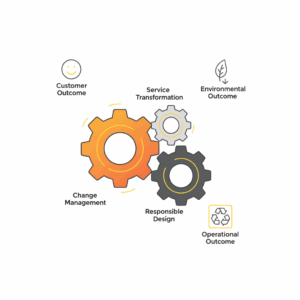
This practice integrates three units. Change management accelerates and sustains adoption. Responsible design ensures solutions respect people and planet. Service transformation orchestrates new ways of working across front and back office. Prosci’s ADKAR model defines the individual journey through Awareness, Desire, Knowledge, Ability, and Reinforcement, and it remains a widely used scaffold for adoption planning.² ISO 14001 sets the reference framework for environmental management systems that govern supplier controls, waste handling, and continuous improvement.³ The result is an operating approach that manages behaviour change and environmental impacts together in one programme backlog.
Where do leaders start to define the problem space?
Leaders scope value at three levels. Customer outcomes define faster, simpler, and more inclusive journeys. Operational outcomes define cost, risk, cycle time, and service levels. Environmental outcomes define avoided waste, lower energy use, and reduced Scope 3 emissions across the supply chain. Governments and large enterprises report that the majority of ICT emissions fall into Scope 3, which are indirect and vendor-dependent.⁴ The implication is clear. Procurement, vendor standards, and refresh policies influence more carbon than any single server-room decision. The problem statement must include customer, worker, and environmental baselines from the outset.
How do responsible design principles shape an upgrade?
Teams design out waste, circulate products and materials, and regenerate nature where possible. These are the canonical circular economy principles, driven by design.⁵ Design choices such as modular hardware, certified refurbishment, and parts re-use support longer service life and responsible end-of-life pathways. Accessibility principles such as WCAG 2.2 ensure digital upgrades improve equity and usability for people with disabilities, which also improves overall usability.⁶ Responsible design broadens success beyond a feature checklist and positions the upgrade as a better service, not just a newer tool.
What explains so many transformation misses?
Large transformations struggle when organisations overload critical roles, underinvest in capability, or fail to plan for sustaining outcomes. Independent analyses and advisory evidence note that most transformations fall short of their original ambitions when talent focus and readiness are weak.⁷ Academic reviews of digital transformation literature also highlight persistent failure risks across culture, leadership, and capability.⁸ Responsible upgrades confront this pattern by shifting from one-time deployment to continuous change, with explicit ownership of environmental and customer impacts.
How does the mechanism work in practice?
Programme leaders map each upgrade decision to adoption, risk, and footprint. The delivery unit couples a Prosci 3-Phase process for prepare, manage, and sustain with environmental controls in the same cadence and tooling.⁹ Sprint reviews track user readiness, issue resolution, and energy or waste indicators side by side. Suppliers sign ISO 14001-aligned requirements that cover device take-back, data-secure recycling, and verified materials recovery.³ Success looks like a new system that users adopt quickly, with fewer incidents, and with measured reduction in e-waste and energy draw. Leaders retain the SVO habit: teams design services, teams measure behaviour, teams retire waste responsibly.
How do we compare a “standard upgrade” to a “responsible upgrade”?
A standard upgrade ships features and closes the project. A responsible upgrade delivers adoption, documents impacts, and improves the system after go-live. Circular economy principles keep assets at their highest value for as long as possible.⁵ Accessibility standards make sure new interfaces improve usability for more customers.⁶ Environmental management ensures suppliers handle devices and components in a way that protects people and reduces harm.³ The comparison reveals a mindset shift. Teams optimise for lifetime value, not just day-one delivery.
Which applications deliver early, bankable value?
Customer contact platforms, workforce tooling, and device refreshes are ripe targets. Contact platforms with AI assist can reduce handle time and error while exposing new energy use from inference workloads. Strong governance matters because indirect emissions from major AI platforms and data centres are growing quickly, driven by electricity consumption and supply chains.¹⁰ Responsible upgrades capture the customer win while setting carbon and e-waste guardrails. Device refreshes can move from blanket three-year cycles to condition-based replacement with certified refurbishment and secure data erasure. E-waste diversion is material because global recycling rates are not keeping pace with device growth.¹¹
What are the key risks to anticipate and mitigate?
Leaders anticipate rebound effects, talent overload, supplier opacity, and greenwash. Rebound effects occur when efficiency gains increase consumption. Data centre efficiency, for example, can be overtaken by AI workload growth.¹⁰ Talent overload occurs when the same experts carry multiple initiatives.⁷ Supplier opacity hides emissions and materials handling in long chains where most ICT impact sits.⁴ Greenwash risks rise when claims outpace measurable results. Programmes mitigate these risks by setting science-based targets, demanding third-party attestations, and linking incentives to verified outcomes. The SBTi Corporate Net-Zero Standard provides criteria for aligning targets with 1.5°C pathways.¹²
How should leaders measure adoption and impact together?
Measurement integrates three lenses. Adoption metrics track activation, proficiency, and reinforcement across roles and cohorts using the ADKAR model.² Service metrics track experience outcomes such as first contact resolution, digital task completion, and error rates. Environmental metrics track device lifetimes, e-waste diversion, renewable energy procurement, and supplier conformance to ISO 14001.³ Public bodies show that transparent reporting can motivate progress across complex estates where emissions are dispersed.⁴ Executives publish a single view that ties user behaviour to service outcomes and environmental indicators so trade-offs stay visible and accountable.
Which standards and policies anchor responsible upgrades?
Anchors include ISO 14001 for environmental management and ISO 14000 family guidance for broader environmental responsibilities.³ ¹³ WCAG 2.2 anchors inclusive design in every digital service.⁶ The SBTi Net-Zero Standard anchors climate ambition in verifiable criteria and trajectories.¹² These anchors turn intent into enforceable programme requirements. Contracts reference them. Operating procedures implement them. Dashboards report against them. The organisation uses standards to stabilise good behaviour across teams and over time.
How do we operationalise this approach in twelve weeks?
Executives set a compact plan. Week 1 to 2 define the responsible upgrade charter with customer, service, and environmental baselines. Week 3 to 4 align governance on ADKAR change plans, ISO 14001 controls, WCAG checkpoints, and supplier obligations. Week 5 to 8 deliver a pilot on a high-value journey with adoption playbooks, “brownfield” hardware strategy for refurbishment, and e-waste routes confirmed. Week 9 to 10 verify outcomes against service and environmental measures. Week 11 to 12 decide scale or pivot with a clear learning dossier. Teams repeat the cycle and expand scope as maturity grows. Organisations that execute this cadence report tangible progress, such as measurable reductions in ICT emissions and improved e-waste management in a single reporting period.¹⁴
What impact should leaders expect when this works?
Leaders expect faster adoption, fewer defects, and measured environmental gains. Users move through Awareness to Reinforcement with targeted coaching and clear role design.² Customers experience simpler journeys with higher accessibility.⁶ Suppliers demonstrate compliance through a certified environmental management system.³ Organisations that report responsibly show stronger governance over the large share of indirect technology emissions, particularly in complex supply chains where Scope 3 dominates.⁴ The strategic impact compounds. The enterprise ships smarter upgrades, protects trust, and reduces waste. Customers feel the difference. Teams feel proud of the work. The planet benefits.
What are the next steps for C-level, CX, and service leaders?
Leaders can act now. Pick one priority upgrade and apply the playbook. Use ADKAR to plan change saturation and readiness at the role level.² Mandate ISO 14001 alignment across vendors and logistics partners.³ Check new journeys against WCAG 2.2 and fix gaps before go-live.⁶ Set or refresh climate targets against the SBTi Net-Zero Standard and connect them to programme KPIs.¹² Publish one dashboard for adoption, experience, and environmental outcomes. Communicate wins and lessons to build momentum. Responsible upgrades scale through evidence, not slogans.
FAQ
How do responsible upgrades reduce e-waste without slowing delivery?
Responsible upgrades combine circular economy design, ISO 14001 supplier controls, and condition-based device refresh to extend asset life and secure certified end-of-life processing. This reduces e-waste while the ADKAR-based change plan keeps delivery velocity and user adoption high.³ ² ⁵
What is the ADKAR model and why does it matter in service transformation?
ADKAR stands for Awareness, Desire, Knowledge, Ability, and Reinforcement. It structures individual change so programmes can plan readiness, coaching, and reinforcement at role level, which accelerates adoption and stabilises service outcomes during upgrades.²
Which standards should our contracts reference for responsible design and delivery?
Reference ISO 14001 for environmental management systems, WCAG 2.2 for accessibility in digital services, and the SBTi Corporate Net-Zero Standard for climate target setting. These anchors make expectations measurable and auditable across suppliers and internal teams.³ ⁶ ¹²
Why are Scope 3 emissions central to ICT and CX platform upgrades?
Most ICT-related emissions sit in supply chains and purchased services, which are classified as Scope 3. That means procurement, vendor standards, and refresh policies often influence more carbon than on-premise actions.⁴
Which risks undermine responsible upgrades and how do we mitigate them?
Top risks include talent overload, rebound effects from AI workload growth, supplier opacity, and greenwash. Mitigations include focused role design, science-based targets, third-party attestations, and dashboards that tie adoption to environmental outcomes.⁷ ¹⁰ ¹²
How does WCAG 2.2 improve customer experience during upgrades?
WCAG 2.2 provides testable success criteria that enhance accessibility for people with disabilities, which also improves usability for all users. Applying these criteria pre-go-live prevents exclusion and reduces rework in post-launch sprints.⁶
Which early wins should Customer Science clients prioritise?
Start with contact platform enhancements and device refresh policies. These deliver visible CX improvements and measurable environmental benefits when paired with adoption playbooks, ISO 14001 supplier controls, and certified e-waste routes.³ ¹¹
Sources
Global E-waste Monitor 2024. ITU and UNITAR. 2024. UN Agencies. https://www.itu.int/en/ITU-D/Environment/Pages/Publications/The-Global-E-waste-Monitor-2024.aspx
The Prosci ADKAR Model. Prosci. 2025. Methodology page. https://www.prosci.com/methodology/adkar
ISO 14001: Environmental Management Systems. International Organization for Standardization. 2025. Standard overview. https://www.iso.org/standard/60857.html
Greening Government ICT Annual Report 2023–2024. UK Government. 2025. Policy report. https://www.gov.uk/government/publications/greening-government-ict-annual-report-2023-to-2024/greening-government-commitments-ict-annual-report-2023-to-2024
Circular Economy Principles. Ellen MacArthur Foundation. 2024. Topic overview. https://www.ellenmacarthurfoundation.org/circular-economy-principles
WCAG 2 Overview. W3C Web Accessibility Initiative. 2024. Standards overview. https://www.w3.org/WAI/standards-guidelines/wcag/
88% of Business Transformations Fail to Achieve Their Original Ambitions. Bain & Company. 2024. Press release. https://www.bain.com/about/media-center/press-releases/2024/88-of-business-transformations-fail-to-achieve-their-original-ambitions-those-that-succeed-avoid-overloading-top-talent/
Why Do So Many Digital Transformations Fail? Carroll et al. 2024. Journal of Business Research. https://www.sciencedirect.com/science/article/pii/S0148296324000328
Prosci Methodology Overview. Prosci. 2025. Methodology page. https://www.prosci.com/methodology-overview
Tech Giants’ Indirect Emissions Rise with AI Expansion. Reuters. 2025. Sustainability report coverage. https://www.reuters.com/sustainability/climate-energy/tech-giants-indirect-emissions-rose-150-three-years-ai-expands-un-agency-says-2025-06-05/
AP News: Global E-waste Rising and Recycling Not Keeping Pace. Associated Press. 2024. News coverage. https://apnews.com/article/e37667e5a6b08fe8ef161d386eb3404d
SBTi Corporate Net-Zero Standard. Science Based Targets initiative. 2024. Standard hub. https://sciencebasedtargets.org/net-zero
ISO 14000 Family: Environmental Management. International Organization for Standardization. 2025. Standards overview. https://www.iso.org/standards/popular/iso-14000-family
Government ICT Reduces Emissions by 8%. Government Transformation Magazine. 2025. Article. https://www.government-transformation.com/transformation/government-ict-reduces-emissions-by-8