




















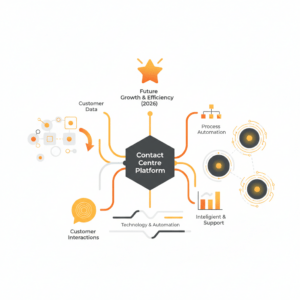
Agentic AI in contact centres should be deployed first in narrow, high-volume workflows where the system can perceive, reason, and act within clear limits. In 2026, the strongest use cases are knowledge-assisted resolution, email and case triage, quality and compliance support, after-call work, and forecasting-led orchestration. The biggest mistake is giving AI broad action rights before governance, knowledge quality, and escalation controls are ready.¹˒²˒³ (sciencedirect.com)
What is agentic AI in a contact centre?
Agentic AI is different from a normal chatbot or copilot. A chatbot mainly answers. A copilot mainly assists. An agentic system can perceive inputs, reason over context, choose tools, and take bounded actions to complete a goal. Recent academic work defines autonomous AI agents as systems that perceive, reason, and act on information from their environment while operating toward assigned tasks, including adaptive multi-step workflows.¹ That distinction matters in customer service because the step from “suggest” to “do” changes risk, workflow design, and accountability.¹˒² (sciencedirect.com)
In contact centres, that means the useful question is not whether AI can talk. It is whether AI can safely complete a service task with the right permissions, controls, and fallback paths. ISO 18295 still matters here because contact centre quality depends on managed service requirements, not just technology features.⁴ And ISO/IEC 42001 and ISO/IEC 23894 matter because they frame AI as a governance and risk-management problem as much as a capability opportunity.⁵˒⁶ (ISO)
Why is 2026 the year this matters?
The shift from experiments to operational scale is now the real story. Gartner said in March 2025 that by 2029, agentic AI will autonomously resolve 80% of common customer service issues without human intervention, with a projected 30% reduction in operational costs.³ Whether that forecast proves exactly right is less important than what it signals: service leaders are moving from assistive AI to action-taking AI.³ (Gartner)
At the same time, governance expectations have tightened. NIST’s Generative AI Profile says organisations should manage trustworthiness risks across the AI lifecycle, while the OECD’s February 2026 guidance pushes enterprises to identify, prevent, mitigate, and remedy adverse impacts from AI use.²˒⁷ In Australia, APRA’s CPS 230 is in force from 1 July 2025 for regulated entities, and OAIC guidance makes clear that privacy obligations apply when organisations use commercially available AI products involving personal information.⁷˒⁸˒⁹ (NIST Publications)
How should leaders think about AI agents for customer service?
Use a simple hierarchy. First, assist the human. Second, automate the low-risk step. Third, let the agent act only where the task is stable, the knowledge source is trusted, and reversal is possible. This is the practical lesson from both AI-CRM research and responsible-AI guidance. Successful AI integration depends on centralised customer data, ethics by design, model retraining, and ongoing user involvement rather than one-off deployment.¹⁰² (sciencedirect.com)
That framing is important because not every contact centre task deserves autonomy. Research on GenAI-enabled customer service warns of persistent paradoxes: lower cost can come with less empathy, better personalisation can feel intrusive, and higher technical power can increase vulnerability.¹¹ So the design rule is plain. Let agents handle thinking-heavy and process-heavy work first. Keep humans central in feeling-heavy, ambiguous, or high-stakes moments.¹¹˒¹² (sciencedirect.com)
Which agentic AI use cases contact centre teams should deploy first?
The best first use cases are the ones with clear intent classes, strong audit needs, and measurable operational value.
Knowledge-assisted resolution
This is usually the safest starting point. The agent retrieves approved knowledge, drafts an answer, recommends the next best action, and leaves the final send or commit step to a human. Customer Science’s agentic AI readiness framework explicitly recommends knowledge-assisted resolution first because it reduces handling time without granting transaction authority.¹³ Zero-Click Knowledge for Contact Centre Agents is relevant here because it combines Knowledge Quest and CommScore.AI around grounded answers, drafting, and knowledge health inside the agent workflow.¹⁴ (Customer Science)
Email and case triage
This is one of the clearest live uses of agentic AI. An agent can classify intent, assess urgency, route work, draft the response, and auto-resolve low-risk intents when policy allows. Customer Science’s Triage AI case study reports a 40% reduction in agent-handled email volume across eight weeks, with a 55% faster time to first response, using auto responses, self-service nudges, intelligent routing, and draft assist.¹⁵ That is a strong example because the architecture stayed thin, auditable, and reversible.¹⁵ (Customer Science)
Quality and compliance support
Here the agent evaluates interactions against scorecards, flags risk, checks policy adherence, and proposes coaching actions. This is a strong 2026 use case because it improves consistency without giving the AI authority to decide an outcome for the customer. Customer Science’s readiness framework lists quality and compliance support as a priority first-wave application.¹³ (Customer Science)
After-call work and summarisation
This use case removes admin load. The agent writes the summary, fills CRM fields, recommends wrap codes, and proposes follow-up actions. The value is not only average handle time. It is also data quality, coaching visibility, and reduced cognitive strain on agents. This fits the broader literature on AI integration in CRM, where ongoing user involvement and customer-data centralisation are essential to real value.¹⁰ (sciencedirect.com)
Forecasting-led orchestration
This is less visible to customers but strategically important. AI and ML models can forecast inbound volumes, identify queue pressure early, and trigger staffing or workflow moves. Research on call-centre arrivals forecasting shows practical ML approaches can improve prediction accuracy and make AI-driven forecasting usable for real operational decisions.¹⁶ (sciencedirect.com)
Which use cases should stay human-led?
Do not lead with full autonomy in service recovery, complaints, vulnerability, hardship, bereavement, fraud disputes, or complex exception handling. Research in 2025 found that voice-driven AI in service recovery lowers perceived customer orientation and downstream service outcomes when the task needs feeling skills rather than thinking skills.¹² Human-AI collaborative recovery research also shows that recovery outcomes depend on the sequence of human and AI involvement, not just the presence of automation.¹⁷ (sciencedirect.com)
That does not mean AI has no role in these journeys. It means AI should support diagnosis, context gathering, drafting, and case preparation while a human owns the emotional and discretionary part of the resolution. That is the safer and more effective form of AI agents for customer service in sensitive moments.¹²˒¹⁷ (sciencedirect.com)
What risks should contact centre leaders watch?
The first risk is action risk. When permissions are too broad, the agent can do the wrong thing at speed. The second is security risk. OWASP’s 2025 guidance still treats prompt injection as a major issue because manipulated inputs can alter model behaviour and bypass intended controls.¹⁸ The third is privacy risk, especially when personal information flows into commercial AI products or external tool chains. OAIC has been explicit that the Privacy Act applies to uses of AI involving personal information.⁹ ˒¹⁸ (OWASP Gen AI Security Project)
There is also an operational resilience risk. Once agents sit inside routing, triage, or knowledge decisions, they become part of the service backbone. That means outage plans, vendor dependency, audit logging, rollback paths, and release management move from technical detail to executive concern.²˒⁸ (NIST Publications)
How should you measure success?
Measure outcomes and controls together. The balanced scorecard from Customer Science’s readiness framework is sensible: customer impact measures such as first contact resolution, complaint rate, customer effort, and recontact within seven days; operational measures such as handle time, after-call work, throughput per FTE, and time to proficiency; and control measures such as policy adherence, hallucination incidence, override rates, blocked prompt-injection attempts, and drift indicators.¹³ (Customer Science)
For organisations building that operating model properly, CX Consulting and Professional Services is relevant because the problem is usually not the model alone. It is use-case selection, risk design, change management, instrumentation, and governance across service operations.¹⁹ (Customer Science)
What should happen next?
Start with one bounded workflow in the next 90 days. Pick a contact reason with high volume, low ambiguity, strong knowledge, and reversible actions. Define the action boundary, escalation path, stop rules, audit requirements, and weekly scorecard before go-live. Then run the pilot with a real service team, not in a lab.²˒¹³ (NIST Publications)
That sequence matters because agentic AI is not a chatbot upgrade. It is a change in how work gets done. The contact centres that benefit most in 2026 will be the ones that treat autonomy as an operating-model decision, not a feature launch.¹˒³˒¹⁰ (sciencedirect.com)
FAQ
What are the best first agentic AI use cases contact centre teams should try?
Knowledge-assisted resolution, email triage, quality and compliance support, after-call work, and low-risk workflow orchestration are the best first candidates because the value is clear and the action surface is constrained.¹³˒¹⁵ (Customer Science)
Are AI agents for customer service the same as chatbots?
No. Chatbots mainly answer questions. Agentic systems can plan, use tools, and complete bounded multi-step tasks.¹˒² (sciencedirect.com)
Where should humans stay central?
Humans should remain central in complaints, service recovery, vulnerable-customer cases, hardship, disputes, and other high-emotion or high-discretion work.¹²˒¹⁷ (sciencedirect.com)
What usually blocks scale?
Weak knowledge, poor permissions design, fragmented customer data, unclear ownership, and missing audit controls block scale more often than the model itself.¹⁰˒¹³ (sciencedirect.com)
How should leaders govern agentic AI?
Use lifecycle governance, privacy review, action boundaries, human override, model monitoring, and service-level rollback plans. That aligns with NIST, OECD, OAIC, and APRA expectations.²˒⁷˒⁸˒⁹ (NIST Publications)
What helps agents trust AI outputs in live service?
Trusted, current, grounded knowledge helps most. Knowledge Quest is relevant where the priority is reliable answers, knowledge-gap detection, and faster updates across customer service channels.²⁰ (Customer Science)
Evidentiary Layer
The evidence base supports a cautious but practical conclusion. Agentic AI is real enough in 2026 to create value in contact centres, especially in knowledge, triage, compliance, admin, and orchestration work. But the same evidence also shows that empathy, privacy, security, resilience, and control remain decisive constraints. Academic research supports bounded autonomy and stronger human roles in emotionally complex work. Official guidance supports lifecycle governance, privacy discipline, and operational risk controls. The winning model is not full autonomy everywhere. It is narrow autonomy where the task fits and the guardrails hold.²˒⁷˒⁸˒¹¹˒¹² (NIST Publications)
Sources
-
Gonzalez, G. R., Habel, J., Hunter, G. K. AI agents, agentic AI, and the future of sales. Journal of Business Research, 2026. DOI: 10.1016/j.jbusres.2025.115799. (sciencedirect.com)
-
NIST. Artificial Intelligence Risk Management Framework: Generative AI Profile, NIST AI 600-1, 2024. (NIST Publications)
-
Gartner. Gartner Predicts Agentic AI Will Autonomously Resolve 80% of Common Customer Service Issues Without Human Intervention by 2029, 5 March 2025. (Gartner)
-
ISO. ISO 18295-1:2017 Customer contact centres, Part 1: Requirements for customer contact centres. (ISO)
-
ISO/IEC. ISO/IEC 42001:2023 AI management systems. (ISO)
-
ISO/IEC. ISO/IEC 23894:2023 Artificial intelligence, Guidance on risk management. (ISO)
-
OECD. OECD Due Diligence Guidance for Responsible AI, 19 February 2026. (OECD)
-
APRA. Prudential Standard CPS 230 Operational Risk Management, in force from 1 July 2025. (APRA Prudential Handbook)
-
OAIC. Guidance on privacy and the use of commercially available AI products, 21 October 2024. (OAIC)
-
Ledro, C., Nosella, A., Vinelli, A. Artificial intelligence in customer relationship management: A systematic framework for a successful integration. Journal of Business Research, 2025. DOI: 10.1016/j.jbusres.2025.115214. (sciencedirect.com)
-
Ferraro, C., Demsar, V., Sands, S., et al. The paradoxes of generative AI-enabled customer service: A guide for managers. Business Horizons, 2024. DOI: 10.1016/j.bushor.2024.04.014. (sciencedirect.com)
-
Carrilho, M. G., Wagner, R., Pinto, D. C., et al. The feeling skills gap: the role of empathy in voice-driven AI for service recovery. Journal of Business Research, 2025. DOI: 10.1016/j.jbusres.2025.115703. (sciencedirect.com)
-
Customer Science. Agentic AI readiness framework for Australian organisations, 2026. (Customer Science)
-
Customer Science. Zero-Click Knowledge for Contact Centre Agents, 2026. (Customer Science)
-
Customer Science. Case Study: 40% Email Deflection via Triage AI, 18 October 2025. (Customer Science)
-
Albrecht, T., et al. Call me maybe: Methods and practical implementation of artificial intelligence in call center arrivals’ forecasting. Journal of Business Research, 2021. DOI: 10.1016/j.jbusres.2020.10.018. (sciencedirect.com)
-
Yang, G., et al. Human-AI collaborative recovery: How recovery sequence and strategy order drive consumer forgiveness. Journal of Retailing and Consumer Services, 2025. (sciencedirect.com)
-
OWASP. LLM01:2025 Prompt Injection, OWASP GenAI Security Project. (OWASP Gen AI Security Project)
-
Customer Science. CX Consulting and Professional Services. (Customer Science)
-
Customer Science. Knowledge Quest. (Customer Science)