































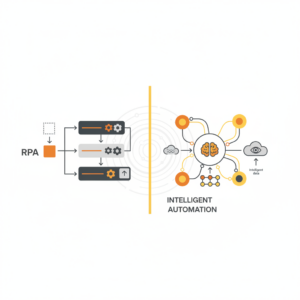
RPA still creates value where work is stable, rules are explicit, and systems change slowly. Intelligent automation creates more value when the work needs judgment, document understanding, orchestration, or adaptation across steps. The business case is not about replacing every bot with AI. It is about deciding where deterministic automation is enough and where upgrading from RPA to AI will improve speed, resilience, and customer outcomes. (Springer Nature Link)
What is RPA and what is intelligent automation?
Robotic process automation, or RPA, uses software bots to mimic repetitive human actions in existing systems, usually through the user interface. It is strongest where inputs are structured, rules are fixed, and the process rarely changes. Academic implementation work describes RPA as a lightweight automation technique for already digital, manual tasks or subprocesses carried out through existing interfaces.¹˒² (Springer Nature Link)
Intelligent automation is broader. It combines RPA with workflow, orchestration, machine learning, document understanding, language models, analytics, and decision support. The aim is not only to automate clicks, but to automate more of the end-to-end work, including classification, interpretation, routing, exception handling, and continuous optimisation. The literature on intelligent automation treats it as a business-value model for knowledge and service work, not just a tooling upgrade.³˒⁴ (sciencedirect.com)
Why is the RPA vs intelligent automation question more important now?
The question matters more now because many organisations already have a first wave of bots. Some are delivering value. Some are brittle, expensive to maintain, and hard to scale. At the same time, AI capabilities have improved quickly, which makes “upgrading from RPA to AI” sound inevitable. It is not inevitable. But it is increasingly relevant where the process contains unstructured inputs, frequent exceptions, or handoffs that plain bots handle badly. (Springer Nature Link)
This is also a governance issue now, not only a productivity issue. NIST’s Generative AI Profile, ISO/IEC 42001, and APRA CPS 230 all reinforce the same executive point in different language: once automation becomes adaptive, model-driven, or service-critical, leaders need stronger controls around risk, accountability, resilience, and service providers.⁵˒⁶˒⁷ (NIST)
How does the business case mechanism differ?
RPA creates value mainly through labour substitution, cycle-time reduction, and lower error rates in fixed tasks. It is often justified through quick wins: less copying and pasting, fewer manual updates, faster case closure, and better compliance on repetitive steps. Recent research on RPA value creation found positive effects across operational activities, especially where firms analysed applicability carefully before deployment.² (Springer Nature Link)
Intelligent automation creates value differently. It still reduces manual effort, but it also improves decision quality, handles more variation, and reduces the hidden cost of broken handoffs. That means its value shows up not only in hours saved, but in fewer exceptions, lower rework, faster changes, better customer outcomes, and more resilient process execution. That is why the business case often shifts from “cheaper task execution” to “better process performance and operating flexibility.”³˒⁴ (sciencedirect.com)
What is the real difference between RPA and intelligent automation?
The practical difference is this: RPA follows the known path. Intelligent automation can help manage the uncertain path. If a claims update always follows the same screen sequence, RPA may be enough. If the case arrives with mixed documents, changing wording, uncertain intent, and a need to prioritise or escalate, intelligent automation is usually the better fit.¹˒³ (Springer Nature Link)
That does not make RPA obsolete. In fact, many intelligent automation stacks still rely on RPA at the execution layer. The upgrade is architectural, not ideological. RPA handles deterministic steps. AI handles interpretation. Workflow handles orchestration. Analytics measures whether the automation improved the outcome. The mistake is treating RPA vs intelligent automation as a winner-takes-all decision. In most enterprise environments, the answer is layered automation, not replacement for its own sake.³˒⁴ (sciencedirect.com)
When should organisations keep RPA and when should they upgrade from RPA to AI?
Keep RPA where the process is stable, the data is structured, the exception rate is low, and the UI path is dependable enough that maintenance remains acceptable. Typical examples include data entry between legacy systems, status updates, scheduled reconciliations, and deterministic after-call work. Those use cases still produce strong returns when process discipline is good.¹˒² (Springer Nature Link)
Upgrade from RPA to AI when the process breaks because it needs reading, classification, summarisation, prioritisation, or flexible routing. That includes email triage, document-heavy onboarding, complex service requests, and cross-system workflows where the next step depends on context rather than one fixed rule. Adoption research on intelligent automation shows strategic value rises when firms have the digital capability to absorb these broader technologies, not only deploy them tactically.⁴ (sciencedirect.com)
Where should the business case start?
Start with one process family, not the whole enterprise. Good candidates are service operations where there is visible rework, slow handling, repetitive admin, and customer impact when work stalls. That is why many firms begin in customer service, shared services, finance operations, and claims-style environments. Evidence from current Customer Science automation guidance points to high-ROI use cases such as after-call work, identity and entitlement checks, billing corrections, and back-office service workflows. (Customer Science)
A practical starting point for firms moving off brittle legacy bots is Customer Science’s Legacy RPA Migration to Intelligent Automation Platforms, which frames the shift as product modernisation rather than a tool swap, with inventory, stabilisation, API-first redesign, and governed migration in waves. (Customer Science)
How should leaders compare cost, resilience, and change speed?
RPA often wins on entry cost and speed to first automation. It is usually easier to justify when the process is narrow and the economics are local. But it can lose over time if maintenance rises every time an upstream interface changes. That is the hidden tax of screen-level automation.¹˒² (Springer Nature Link)
Intelligent automation usually requires more upfront design, stronger governance, and better data foundations. But it can outperform on resilience and change speed when the work changes often or spans multiple systems and handoffs. That is the real board-level comparison. Not “Which tool is smarter?” but “Which architecture reduces operating friction and future change cost?” Recent Forrester commentary on automation in 2026 also suggests many firms will use narrower embedded agents within deterministic workflows rather than jump straight to broad autonomy, which supports a staged business case rather than a big-bang rewrite. (Forrester)
What risks should executives watch?
The first risk is automating a bad process. If the process is poorly designed, both RPA and intelligent automation can scale the wrong work faster. The second risk is brittle dependency. Legacy bots tied to unstable screens often create operational fragility. The third risk is overreaching with AI, where organisations add model-driven decisions before they have enough controls, auditability, or rollback paths.²˒⁵˒⁷ (Springer Nature Link)
There is also a governance risk in regulated sectors and customer-facing operations. ISO/IEC 42001 sets out requirements for an AI management system, while APRA CPS 230 requires regulated entities to manage operational risk, critical operations, and service-provider risk. Once automation begins to affect decisioning, customer outcomes, or critical service flow, these controls stop being optional architecture details and become part of the business case itself.⁶˒⁷ (ISO)
How should you measure the business case?
Measure the business case in layers. Start with operational metrics such as cycle time, exception rate, rework, average handle time, and error reduction. Add service metrics such as first contact resolution, backlog age, and repeat contact where customer-facing work is involved. Then add financial metrics such as labour capacity released, cost per case, margin protected, and the cost of maintaining the automation over time.²˒³ (Springer Nature Link)
That layered scorecard matters because simple hours-saved models often flatter weak automations. A better question is whether the automation improved the process sustainably, not whether it removed a few manual clicks in quarter one. For organisations that need help building that measurement model across service, workflow, and governance, Customer Science’s Intelligent Automation Consulting Services Australia is the right type of support because it is positioned around designing, implementing, and running digital workers with business and CX outcomes in view. (Customer Science)
What should happen next?
The next step is not to ask whether the whole organisation should move from RPA to intelligent automation. The next step is to classify the current automation estate. Which bots are stable and worth keeping? Which are brittle but still valuable? Which should be replatformed into workflow and API-led automation? Which need AI because the core bottleneck is interpretation rather than keystrokes? Customer Science’s current migration guidance recommends exactly this inventory-and-wave approach. (Customer Science)
Once that is clear, build one pilot with a hard economic case. Pick a process with visible exception cost, measurable customer impact, and enough volume to matter. Then decide whether deterministic automation is enough or whether the process genuinely needs intelligent automation. That is how the business case becomes evidence-based instead of vendor-led. (Springer Nature Link)
FAQ
Is intelligent automation just RPA with AI added?
Not exactly. RPA can be one component of intelligent automation, but intelligent automation usually includes workflow, AI or ML, orchestration, analytics, and controls that go beyond UI-level task automation.³˒⁴ (sciencedirect.com)
Should every legacy bot be upgraded from RPA to AI?
No. Stable, rules-based bots may still be the best answer. Upgrade only where the process needs interpretation, exception handling, or cross-step decisioning that deterministic bots handle poorly.¹˒² (Springer Nature Link)
What is the best first use case for intelligent automation?
A good first use case usually has high volume, visible exception cost, and enough ambiguity that plain RPA struggles. Email triage, document-heavy service workflows, and complex case routing are common starting points. (sciencedirect.com)
Does intelligent automation always produce a stronger ROI than RPA?
No. Intelligent automation often has a bigger upside, but it also needs stronger data, governance, and design. For simple stable tasks, RPA may still produce the cleaner business case.²˒⁴ (Springer Nature Link)
What usually blocks migration from RPA to intelligent automation?
Weak process ownership, unclear metrics, fragmented data, brittle legacy dependencies, and poor governance usually block migration more than the technology itself.⁴˒⁵˒⁷ (sciencedirect.com)
What helps organisations control AI risk during the upgrade?
A governed human review layer helps. Customer Science’s Human-in-the-Loop AI Governance for Accurate Knowledge is relevant where teams need accountable review, audit-ready evidence, and tighter control over AI-generated outputs in service environments. (Customer Science)
Evidentiary Layer
The evidence does not support a simplistic “RPA is old, AI is new” story. Recent research shows RPA still creates operational value when it is applied to the right type of task, while intelligent automation creates broader value when organisations need adaptation, orchestration, and stronger strategic fit.²˒³˒⁴ Governance standards and regulatory guidance now add a second filter: once automation becomes model-driven or service-critical, resilience, accountability, and provider risk become part of the investment case.⁵˒⁶˒⁷ The strongest business case, then, is not a technology comparison alone. It is a design choice about where deterministic automation is enough and where intelligence materially improves the economics and control of the process. (Springer Nature Link)
Sources
-
Herm, L. V., Janiesch, C., Reijers, H. A. A framework for implementing robotic process automation projects. Electronic Markets, 2023. DOI: 10.1007/s10257-022-00553-8.
-
Durão, D., et al. How does robotic process automation create value for firms? Electronic Markets, 2024. DOI: 10.1007/s10257-024-00685-z.
-
Coombs, C., Hislop, D., Taneva, S. K., Barnard, S. The strategic impacts of intelligent automation for knowledge and service work: An interdisciplinary review. Journal of Strategic Information Systems, 2020. DOI: 10.1016/j.jsis.2020.101600.
-
Mubarik, M., et al. Strategic and organisational factors for advancing intelligent automation implementation. Internet Policy Review, 2025. Stable article record.
-
NIST. Artificial Intelligence Risk Management Framework: Generative AI Profile, NIST AI 600-1, 2024.
-
ISO/IEC 42001:2023. Artificial intelligence management system requirements. ISO, 2023.
-
APRA. Prudential Standard CPS 230 Operational Risk Management, in force 1 July 2025.
-
Jin, W., et al. A review of AI-driven automation technologies. Computer Standards & Interfaces, 2025. Stable article record.
-
Krzywy, J., et al. Study of the use of robotic process automation in customer service processes. Procedia Computer Science, 2024. Stable article record.
-
Ledro, C., Nosella, A., Vinelli, A. Artificial intelligence in customer relationship management: A systematic framework for successful integration. Journal of Business Research, 2025. DOI: 10.1016/j.jbusres.2025.115214.