































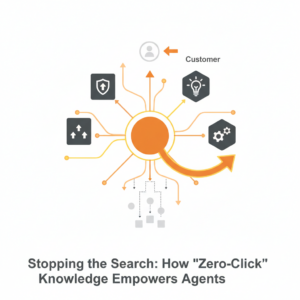
Zero-click knowledge stops the search loop by surfacing the best answer inside the agent’s workflow, at the moment of need. It reduces context switching, improves answer consistency, and shortens time to resolution. When combined with governance and measurable knowledge health, it can lift productivity, improve customer sentiment, and strengthen agent experience across voice and digital channels.
What is zero-click knowledge?
Zero-click knowledge is an operating model where agents do not “go hunting” across portals, PDFs, or intranet pages. The system proactively delivers the most relevant guidance, policy, and next steps in the same screen where the interaction is handled. It can use intent detection, case context, customer attributes, and journey stage to rank answers and recommended actions.
The important distinction is not the interface. It is the reduction of “search friction” as a hidden tax on service performance. In many contact centres, the real workload is not the customer question. It is finding the right internal interpretation of policy, product, process, and exception handling, then translating it into a compliant and human response.
Why do agents keep searching?
Agents search because knowledge is fragmented, duplicated, or outdated. They also search because the organisation has not defined a single “source of truth” for each decision. In practice, this creates rework and creates avoidable escalations, because agents hedge when they cannot verify the latest rule or exception.
Search also creates cognitive overhead. Interruptions and task switching carry measurable costs. A field study by University of California, Irvine researchers found it can take around 23 minutes to resume work after interruptions.³ In contact centres, that “resumption” is repeated many times per hour across tools, queues, and knowledge sources.
How does zero-click knowledge work in practice?
Zero-click knowledge typically combines four layers.
First is content normalisation. Policies and procedures are structured into consistent formats so the system can retrieve the right step, not just the right document. This aligns to the lifecycle view in ISO 30401 knowledge management systems.⁴
Second is context-driven retrieval. Case metadata, product, channel, and customer segment constrain what “correct” means. This prevents generic answers from winning ranking simply because they are common.
Third is decision support, not just text snippets. The system can present “what to do next”, required checks, and “do not say” compliance cues. This makes knowledge operational, not encyclopaedic.
Fourth is closed-loop learning. The contact centre becomes a sensor. Outcomes like first contact resolution, recontact, and QA flags identify where knowledge failed, not just where content exists.
Zero-click knowledge vs traditional knowledge bases and AI chatbots
Traditional knowledge bases assume the user will search and then judge relevance. This is workable for stable topics, but it fails under change, exceptions, and multi-step service processes. It also fails when agents are measured on speed, because search time competes directly with handle time.
Chatbots help customers and agents, but they introduce a different risk profile. Freeform generation can be fast, but it must be constrained by retrieval and approved content to prevent confident errors. Evidence from customer-service deployments shows that AI assistance can improve productivity by about 14% on average, with the largest gains for less experienced agents.¹ The same evidence also suggests improvements in customer sentiment and retention when used as augmentation, not replacement.¹
A practical comparison is this: traditional KB improves “findability”, chatbots improve “front-door convenience”, and zero-click knowledge improves “in-workflow execution”. High-performing operations combine all three, with governance that defines where each is allowed to answer.
Where should leaders apply zero-click knowledge first?
Start where searching is most damaging to outcomes.
High-volume, policy-heavy enquiries are ideal because small errors create downstream cost. These include billing disputes, eligibility, hardship, identity processes, and regulated disclosures. The second strong target is complex exception handling, where agents need guardrails rather than generic summaries.
In a products-and-tools strategy, the goal is to operationalise knowledge health. Customer Science positions Knowledge Quest as an AI-powered knowledge management approach that converts real interactions into actionable answers and drafts, with a focus on reducing handling time and improving satisfaction.
To make this stick,Consortium for Service Innovation Knowledge-Centered Service (KCS), which treats knowledge as the way work is done, not extra documentation.⁵
What risks can undermine zero-click knowledge?
The first risk is trust decay. One visible mistake can drive agents back to manual searching. Control this with approved sources, clear confidence cues, and simple escalation paths when an answer is missing.
The second risk is privacy and purpose drift. If the system uses conversation data, governance must match privacy obligations. In Australia, the Office of the Australian Information Commissioner explains that personal information should only be used or disclosed for the primary purpose of collection unless an exception applies.⁶ This matters when transcripts are used to train models or generate new content.
The third risk is compliance inconsistency across channels. If your voice scripts differ from your email templates, you can create contradictory “truths”. This is why zero-click knowledge should connect to a communications quality layer, not just a knowledge repository.
The fourth risk is operational gaming. If agents are rewarded for speed alone, they may over-accept the first surfaced answer. Counter this with QA design that measures correctness, not just brevity.
How do you measure if zero-click knowledge is working?
Measure outcomes, not adoption. Adoption can be high even when the system surfaces the wrong thing quickly.
Use a balanced scorecard:
-
Average handle time (AHT) and after-call work.
-
First contact resolution (FCR) and repeat contacts within 7 days.
-
QA critical error rate and compliance breaches.
-
Knowledge gap rate, meaning interactions where no approved answer exists.
-
Time to publish or update knowledge after a policy change.
-
Agent effort and confidence scores, captured in short pulse surveys.
Australia-specific workforce measures matter because attrition amplifies training cost. ACXPA reports average contact centre attrition around 27% in its 2024 best practice report.² A strong zero-click program reduces time-to-competence for new hires, which is where AI assistance has shown outsized gains.¹
If you need structured governance for AI risk, align controls to NIST AI RMF and ISO/IEC 23894.⁷˒⁸
What are the next steps to implement zero-click knowledge safely?
Start with a “single truth map”. For each top contact driver, define the authoritative policy owner, the approved answer format, and the required evidence links. Then instrument your current workflow to measure search time and recontact rates, so you can quantify uplift.
Move to a pilot that limits scope. Use three to five intents, one business unit, and one channel. Build calibration into daily operations so frontline leaders can accept, reject, or refine surfaced answers. This makes improvement continuous and visible.
Finally, operationalise governance. Use ISO 30401 principles to define knowledge roles, lifecycle controls, and performance evaluation.⁴ Use the Australian Digital Service Standard as a usability lens to ensure services stay measurable and user-centred.⁹
For enterprise delivery support, embed change management, measurement, and operating model design through CX Consulting and Professional Services.
Evidentiary Layer
Zero-click knowledge is not a content project. It is a service performance system. The most defensible business case ties reduced search and reduced rework to measurable improvements in productivity, quality, and retention.
Two evidence anchors are particularly useful for executive alignment. First, rigorous field evidence shows generative AI assistance can lift customer support productivity by about 14% on average, with stronger gains for novices.¹ Second, interruption and context-switching research demonstrates why reducing tool switching and searching is a direct productivity lever, not a “nice to have”.³
Risk evidence matters too. Privacy and purpose limitations in Australian privacy guidance affect how interaction data can be used to generate or tune knowledge.⁶ AI risk frameworks provide practical control sets to keep speed improvements from creating new operational or compliance exposure.⁷˒⁸
Sources
-
Brynjolfsson, E., Li, D., Raymond, L. “Generative AI at Work.” NBER Working Paper 31161 (2023). https://www.nber.org/papers/w31161
-
ACXPA. “2024 Australian Contact Centre Industry Best Practice Report.” (2024). https://acxpa.com.au/2024-australian-contact-centre-industry-best-practice-report/
-
Mark, G., Gudith, D., Klocke, U. “The Cost of Interrupted Work: More Speed and Stress.” CHI (2008). https://www.ics.uci.edu/~gmark/chi08-mark.pdf
-
ISO 30401:2018. “Knowledge management systems.” (2018). https://www.iso.org/standard/68683.html
-
Consortium for Service Innovation. “Knowledge-Centered Service (KCS).” (accessed 2026). https://www.serviceinnovation.org/kcs/
-
Office of the Australian Information Commissioner (OAIC). “APP 6 Use or disclosure of personal information.” (Guidelines). https://www.oaic.gov.au/privacy/australian-privacy-principles/australian-privacy-principles-guidelines/chapter-6-app-6-use-or-disclosure-of-personal-information
-
NIST. “Artificial Intelligence Risk Management Framework (AI RMF 1.0).” NIST AI 100-1 (2023). https://nvlpubs.nist.gov/nistpubs/ai/NIST.AI.100-1.pdf
-
ISO/IEC 23894:2023. “Artificial intelligence Guidance on risk management.” (2023). https://www.iso.org/standard/77304.html
-
Australian Government. “Digital Service Standard.” (current version). https://www.digital.gov.au/policy/digital-experience/digital-service-standard
-
Australian Government, Department of Industry. “Australia’s AI Ethics Principles.” (2019). https://www.industry.gov.au/publications/australias-ai-ethics-principles
-
Brynjolfsson, E., Li, D., Raymond, L. “Generative AI at Work.” The Quarterly Journal of Economics 140(2) (2025). DOI: 10.1093/qje/qjae052. https://academic.oup.com/qje/article/140/2/889/7990658
-
ContactBabel. “Australian and New Zealand Contact Centre Decision-Makers’ Guide Executive Summary 2023–24.” (2023). https://auscontact.com.au/common/Uploaded%20files/Reports/2023Reports/ContactBabel%202023-24%20ANZ%20CC%20DMG%20Exec%20Summary.pdf
FAQ
What does “zero-click knowledge” mean for agent experience?
Zero-click knowledge reduces tool switching and searching, so agents spend more time resolving and less time verifying. That typically improves confidence, lowers stress, and improves consistency across new and experienced staff.³
Does zero-click knowledge replace training?
Zero-click knowledge reduces time-to-competence, but it does not replace product, policy, and empathy training. AI assistance has shown stronger gains for novice agents, which makes it a powerful complement to coaching.¹
How do you prevent wrong answers from being surfaced quickly?
Use retrieval from approved sources, clear confidence cues, and a closed-loop process where agents and QA can flag gaps and errors. Align controls to AI risk frameworks such as NIST AI RMF and ISO/IEC 23894.⁷˒⁸
Can we use customer conversations to generate knowledge articles?
You can, but privacy governance must be explicit. In Australia, personal information use should align to the primary purpose of collection unless an exception applies, so data handling and consent models need review.⁶
What should we measure first?
Start with search time, knowledge gap rate, AHT, and repeat contact rate. Then add quality measures such as critical error rate and compliance outcomes, plus agent confidence and effort scores.²
How does this connect to customer communications quality?
Surfaced answers should match approved written templates and tone rules, so customers receive consistent guidance across phone, chat, and email. A communications optimisation layer such as CommScore.AI can support consistency and clarity.