




























Why validate a service blueprint before you scale?
Leaders ship better services when teams validate the blueprint for completeness and usability before investment. A service blueprint is a structured visualization of the customer journey, the frontstage and backstage actions, the support processes, and the evidence that customers perceive as part of the experience. Service blueprinting grew from service design and operations research to help organizations see the service as a system that can be improved and measured.¹ The practice links directly to customer experience strategy, because it turns qualitative insight into operational clarity that product, operations, and technology teams can act on.²
What does “complete and usable” mean in practice?
Teams call a blueprint complete when it shows the end-to-end service from a clear trigger to a clear outcome, including the people, processes, tools, and evidence that matter. Teams call a blueprint usable when practitioners can read it, navigate it, and use it to make decisions without additional explanation. Usability has a formal definition. A system is usable when specified users achieve specified goals with effectiveness, efficiency, and satisfaction in a specified context of use.³ A blueprint should meet the same bar, because it is a working artefact used by cross-functional teams to plan, prioritize, and execute change.³
How should leaders set the validation scope?
Executives set the scope by confirming the bread-and-butter questions up front. Which customer segment and scenario does this blueprint cover. Which channels are in play. Which business outcome does this service drive. Which internal processes are impacted. Scope discipline reduces noise and prevents version sprawl. Service design principles support this stance by asking teams to work co-creatively, sequence the experience, take a holistic view, and keep the customer at the center.² Leaders should make those principles explicit in the review brief and hold the team accountable for them.
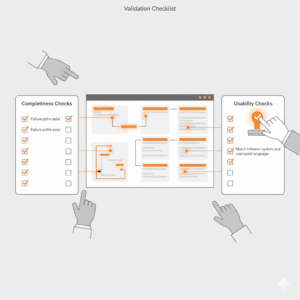
Validation Checklist: Blueprint Completeness
Use this section to confirm the blueprint shows the right service, at the right depth, with the right ties to operations.
Start and finish are explicit. The blueprint names the entry trigger, the exit condition, and the success state a customer would recognize. This anchors measurement and handoffs.¹
Customer actions are sequenced and testable. Each customer step is observable and verifiable across channels. Duplicate or ambiguous steps are resolved.²
Frontstage actions are visible and labeled. Agents, bots, or interfaces that customers touch are represented with verbs that show intent and state change.¹
Backstage actions support the frontstage. The blueprint maps backstage tasks, roles, and systems that enable each visible step. Gaps are flagged as risks.¹
Support processes are connected. Legal, risk, finance, HR, and platform services show up where they influence lead time and quality. This prevents “invisible blockers.”¹
Evidence is specified. The blueprint lists the artifacts customers see or receive at each step, such as notifications, receipts, transcripts, and packaging. Evidence is key because customers judge quality through what they can observe.¹
Policies and rules appear where decisions happen. Decision points reference the policy or rule set that governs the outcome. This reduces rework during implementation.¹
Failure paths exist. The blueprint shows common errors and recovery flows. Teams include the conditions, detection methods, and resolution owners. Clear error handling improves perceived reliability.⁴
Data flows are legible. Inputs, outputs, and data stores are mapped at the step where they matter for personalization, compliance, and analytics. This supports privacy reviews and measurement later.¹
Interfaces to adjacent services are shown. Upstream and downstream blueprints or APIs are referenced so readers can navigate to them. This preserves context and avoids double work.²
Validation Checklist: Blueprint Usability
Apply standard usability criteria to ensure the blueprint drives action, not confusion.
Recognition over recall. Labels, icons, and swimlanes follow a consistent legend so readers recognize patterns rather than memorize symbols. This aligns with established usability heuristics.⁴
Match between system and real-world language. The blueprint uses the same terms agents and customers use. Technical jargon appears only where it is the system of record.⁴
User control and freedom for the reader. Layers toggle on and off for audiences. Stakeholders can filter by role, channel, or risk. This reduces cognitive load and supports efficiency.⁴
Consistency and standards. Step names, actor tags, and artifact icons are consistent across products and channels. Consistency reduces interpretation errors and speeds comprehension.⁴
Error prevention in the artefact. The template prevents common authoring mistakes such as unlabeled arrows or orphaned steps. Preventive design raises quality before content review.⁴
Accessibility for the audience. Text size, color contrast, keyboard navigation, and alt text meet WCAG 2.2 guidance where the blueprint is delivered via web or intranet.⁵
Effectiveness, efficiency, satisfaction evidence. A quick usability test with target practitioners confirms they can answer task questions accurately, quickly, and with confidence. This follows ISO 9241-11.³
Findability and version control. The blueprint includes a title, date, owner, version, and link to the canonical repository so teams can find and trust the current state.³
Decision-readiness. The artefact ends with explicit recommendations, constraints, and open questions. This improves the usefulness of the blueprint in governance forums.¹
What mechanisms keep evidence credible and discoverable?
Teams increase credibility when they show the chain from customer evidence to operational reality. Evidence items should trace to the system that generates them, with IDs where possible. Customer-facing evidence should follow accessibility guidelines such as perceivable, operable, understandable, and robust.⁵ Discovery improves when blueprints are structured for reuse across portfolios and tagged with customer segment, scenario, channel, and lifecycle stage. These steps keep the artefact alive across change cycles and reduce the cost of future redesign.²
How do checklists improve outcomes in complex work?
Checklists work in complex domains because they standardize critical steps, improve team communication, and reduce variability. Studies on surgical safety show large reductions in complications and mortality when teams use a short, clear checklist with defined pauses and roles.⁶ Implementation guidance also stresses brevity, local adaptation, and practice to embed the checklist in routine work.⁷ Leaders can borrow the same principles for blueprint validation. Keep the list short, put checks at natural pauses, test it in live reviews, and coach the team until the behavior sticks.⁷
How should you run a blueprint validation session?
Leaders get better outcomes when they run short, focused sessions with clear roles. Appoint a facilitator to keep pace and capture decisions. Ask content owners to walk the flow at a conversational speed. Invite operations, engineering, legal, and finance to review their respective lanes in real time. Use a visible checklist to guide the room, and time-box the group to maintain energy. This mirrors proven team behaviors in high-stakes environments where checklists coordinate diverse experts.⁶
What metrics prove the blueprint is ready for delivery?
Set success criteria that tie to completeness, usability, and business readiness. Track the count of unresolved gaps, the percentage of steps with mapped evidence, and the rate of unowned actions. Run short task-based usability tests with cross-functional readers and capture effectiveness, efficiency, and satisfaction scores against predefined tasks such as “identify the owner of step X” or “find the recovery flow for error Y.”³ Track review cycle time, decision latency, and post-handoff rework. Compare these metrics before and after introducing the checklist to confirm impact. Leaders should also sample downstream defects that trace back to blueprint omissions to quantify the cost of poor artefacts.¹
Which anti-patterns stall validation?
Avoid sprawling mega-maps that try to do everything. Avoid unlabeled relationships, inconsistent symbols, and ambiguous actor names. Avoid empty “evidence” rows that list only generic terms. Avoid deferring all error handling to engineering. Avoid inaccessible formats that cannot be read on common devices. These anti-patterns create confusion and increase downstream risk. Usability heuristics and accessibility standards exist to remove this friction.⁴ ⁵
How do you adapt the checklist for regulated and omnichannel environments?
Adaptation matters. In regulated services, add checks for policy references, consent capture, retention schedules, and audit trail visibility. In omnichannel services, ensure step parity across web, app, voice, branch, and field service. Confirm that evidence is channel-appropriate and accessible to customers with diverse needs. WCAG 2.2 guidance helps teams design artifacts and evidence that meet inclusive standards, which is essential for both compliance and customer equity.⁵
Sample Working Checklist (ready to copy into your template)
Completeness checks
[ ] Start trigger, end state, success criteria are explicit.¹
[ ] Customer, frontstage, backstage, support lanes are populated and connected.¹
[ ] Evidence items are specified at each step and trace to a source system.¹
[ ] Policies, rules, and decision points are referenced in context.¹
[ ] Failure paths include detection, owner, and resolution.⁴
[ ] Data inputs, outputs, and stores are mapped per step.¹
[ ] Interfaces to adjacent blueprints or APIs are linked.²
Usability checks
[ ] Labels use real-world language and a consistent legend.⁴
[ ] Layers filter by role, channel, or risk.⁴
[ ] Template prevents common authoring errors.⁴
[ ] Artefact meets WCAG 2.2 basics for contrast, keyboard, and alt text.⁵
[ ] Quick usability test shows readers can answer target tasks efficiently and with confidence.³
[ ] Version, owner, date, and repository link are present.³
[ ] Recommendations, constraints, and open questions are summarized at the end.¹
What impact should executives expect?
Executives should expect faster decisions, fewer downstream defects, and stronger alignment across CX, operations, and technology. Service blueprinting has delivered value for innovation and operational improvement because it visualizes work at the level where teams act, not just at the level where leaders talk.¹ When teams validate completeness and usability with a structured checklist, they reduce rework and raise service quality. The mechanism is simple. The checklist surfaces gaps early and standardizes good review behaviors. Evidence from other complex domains shows that well-run checklists improve outcomes by reducing avoidable errors and improving team communication.⁶
FAQ
What is a service blueprint in Customer Science terms?
A service blueprint is a structured, visual map of customer actions, frontstage and backstage work, support processes, and the evidence customers perceive, used to align CX, operations, and technology for service delivery.¹
How do we measure blueprint usability for our CX and contact centre teams?
Measure usability with short task-based tests against ISO 9241-11 criteria. Confirm that readers can complete specified tasks with effectiveness, efficiency, and satisfaction in the intended context of use.³
Why does the evidentiary row matter in service blueprinting?
Evidence items such as notifications, transcripts, receipts, or packaging shape customer perception of quality. Mapping evidence at each step increases fidelity and supports measurement and compliance.¹
Which usability heuristics should we apply to blueprint artefacts?
Apply well-known heuristics such as recognition over recall, match to real-world language, consistency, error prevention, and clear error handling to raise blueprint readability and decision-readiness.⁴
Which accessibility standard should govern blueprint delivery on our intranet?
Use WCAG 2.2 guidance for contrast, keyboard navigation, alt text, and structure. This supports inclusive access for stakeholders and aligns with current accessibility recommendations.⁵
What proof exists that checklists improve outcomes in complex work?
Research on surgical safety demonstrates that short, well-run checklists with defined pauses reduce complications and deaths by large margins, due to better communication and standardized critical steps.⁶
Which governance artifacts should accompany an approved blueprint?
Include a version header, owner, date, repository link, decision log, open risks, and next steps. This increases findability and trust and supports portfolio-level reuse.³
Sources
Service Blueprinting: A Practical Technique for Service Innovation — Mary Jo Bitner, Amy L. Ostrom, Felicia N. Morgan, 2008, California Management Review. https://cmr.berkeley.edu/2008/05/50-3-service-blueprinting-a-practical-technique-for-service-innovation/
This Is Service Design Thinking: Basics, Tools, Cases — Marc Stickdorn, Jakob Schneider, 2011, Book. https://archive.org/details/thisisservicedes0000unse
ISO 9241-11:2018 Ergonomics of human-system interaction — Part 11: Usability: Definitions and Concepts — International Organization for Standardization, 2018, Standard. https://cdn.standards.iteh.ai/samples/63500/33c267a5a7564f298f02bbd65721a181/ISO-9241-11-2018.pdf
Jakob’s Ten Usability Heuristics — Nielsen Norman Group, 2020 update, Guidance PDF. https://media.nngroup.com/media/articles/attachments/Heuristic_Summary1-compressed.pdf
Web Content Accessibility Guidelines (WCAG) 2.2 — W3C Web Accessibility Initiative, 2023, Standard Overview. https://www.w3.org/WAI/standards-guidelines/wcag/
A Surgical Safety Checklist to Reduce Morbidity and Mortality in a Global Population — Alex B. Haynes et al., 2009, New England Journal of Medicine. https://www.nejm.org/doi/pdf/10.1056/NEJMsa0810119
Implementation Manual: WHO Surgical Safety Checklist — World Health Organization, 2009, Manual. https://iris.who.int/bitstream/handle/10665/44186/9789241598590_eng.pdf?sequence=1.+Accessed+19%2F07%2F2019