






























Why did claims support stall in the first place?
Claims leaders faced an all-too-familiar triad of pain. Customers waited for updates, frontline teams chased information across siloed systems, and leaders lacked a stable view of failure points. Service complexity multiplied every handoff. Customers felt the burden as effort. Research shows that reducing customer effort is a stronger predictor of loyalty than simply delighting customers.¹ Customers reward brands that make problem resolution easy.²
What is service blueprinting and why does it matter now?
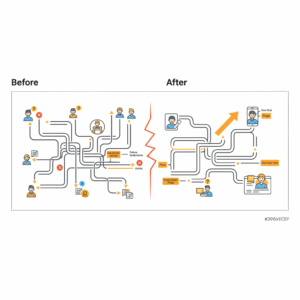
Service blueprinting maps the customer journey and the underlying frontstage and backstage activities that create it. It shows the links between people, processes, policies, and platforms at each touchpoint. Academic and practitioner literature recognises blueprinting as a practical technique for service innovation that aligns operations to the customer’s experience.³ Government service manuals also describe blueprints as the first tool to visualise the whole service, connect user and business needs, and orchestrate teams.⁴ Blueprinting matters now because claims journeys are long, regulated, and data heavy. A blueprint makes failure visible, measurable, and fixable.
Context: the insurer, the moment, the mandate
An established insurer entered this work after a spike in call-backs and a rise in escalations following storm events. Customer Experience and Operations jointly sponsored the initiative. The aim was simple and ambitious. Reduce avoidable effort for customers and agents while improving settlement speed and transparency. Similar programs in the industry have paired journey design with digital and AI capabilities to lift satisfaction and reduce costs.⁵ ⁶
Mechanism: how the blueprint reset the claims journey
We set a clear scope. First Notification of Loss to settlement for home and motor, including vulnerable-customer protocols. We convened cross-functional teams. Claims handlers, assessors, repair network leads, underwriting, fraud, finance, and digital channels jointly mapped the “as-is” service. Literature recommends co-creation to surface dependencies and handoffs that text documents miss.³ The blueprint instrumented five layers: customer actions, frontstage interactions, backstage activities, support processes, and evidence. Evidence logged the exact artefacts customers see, which becomes crucial for later quality controls.
Patterned failure emerged. We saw duplicated document requests, ambiguous status messages, and manual triage where data already existed upstream. We found a mismatch between the tone of SMS updates and the actual claim state. We also found that assessors lacked a single view of tasks spanning internal and partner systems. The blueprint concentrated these insights in one frame so leadership could prioritise and sequence change.
Comparison: how blueprinting beats ad hoc fixes
Leaders often leap to system changes. Blueprinting resists that impulse by clarifying the service logic first. Classic sources show that blueprints distinguish frontstage from backstage, which prevents cosmetic changes from masking structural defects.³ Public-sector guidance echoes that a blueprint integrates user needs with organisational constraints.⁴ By anchoring teams in a visual model, the insurer avoided fragmented initiatives and created a shared language for product, ops, and risk.
Applications: what we rebuilt in claims support
We translated the blueprint into four practical interventions.
Low-effort communications. We redesigned notifications to answer the top intent questions ahead of time. “What is happening next, by when, and what do you need from me.” Customer Effort Score research shows customers value frictionless resolution more than theatrics.¹ ² Notifications now matched the real claim state and included links to upload media and documents once, not repeatedly.
Event-driven orchestration. We created triggers from policy data, damage type, and geolocation to route claims into straight-through, light-touch, or complex pathways. Industry case work indicates that pairing triage with AI and automation can reduce handling time and improve outcomes.⁵
One task view for frontline and partners. We implemented a unified task list that drew from internal and partner systems. The blueprint’s backstage layer guided which APIs mattered and which user roles could complete or reassign tasks.
Evidence and controls by design. We embedded evidence slots in the journey so each customer-facing message had a corresponding audit artefact. This reduces rework and supports regulatory obligations.
Risks and controls: what could go wrong without guardrails?
Service redesign can drift into technology-first delivery. A blueprint reduces that risk by forcing design decisions to show customer impact and operational implications side by side. Compliance risk rises when communications and case states diverge. Evidence-led blueprinting mitigates that by linking each message to a system-of-record event. Operational risk appears when triage models overfit to historical data. Leaders should combine algorithmic triage with clear override rules and bias monitoring. External case studies advise pairing automation with human checkpoints in high-impact steps.⁵
Measurement: how did we prove effort went down?
We instrumented three levels of success.
Customer level. We used Customer Effort Score after key interactions and correlated scores with repeat contact and time-to-resolution. CES has provenance as a loyalty predictor and is widely used in service contexts.¹ ²
Operational level. We tracked average handling time, cycle time to decision, and rework rate by failure mode. Service blueprinting literature emphasises using failure points to guide measurement.³
Business level. We monitored retention at renewal and repair network yield. External analyses show that improved customer experience correlates with revenue growth, making commercial outcomes a legitimate part of the scorecard.⁷
Impact: what changed for customers, teams, and the P&L?
Customers experienced fewer status-chasing calls, clearer next steps, and a single upload request for documents. Agents handled fewer duplicate contacts and saw a streamlined task list. Leaders made cleaner trade-offs because evidence and process states aligned. Comparable insurers that combine journey redesign with digital replatforming have reported higher satisfaction and lower costs at scale, which reinforces the business case for CX-led transformation.⁶ ⁷
How do you run blueprinting sprints that executives trust?
Executives need speed and certainty. We used two-week sprints that deliver a tangible asset at the end of each cadence. Sprint 1 captures the “as-is” blueprint with quantified failure points and effort hypotheses. Sprint 2 delivers the “to-be” blueprint with a testable set of interventions and a measurement plan. Sprint 3 pilots the riskiest change, often communications and triage, to generate early evidence. This cadence respects the principle that blueprinting is not an academic artefact. It is a mechanism to align delivery.
Which decisions create the biggest lift in claims support?
Three decisions carried disproportionate impact. First, decide to treat communications as part of the product, not an afterthought. Second, decide triage criteria with a joint team across risk, claims, and CX, then publish the decision tree to agents. Third, decide to expose status and evidence to customers through a single pane of glass, even if backend systems remain fragmented. These decisions cut effort at the root and set a platform for automation.
What should leaders do next to scale service blueprinting?
Leaders should lock in three enablers. Establish a blueprint library as a living asset owned by Service and Operations. Train product managers and claims leaders in blueprint literacy so governance conversations reference the same map. Fund a thin orchestration layer that makes the blueprint executable by connecting triggers, tasks, and evidence. Industry examples demonstrate that when blueprinting informs digital rewiring, organisations sustain improvements instead of one-off gains.⁵ ⁶
Evidentiary layer: the signals that prove it worked
Executives need proof. The evidentiary layer ties each change to a measurement. A redesigned SMS must show a drop in repeat contact and a lift in CES. A new triage rule must shorten time to first decision and cut handoffs. A unified task view must lower rework and exceptions. External sources provide credible framing for these relationships. CES is validated as a predictor of loyalty.¹ Blueprinting’s structure is recognised for surfacing failure points and aligning teams.³ Public service manuals formalise these practices for complex services.⁴ Case studies show that AI-enabled claims and digital platforms drive measurable operational and customer gains.⁵ ⁶ ⁷
FAQ
How does service blueprinting reduce customer effort in claims support?
Service blueprinting exposes duplicated requests, unclear status messages, and hidden handoffs by mapping frontstage and backstage activities in one view. Teams then redesign communications, triage, and task orchestration to remove work customers would otherwise do themselves.³ ⁴
What is the Customer Effort Score and why should insurers use it?
Customer Effort Score is a single-item metric that asks customers how much effort they expended to resolve an issue. Research shows CES predicts loyalty better than traditional satisfaction or recommendation metrics, making it well suited to claims interactions.¹ ²
Which industry examples validate digital and AI improvements in claims?
Public case work highlights insurers that rewired claims journeys with AI and digital platforms to improve outcomes and reduce costs, reinforcing the business case for CX-led redesign.⁵ ⁶
Which metrics prove blueprinting made a difference?
Leaders should track CES after key steps, repeat contact rates, cycle time to decision, rework, and renewal retention. These metrics connect customer effort, operational performance, and commercial outcomes.¹ ³ ⁷
Why should communications be treated as part of the product in claims?
Customers judge the journey by clarity of next steps and transparency of progress. Redesigning notifications to match true claim state reduces follow-up effort and prevents misalignment between customer expectations and operational reality.¹ ³
Which organisations can benefit from blueprinting beyond insurance?
Any complex, multi-party service with regulated steps or multiple handoffs benefits. Public service manuals recommend blueprinting to visualise entire services, align teams, and integrate user and business needs.⁴
Which first steps help Customer Science clients operationalise blueprinting?
Start with a time-boxed “as-is” blueprint, quantify failure points, define a small set of to-be interventions, and pilot communications and triage with embedded measurement. This creates evidence quickly and builds momentum for platform changes.³ ⁷
Sources
“Stop Trying to Delight Your Customers.” Matthew Dixon, Karen Freeman, Nicholas Toman. 2010. Harvard Business Review. https://hbr.org/2010/07/stop-trying-to-delight-your-customers
“The Effortless Experience: Conquering the New Battleground for Customer Loyalty.” Matthew Dixon et al. 2016. CEB presentation excerpts. https://research.wpcarey.asu.edu/services-leadership/wp-content/uploads/2017/08/CTS_Effortless-Experience_MattDixon_2016.pdf
“Service Blueprinting: A Practical Technique for Service Innovation.” Mary Jo Bitner, Amy L. Ostrom, Felicia N. Morgan. 2008. California Management Review. https://cmr.berkeley.edu/2008/05/50-3-service-blueprinting-a-practical-technique-for-service-innovation/
“Designing a Service: Service Blueprinting.” Scottish Government Service Manual. 2023. https://servicemanual.gov.scot/designing-a-service
“Aviva: Rewiring the Insurance Claims Journey with AI.” McKinsey & Company. 2024. https://www.mckinsey.com/capabilities/mckinsey-digital/how-we-help-clients/rewired-in-action/aviva-rewiring-the-insurance-claims-journey-with-ai
“Allianz Direct: Advancing as Europe’s Leading Digital Insurer.” McKinsey & Company. 2023. https://www.mckinsey.com/capabilities/mckinsey-digital/how-we-help-clients/rewired-in-action/allianz-direct-advancing-as-europes-leading-digital-insurer
“Improving CX Can Drive More Than One Billion Dollars In Revenue.” Maxie Schmidt. 2025. Forrester Blog. https://www.forrester.com/blogs/improving-cx-can-drive-more-than-one-billion-dollars-in-revenue-2024/