































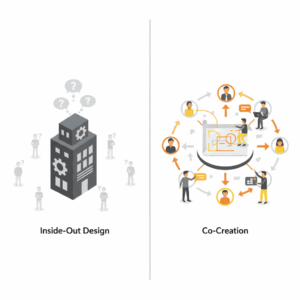
What is co-creation and why should leaders care?
Executives face a common problem. Traditional, inside-out design optimizes for internal constraints, not for customer value. Co-creation solves this by inviting customers to shape value propositions, journeys, and operating models as equal partners. Co-creation is the structured involvement of customers in discovery, design, and delivery to produce mutual value. Classic research positions customers as active co-creators of value rather than passive recipients of products and services.¹ This reframing matters because modern value is experiential, contextual, and co-produced in use. The concept is not new, but its operational maturity has accelerated as digital channels and data make collaboration practical at scale.² When leaders shift from inside-out to co-creation, they move from guessing customer needs to validating them with customers in the loop. The result is better fit, faster adoption, and less waste.¹
How does inside-out design hold organizations back?
Inside-out design starts with the organization’s structure, systems, and assumptions. Teams often define requirements, write business cases, and build solutions before testing desirability with real users. This approach creates risk. It amplifies confirmation bias, hides unmet needs, and locks teams into costly rework. The Double Diamond shows why the pattern persists. Many teams converge too early on solutions without doing the divergent work of discovery with users.³ Public service standards underline the same point and insist that teams start with user needs, not policy or technology.⁴ When organizations skip this, they ship features that miss context, which then drives low adoption, high support costs, and eroded trust. Inside-out design rewards internal certainty. Co-creation rewards external truth. Leaders who recognize this shift reorient governance to protect discovery and to fund learning before scaling.
What does good co-creation look like in practice?
High-performing teams design for participation. They recruit customers for continuous discovery, not just one-off focus groups. They instrument prototypes, service blueprints, and live pilots so customers can react with evidence. A practical frame uses three loops. The first loop maps customer jobs, outcomes, pains, and gains. The second loop co-designs the experience and its enabling policies, processes, and technology. The third loop measures value in production and feeds the next iteration. Payne, Storbacka, and Frow describe this as managing the co-creation process across customer, provider, and encounter processes, which keeps the customer on equal footing with the firm.² When teams operationalize these loops, they convert opinion into observation. They also surface constraints early, which de-risks change. The goal is not workshops. The goal is a repeatable system that keeps customers in the room from insight to impact.²
Where does co-creation outperform on growth and risk?
Co-creation improves growth because it aligns effort with what customers value and will adopt. Experience-led growth research finds that companies with stronger customer experience outperform peers in growth, and they do so by improving journeys, not just touchpoints.⁵ Quantitative analyses show that redesigning digital customer experiences can lift satisfaction by 15 to 20 percent, cut cost to serve by 20 to 40 percent, and boost conversion and growth by up to 20 percent when executed with discipline.⁶ Co-creation also reduces risk by validating options before large commitments. It tempers common failure modes such as over-personalization that erodes confidence and increases post-purchase regret.⁷ Service leaders also report that technology bets often fail to deliver promised results when not anchored in clear customer outcomes, which reinforces the need to co-create measures of success with users.⁸ The pattern is consistent. Involve customers early, and risk falls while value rises.⁵
How does co-creation compare with personalization and mass testing?
Co-creation differs from personalization and from brute-force A/B testing. Personalization tunes messages or offers within an assumed solution. Co-creation tests the solution itself with the people who will live with it. This matters because personalization at the wrong moment can undermine buyer confidence and suppress loyalty.⁷ A/B testing at scale can find local maxima, but it rarely reframes the problem. Co-creation invites reframing. It asks whether the job, outcome, or constraint has been misunderstood. Early thought leadership called this shift co-opting customer competence and argued for integrating customers into the firm’s learning system.⁹ Modern practice extends that idea with accessible methods for discovery, prototyping, and service standards that codify participatory design.⁴ When leaders confuse these approaches, they optimize tactics around the edges. When they distinguish them, they redesign systems that create value with customers, not for them.¹
What operating model enables co-creation at scale?
Leaders enable co-creation with a clear operating model. Start by protecting divergent and convergent modes of work. The Double Diamond remains a helpful device because it creates a shared language for discovery and definition, and for development and delivery.³ The Design Council’s systemic extensions add orientation, reframing, and catalyzing to connect portfolio, policy, and service delivery.¹⁰ Translate that guidance into governance. Fund problems, not projects. Gate decisions on user evidence, not on slideware. Require cross-functional squads that include design, research, operations, policy, technology, and service. Institutionalize direct customer access with research panels and feedback communities. Equip teams with reusable service patterns and data standards so co-created solutions fit the enterprise. When this model is in place, co-creation stops being a special event. It becomes the routine way the organization learns and builds.
How do you measure co-creation effectiveness without gaming the system?
Executives measure co-creation by tracking learning velocity and value creation. Learning velocity combines cadence of customer contact, cycle time from insight to implemented change, and percent of backlog items validated with users. Value creation combines journey-level outcomes such as completion rate, first-contact resolution, time to value, and customer effort with commercial metrics such as conversion, churn, cost to serve, and lifetime value. Leaders should publish these measures at the journey level to align teams and to avoid local optimization. External research supports the link between journey excellence and both revenue growth and cost efficiency.⁵ ⁶ Internal dashboards should add qualitative evidence such as usability findings and verbatims to keep the human stakes visible. Teams should audit experiments for representative participation to protect equity. When measures keep learning honest and make value explicit, co-creation scales without losing integrity.⁶
What risks should leaders anticipate and design out?
Co-creation introduces new failure modes. Teams can over-index on vocal users and miss underserved segments. Sampling bias and design-by-committee can dilute outcomes. To counter this, leaders should set inclusion criteria, use professional research practices, and separate divergent exploration from convergent decision making. Public sector guidance codifies these safeguards and offers patterns for inclusive research, accessibility, and service design that private firms can adopt.¹⁵ Personalization pitfalls create another risk. If teams push tailored content during high-stakes decisions, they can increase regret and suppress repeat purchase, which is a clear warning to privilege customer confidence over algorithmic zeal.⁷ Technology programs can also underperform if they chase features without validated user outcomes.⁸ Governance that funds learning, protects discovery, and requires user evidence at gates closes these gaps. Co-creation works when leadership designs the conditions for truth and for delivery.
How do you get started this quarter and build momentum?
Leaders start small, measure hard, and scale what works. Pick one critical journey where customers feel friction and where the business feels cost or risk. Stand up a cross-functional squad with direct access to customers. Run a six to eight week discovery that maps jobs, outcomes, and constraints with at least five sessions per week. Build and test low-fidelity prototypes weekly. Publish a one-page learning log that links decisions to evidence. In parallel, set up a research panel and a simple feedback community so customer access becomes a habit, not a dependency. Anchor success to two or three journey metrics that matter, such as completion rate, time to resolution, and customer effort. Use governance to reallocate funding based on observed impact. External evidence shows that journey improvements can lift satisfaction and reduce cost to serve when executed with discipline and with customers in the loop.⁶
What is the strategic impact for Customer Experience and Service Transformation?
Customer Experience and Service Transformation succeed when the organization learns with its customers faster than competitors do. Co-creation makes this advantage durable. It turns customers into partners in discovery, design, and delivery. It aligns investment with validated demand and reduces waste from misaligned features and policies. It also builds trust. When customers recognize their fingerprints on the service, they are more willing to adopt, advocate, and forgive. Research across public and private sectors converges on the same pattern. Start with user needs. Use structured discovery and prototyping. Measure value at the journey level.⁴ ⁵ ³ Codify these practices in playbooks, standards, and governance. Customer Science helps executives operationalize this shift by integrating co-creation into strategy, operating models, and change. The payoff is practical. The organization stops shipping what it can make and starts delivering what customers will value.¹
FAQ
What is co-creation in Customer Experience and why is it superior to inside-out design?
Co-creation is a structured method that involves customers as equal partners in discovery, design, and delivery. It outperforms inside-out design by validating needs and solutions with users, which improves adoption and reduces waste.¹ ²
How does the Double Diamond help enterprise teams run co-creation?
The Double Diamond provides a shared language for divergent discovery and convergent delivery. It keeps teams from jumping to solutions too early and aligns work with user needs through structured phases.³
Which public standards support user-centred co-creation for services?
The UK Government Design Principles and the Service Manual promote starting with user needs, inclusive research, and evidence-based delivery. Private firms can adopt these practices for service transformation.⁴ ²¹
Why should CX leaders expect growth and cost wins from co-creation?
Experience-led growth research links stronger journeys with higher revenue growth, and disciplined digital CX redesign can lift satisfaction by 15 to 20 percent while reducing cost to serve by 20 to 40 percent.⁵ ⁶
How can Customer Science support co-creation for enterprise transformations?
Customer Science integrates co-creation into strategy, operating models, and measurement. The team sets up research panels, journey metrics, and governance so co-creation becomes a repeatable system across services.³ ⁴
What risks come with co-creation and how do we mitigate them?
Common risks include sampling bias, design-by-committee, and over-personalization that undermines buyer confidence. Mitigate with professional research practices, inclusive samples, and evidence-based decision gates.⁷ ⁴
Who should be in a co-creation squad for a priority journey?
Include design, research, operations, policy, engineering, and service. Ensure direct access to customers through panels and communities. Govern decisions with user evidence and journey-level metrics.² ³
Sources
Prahalad, C. K., & Ramaswamy, V. (2004). Co-creation experiences: The next practice in value creation. Journal of Interactive Marketing. https://www.venkatramaswamy.com/articles_files/2004-jim.html
Payne, A. F., Storbacka, K., & Frow, P. (2008). Managing the co-creation of value. Journal of the Academy of Marketing Science. https://link.springer.com/article/10.1007/s11747-007-0070-0
Design Council. (2024). The Double Diamond. Design Council Resource. https://www.designcouncil.org.uk/our-resources/the-double-diamond/
Government Digital Service. (2025). Government Design Principles. GOV.UK Guidance. https://www.gov.uk/guidance/government-design-principles
Bough, V., Ehrlich, O., Fanderl, H., & Schiff, R. (2023). Experience-led growth: A new way to create value. McKinsey & Company. https://www.mckinsey.com/capabilities/growth-marketing-and-sales/our-insights/experience-led-growth-a-new-way-to-create-value
McKinsey Digital. (2019). Service industries can fuel growth by making digital customer experiences a priority. McKinsey & Company report. https://www.mckinsey.com/~/media/McKinsey/Business%20Functions/McKinsey%20Digital/Our%20Insights/Service%20industries%20can%20fuel%20growth%20by%20making%20digital%20customer%20experiences%20a%20priority/service-industries-can-fuel-growth-by-making-digital-customer-experiences-a-priority.ashx
Gartner. (2025). Personalization can triple the likelihood of customer regret at key journey points. Press Release. https://www.gartner.com/en/newsroom/press-releases/2025-06-03-gartner-survey-reveals-personalization-can-triple-the-likelihood-of-customer-regret-at-key-journey-points
Gartner. (2025). Nearly half the time, desired results from new customer service technology do not materialize. Press Release. https://www.gartner.com/en/newsroom/press-releases/2025-07-08-gartner-survey-shows-nearly-half-the-time-desired-results-from-new-customer-service-technology-dont-materialize
Prahalad, C. K., & Ramaswamy, V. (2000). Co-opting customer competence. Harvard Business Review. https://hbr.org/2000/01/co-opting-customer-competence
Design Council. (2022). Systemic Design Framework. Design Council Resource. https://www.designcouncil.org.uk/our-resources/systemic-design-framework/