























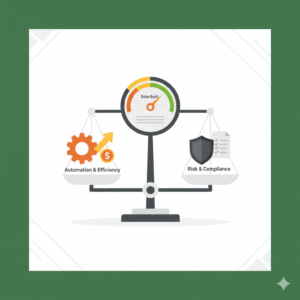
Why do CX leaders need a risk and compliance scorecard for automation?
Executives face a dual mandate. Leaders must scale automation to reduce cost-to-serve while strengthening compliance and customer trust. Many programs move fast without guardrails, which increases exposure to privacy breaches, biased decisions, and operational disruption. A risk and compliance scorecard gives decision makers a simple, repeatable way to test automation readiness before deployment and to evidence control effectiveness after go-live. The scorecard aligns to recognized frameworks, including NIST’s AI Risk Management Framework, EU AI Act obligations, and Australian privacy and prudential standards, so teams can manage risk by design and document outcomes for audit.¹ ² ³ ⁴
What is the risk and compliance scorecard for automation?
This scorecard is a structured assessment that assigns a numeric rating to automation initiatives such as chatbots, decisioning services, routing models, and agent-assist tools. The scorecard measures control maturity across governance, data, model risk, privacy, security, operational resilience, and customer outcomes. The unit computes an overall risk class using weighted sub-scores and issues a Red–Amber–Green outcome with required actions. The structure normalizes language across functions, which allows a contact center to compare a triage bot with a credit decision tool on equal terms. The scorecard also captures the exact evidence needed to satisfy internal audit and external regulators.¹ ² ³
How does the scorecard align with policy, law, and standards?
Compliance alignment anchors the scorecard. NIST AI RMF functions govern, map, measure, and manage risks across the lifecycle, which maps cleanly to automation development and operations. The EU AI Act introduces a risk-based regime with specific duties for high-risk systems, including risk management, data governance, transparency, human oversight, and post-market monitoring. ISO 27001 and PCI DSS set baseline security controls for data, networks, and payment flows. Australia’s Privacy Act and the Australian Privacy Principles define lawful, fair, and transparent handling of personal information, while APRA CPS 230 strengthens operational risk and business continuity expectations for regulated entities. These anchors give executives a common language and a defensible audit trail.¹ ² ⁵ ⁶ ³ ⁴
How do we calculate the score and determine risk class?
Programs calculate a total score from weighted domains, each with 0–5 maturity. The default weighting prioritizes customer outcomes and operational resilience, then privacy, security, and model risk. A normalized 0–100 scale produces a risk class: 0–39 High, 40–69 Moderate, 70–100 Low. Teams can tune weights to reflect sector risks. Each domain contains objective criteria and pass-fail gates. A single critical failure, such as missing privacy impact assessment for personal data, forces a High risk class regardless of the numeric average. The model stores inputs, ratings, and evidence with timestamps, which allows repeatable assessments and trend analysis during ModelOps and service reviews.¹ ² ³
Which control domains should the scorecard assess?
Leaders strengthen the scorecard by covering fifteen practical domains that map to common regulations and control libraries. The domains create a complete picture from strategy to operations and from data to human oversight. The list below sets clear outcomes and typical evidence.
Governance and accountability. Define roles, decision rights, and escalation paths. Capture risk ownership and approval checkpoints. Store steering minutes and sign-offs.¹
Legal and privacy. Run privacy impact assessments. Map data flows. Minimize and anonymize personal data where possible. Record consent handling and notice language.³
Data quality and lineage. Profile datasets. Track provenance. Validate sampling and balance for training and testing. Record data retention and deletion routines.¹ ²
Model risk management. Document model purpose, design, training, validation, and performance thresholds. Independently validate and challenge high-impact models.²
Bias and fairness. Define fairness metrics by use case. Test for disparate impact. Track interventions such as reweighting and post-processing. Document outcomes.²
Security and access. Apply identity, encryption, network segmentation, and vulnerability management. Prove alignment to ISO 27001 and PCI DSS where in scope.⁵ ⁶
Transparency and explainability. Produce model cards, decision logs, and customer-facing explanations suitable for human review.²
Human oversight and controls. Specify human-in-the-loop checkpoints, review queues, and override procedures. Train staff and test scenario readiness.²
Customer experience and outcomes. Define the customer promise. Test usefulness, clarity, and accessibility. Track complaints and misdirection rates. Capture scripts and UI text.
Operational resilience. Map failure modes. Prove fail-safe behavior, degradation paths, and fallbacks to human service. Align to CPS 230 expectations where applicable.⁴
Third-party and procurement. Assess vendor security, privacy, resilience, and ModelOps. Include contractual audit rights and incident notification timelines.
Monitoring and drift. Instrument live services for accuracy, utilization, bias, and safety. Track model drift and data drift with thresholds and alerts.²
Incident detection and response. Maintain runbooks. Test tabletop scenarios. Log incidents, root causes, actions, and customer remediation steps.
Change and release management. Gate releases on regression tests and safety checks. Record approvals and rollback plans. Align to SOC 2 change control expectations.⁷
Documentation and evidentiary layer. Store artifacts, datasets, model versions, test results, approvals, and production logs in a structured repository that supports audit.
How does the evidentiary layer work in practice?
Evidence wins audits. Teams embed an evidentiary layer in the delivery toolchain to capture what happened, when it happened, and who approved it. The layer binds tickets, code, model versions, datasets, tests, and deployment records to a single change identifier. The structure exports a time-stamped dossier for regulators or clients. The layer also maps each artifact to a control and a framework reference such as NIST AI RMF, EU AI Act article, or APP principle. This unit converts episodic documents into a living compliance narrative that reduces the cost and stress of audit moments.¹ ² ³
How does the mechanism fit the delivery lifecycle?
Delivery teams run the scorecard at five checkpoints. Teams assess at opportunity intake to screen ideas. Designers assess before build to confirm data, privacy, and CX clarity. Engineers assess at pre-release to verify testing and fail-safes. Operators assess after 30 days to validate production behavior. Owners assess quarterly to test drift, complaints, and model performance. Each checkpoint updates the risk class and triggers actions if thresholds fall. The cadence keeps automation safe while moving at product speed. It also builds a longitudinal record that supports ModelOps and continuous improvement.¹ ²
How should we interpret thresholds and actions?
Executives should route actions by risk class. High risk requires senior approval, remediation plans, and potentially a stop. Moderate risk requires targeted mitigations, additional monitoring, and a shorter review cycle. Low risk moves forward under standard controls. The scorecard must embed required actions such as fairness remediation, enhanced human review, or rollback. The unit should also include customer-facing mitigations like clear disclosures and easy paths to human service. This approach organizes tradeoffs in daylight and makes decisions transparent to risk, CX, and technology stakeholders.²
What metrics prove the scorecard works?
Leaders prove impact by tracking three metric sets. Risk metrics track residual risk distribution, number of critical control failures, and time to remediate. CX metrics track first contact resolution, containment without deflection, and customer complaint rates for automated flows. Operational metrics track incidents, mean time to detect, mean time to recover, and model drift alerts. Executives should review these metrics in the same forum as cost and performance. The cadence builds a balanced score of cost, control, and customer value, which in turn sustains executive confidence and funding.⁴ ⁷
How do we implement the scorecard and govern adoption?
Organizations implement in four steps. Teams first localize the domain weights to sector risks and regulatory scope. Owners then build the evidentiary layer in the toolchain and define templates. Operators train champions in each function and pilot with two or three use cases. Executives finally mandate scorecard use at intake, release, and quarterly reviews for all automation that touches customers or regulated processes. The approach embeds risk by design without adding friction to delivery. The same structure scales across lines of business and vendors.¹ ² ³
How does this help Customer Experience and Service Transformation programs?
Customer leaders use the scorecard to align service automation with brand promises. The structure ensures bots, decision services, and agent tools are safe, fair, resilient, and useful. The discipline protects vulnerable customers by forcing clear disclosures, easy human handoff, and ongoing quality monitoring. The approach speeds approvals because risk and compliance teams see quality evidence early. It also unlocks reuse. Teams can lift and shift proven components with less rework because the evidence travels with the asset. The result is faster time to value with lower residual risk and stronger customer trust.² ³ ⁴
What does good look like in a live contact center?
Strong programs show consistent Low or Moderate risk classes with no critical failures. Teams maintain model cards, runbooks, and rollback plans. Human supervisors can explain any automated outcome. Customers receive clear notices and easy access to a person. Production dashboards show stability with low variance and no unreviewed drift. Quarterly reviews show declining incident rates and faster remediation cycles. Vendors meet the same standard with contractual audit rights and data handling controls. This picture reflects a system that treats automation as a regulated service, not just a technology project.² ⁴ ⁵
What immediate steps should leaders take this quarter?
Executives can act now. Leaders can adopt the fifteen domains and default weights. Owners can implement the five checkpoints. Teams can integrate the evidentiary layer into delivery tools. Programs can choose two high-impact automations and run the scorecard end to end. Leaders can socialize results in governance forums and set a date when scorecards become mandatory for new work. These steps create momentum, reduce risk, and improve audit readiness before year end. The cadence pays forward by making next year’s automation faster, safer, and easier to defend.¹ ² ³
FAQ
What is the Risk and Compliance Scorecard for Automation at Customer Science?
The scorecard is a structured assessment that rates automation initiatives across governance, data, model risk, privacy, security, resilience, and customer outcomes. It produces a weighted score, a Red–Amber–Green risk class, and a clear set of actions, with evidence mapped to frameworks such as NIST AI RMF, EU AI Act, and Australian Privacy Principles.¹ ² ³
How does the scorecard support Customer Experience & Service Transformation?
The scorecard embeds risk by design in service automation. It forces clarity on customer promises, transparency, human handoff, and ongoing monitoring. The unit improves approvals, reduces rework, and protects vulnerable customers in contact centers and digital service flows.² ³ ⁴
Which regulations and standards does the scorecard align to?
The scorecard aligns to NIST AI RMF functions, EU AI Act risk-based obligations, ISO 27001 information security controls, PCI DSS payment security, Australian Privacy Principles, APRA CPS 230 operational risk, SOC 2 change management, and COSO ERM principles.¹ ² ⁵ ⁶ ³ ⁴ ⁷ ⁸
Who uses the scorecard inside an organization?
Product owners, risk managers, compliance officers, contact center leaders, CX strategists, data scientists, and vendor managers use the scorecard. Executives use risk classes for decisions. Operators use the evidentiary layer to pass audits.
Which metrics demonstrate success after go-live?
Programs track residual risk distribution, number of critical control failures, time to remediate, first contact resolution, complaint rates, incidents, mean time to detect, mean time to recover, and model drift alert rates.⁴ ⁷
Which steps help an enterprise implement within one quarter?
Adopt the fifteen domains, define weights, set five checkpoints, build the evidentiary layer in delivery tools, pilot two high-impact use cases, and mandate scorecards for new automation from a set date.¹ ² ³
Which Customer Science services can help?
Customer Science provides scorecard design, evidentiary layer tooling, automation assurance, and ModelOps governance services tailored to regulated industries in Australia.
Sources
NIST AI Risk Management Framework 1.0 + Playbook. NIST. 2023. National Institute of Standards and Technology. https://www.nist.gov/itl/ai-risk-management-framework
The Artificial Intelligence Act. European Union. 2024–2025. EUR-Lex. https://eur-lex.europa.eu/eli/reg/2024/1689/oj
Australian Privacy Principles. Office of the Australian Information Commissioner. 2022. OAIC. https://www.oaic.gov.au/privacy/the-privacy-act/the-australian-privacy-principles
CPS 230 Operational Risk Management. Australian Prudential Regulation Authority. 2023. APRA. https://www.apra.gov.au/operational-risk-management-cps-230
ISO/IEC 27001 Information Security Management. International Organization for Standardization. 2022. ISO. https://www.iso.org/standard/27001
PCI DSS v4.0 Summary of Changes. PCI Security Standards Council. 2022. PCI SSC. https://www.pcisecuritystandards.org/document_library
Trust Services Criteria for Security, Availability, Processing Integrity, Confidentiality, and Privacy. AICPA. 2017–2022. American Institute of CPAs. https://us.aicpa.org/resources/article/trust-services-criteria
Enterprise Risk Management — Integrating with Strategy and Performance. COSO. 2017. Committee of Sponsoring Organizations of the Treadway Commission. https://www.coso.org/Pages/erm-integratedframework.aspx