

















Why do service teams need a Kaizen event template?
Service leaders face scattered workflows, hidden handoffs, and inconsistent customer outcomes. A clear Kaizen event template aligns the team on one problem, one method, and one set of measures. The template standardizes how you frame a challenge, capture customer demand, surface waste, test improvements, and lock in gains. Kaizen means continuous improvement through small, structured changes. The method relies on a scientific cycle of planning work, running controlled trials, checking results, and acting on evidence.¹ This approach helps service organizations translate strategy into daily practice while building capability in problem solving.² The template below is designed for a three to five day sprint with light preparation and strong follow through. It fits contact centers, back office operations, and field service teams that need measurable improvements within operational constraints.³
What is Kaizen in the context of services?
Kaizen in services is a team-based method to remove friction from customer journeys and internal processes. Practitioners define the customer problem, make the work visible, and run structured experiments to improve flow, quality, and responsiveness.¹ In service environments, variation often hides in communications, digital tools, and decision rules. Teams use service blueprinting to map frontstage and backstage actions, then identify failure points and rework loops.⁴ Kaizen events apply the same lean principles used in manufacturing to intangible work by exposing queues, rework, and unevenness in demand.² The goal is not a one-time fix. The goal is a reliable system that produces stable outcomes and learns quickly from exceptions.³
How does the Kaizen event template work step by step?
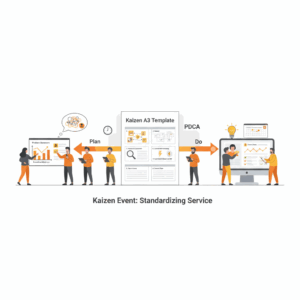
A practical Kaizen event follows a PDCA cycle. Teams prepare by agreeing on the problem statement, baseline measures, and event scope.¹ They then run a time-boxed sprint that includes discovery, analysis, trial changes, and standardization.² Each stage produces tangible artifacts that feed the next. The event finishes with confirmed standard work, updated metrics, and a control plan that protects the gains. Leaders use a visible A3 to summarize the story from problem to countermeasures and results.⁵ This single-page narrative keeps attention on facts, logic, and learning.⁵ The template below packages these practices so service teams can move fast without skipping rigor.
What goes into the Kaizen event charter?
Strong events start with a tight charter that defines success. Use this structure:
Problem statement: State the customer impact, the business impact, and the starting performance. Keep it observable and in scope.¹
Objective and target condition: Describe the desired service performance and the next-state process behavior.²
Scope and boundaries: Name the processes, channels, and time window in scope. Exclude items that distract.²
Team and roles: Assign a facilitator, a process owner, a data lead, and customer representatives.³
Constraints and assumptions: List known policy, compliance, and system limits.²
Baseline metrics: Capture current service level, first contact resolution, handle time, backlog age, error rates, and customer satisfaction.³
A clear charter gives the facilitator authority to focus time, remove blockers, and drive decisions during the sprint.¹
How should teams visualize the current service process?
Teams make work visible through service blueprinting and simple flow charts. Service blueprinting connects customer actions, frontstage interactions, backstage work, and supporting systems on a single map.⁴ This structure exposes breakpoints, queues, and baton-passes that cause delays and errors.⁴ Complement the blueprint with a value stream snapshot that measures lead time, touch time, and wait time for a small sample.² Use a quick waste walk to capture rework, extra approvals, unnecessary movement, and overprocessing in digital form.² Avoid complex software during the event. Use large canvases, sticky notes, and a shared A3 to keep the conversation grounded in the work.⁵
How do we diagnose root causes without overanalyzing?
Teams use simple, disciplined tools that force observable evidence. Start with a SIPOC to bound suppliers, inputs, process steps, outputs, and customers.² Move to a cause-and-effect diagram with clear evidence notes. Apply the 5 Whys to trace each branch to a testable hypothesis.¹ Validate by direct observation, quick data pulls, and micro-experiments during real work. Keep the unit of change small so tests finish within the event window. If a cause lacks evidence, park it. The team writes hypotheses as If–Then statements linked to a measure. The A3 keeps the logic tight and prevents drift into opinions.⁵
What experiments fit a service Kaizen event?
Service teams benefit from low-risk changes that adjust flow, clarity, and decision rights. Typical experiments include clarifying triage rules, simplifying forms, removing duplicate data entry, adding visual controls in the CRM, creating standard response libraries, and rebalancing work queues by skill.² Teams also test guardrails like appointment windows, callback offers, and proactive notifications to shape demand.³ Each trial must have an owner, a start time, a stop time, a predicted effect, and a metric.¹ The group runs two or three iterations, captures evidence, and refines. The facilitator documents countermeasures on the A3 and organizes standard work drafts for signoff.⁵
How do we lock in gains and prevent regression?
Events only matter when results persist. Teams convert successful trials into standard work with clear steps, decision criteria, and roles.² Leaders create a control plan that names the owner, the review cadence, the escalation path, and visual thresholds for each metric.¹ Teams update playbooks, knowledge articles, and system job aids during the event, not weeks later.³ A short leader standard work checklist ensures daily checks on the few vital signals.² The team closes the event with a readout that shows baseline, trial results, and final standard work. The A3 becomes the canonical record and the training artifact for new staff.⁵
Template: the Kaizen event workbook for service teams
Section 1. Charter
Problem statement. Objective and target condition. Scope and boundaries. Team and roles. Constraints and assumptions. Baseline metrics.¹
Section 2. Voice of Customer
Top intents, failure demand categories, verbatim pain points, and desired outcomes. Map to measurable indicators such as repeat contacts and defect rates.³
Section 3. Current State Blueprint
Customer actions, frontstage interactions, backstage activities, systems, and evidence lines. Time-stamp key handoffs and identify queues.⁴
Section 4. Waste and Flow Analysis
Inventory queues, rework loops, extra approvals, and tech switches. Note lead time, touch time, and percent complete and accurate.²
Section 5. Root Cause and Hypotheses
SIPOC, cause-and-effect diagram, and 5 Whys. Hypotheses in If–Then format with predicted effect sizes.¹
Section 6. Experiment Backlog
Trial description, owner, start and stop times, expected change, and metric. Prioritize quick wins with low risk.²
Section 7. Future State and Standard Work
Simplified flow, decision rules, roles, and triggers. Draft standard operating procedures and CRM job aids.²
Section 8. Control Plan and Visual Management
Owner, review cadence, escalation path, thresholds, and dashboards. Tie to daily and weekly rhythms.¹
Section 9. Results and A3 Story
Baseline, trial outcomes, confirmed standard work, and lessons learned. Keep to one page for clarity.⁵
Which metrics best prove impact for contact centers and service operations?
Balanced metrics prove flow, quality, and experience. Track lead time from request to resolution, first contact resolution, repeat contact rate, backlog age, and percent complete and accurate.² Pair these with customer-sourced measures such as satisfaction after resolution and effort to resolve.³ Add operational signals such as schedule adherence, occupancy, and change failure rate for system updates that affect service.² Avoid vanity metrics that move without real improvement. Leaders should publish a small, stable set of signals in a daily visual that triggers action when thresholds are crossed.¹
How should leaders sponsor, not micromanage, a Kaizen event?
Leaders set intent, remove barriers, and protect time. Sponsorship starts with a clear problem and a realistic scope.² Leaders then attend the daily standup, accept evidence over opinion, and fast-track decisions that depend on policy or system access.³ They reinforce learning by asking what was planned, what happened, what was learned, and what will change next.¹ After the event, leaders audit the control plan, honor standard work, and celebrate the team’s discipline, not just the headline metric.² This pattern builds a culture where small, frequent improvements outpace occasional big projects.¹
How does this template align with PDCA and A3 problem solving?
The template is a practical expression of PDCA and A3 thinking. PDCA means Plan the change, Do the change in a controlled test, Check results against predictions, and Act to standardize or learn.¹ The A3 is the one-page narrative that forces clear logic, data, and countermeasures.⁵ The workbook sections map directly to this flow and ensure the team learns faster than the environment changes. By combining PDCA discipline, A3 storytelling, and service blueprinting, the template gives service teams a shared language for improvement work.¹ ⁴ ⁵
What are common risks and how do we mitigate them?
Common risks include overscoping the event, skipping baseline measures, testing too many changes at once, and failing to update standard work.² Mitigate by setting a narrow scope, fixing sampling plans before day one, limiting concurrent trials, and drafting standard work in the room.² Another risk is treating the event as a workshop instead of a change in daily management. Leaders protect gains by installing a control plan and linking the new standards to coaching, quality review, and incentives.¹ Service teams sustain momentum by scheduling the next event and by publishing a cadence of small wins that builds credibility.³
FAQ
What is a Kaizen event in a service context?
A Kaizen event is a short, focused improvement sprint where a cross-functional service team uses PDCA and A3 problem solving to remove waste, improve flow, and standardize better ways of working.¹ ⁵
How does service blueprinting support Kaizen at Customer Science clients?
Service blueprinting maps customer actions, frontstage interactions, backstage work, and systems on one canvas, which helps teams identify breakpoints and queues before designing countermeasures.⁴
Which metrics should contact centers track during a Kaizen event?
Contact centers should track lead time, first contact resolution, repeat contact rate, backlog age, percent complete and accurate, and customer satisfaction after resolution, paired with daily visual thresholds.² ³
Who should be on a Kaizen event team for service transformation?
The team should include a facilitator, a process owner, a data lead, frontline representatives, and customer representatives, all operating under a clear charter and scope.³
Why use an A3 as the Kaizen event record?
The A3 forces a single-page narrative that connects problem, analysis, countermeasures, and results, which keeps the event focused and makes learning portable across teams.⁵
Which risks derail service Kaizen and how can leaders avoid them?
Overscoping, weak baselines, too many concurrent tests, and poor standardization are common risks. Leaders avoid them by setting narrow scope, confirming sampling plans, limiting trials, and installing a control plan.²
How does this template align with Customer Experience and Service Transformation?
The template ties customer pain points to operational changes, turning service insights into measurable improvements in flow, quality, and satisfaction within Customer Science programs.² ³
Sources
Out of the Crisis — W. Edwards Deming — 1986 — MIT Press. https://mitpress.mit.edu/9780262541152/out-of-the-crisis/
Lean Thinking: Banish Waste and Create Wealth in Your Corporation — James P. Womack and Daniel T. Jones — 1996 — Simon & Schuster. https://www.simonandschuster.com/books/Lean-Thinking/James-P-Womack/9780743249270
The Toyota Way: 14 Management Principles from the World’s Greatest Manufacturer — Jeffrey K. Liker — 2004 — McGraw Hill. https://www.mheducation.com/highered/product/toyota-way-liker/M9780071392310.html
Service Blueprinting: A Practical Technique for Service Innovation — Mary Jo Bitner, Amy L. Ostrom, Felicia N. Morgan — 2008 — Journal of the Academy of Marketing Science. https://link.springer.com/article/10.1007/s11747-008-0214-z
Understanding A3 Thinking: A Critical Component of Toyota’s PDCA Management System — Durward K. Sobek II and Art Smalley — 2008 — Productivity Press. https://www.routledge.com/Understanding-A3-Thinking/Sobek-Smalley/p/book/9781563273600