
Handoff Reduction Playbook
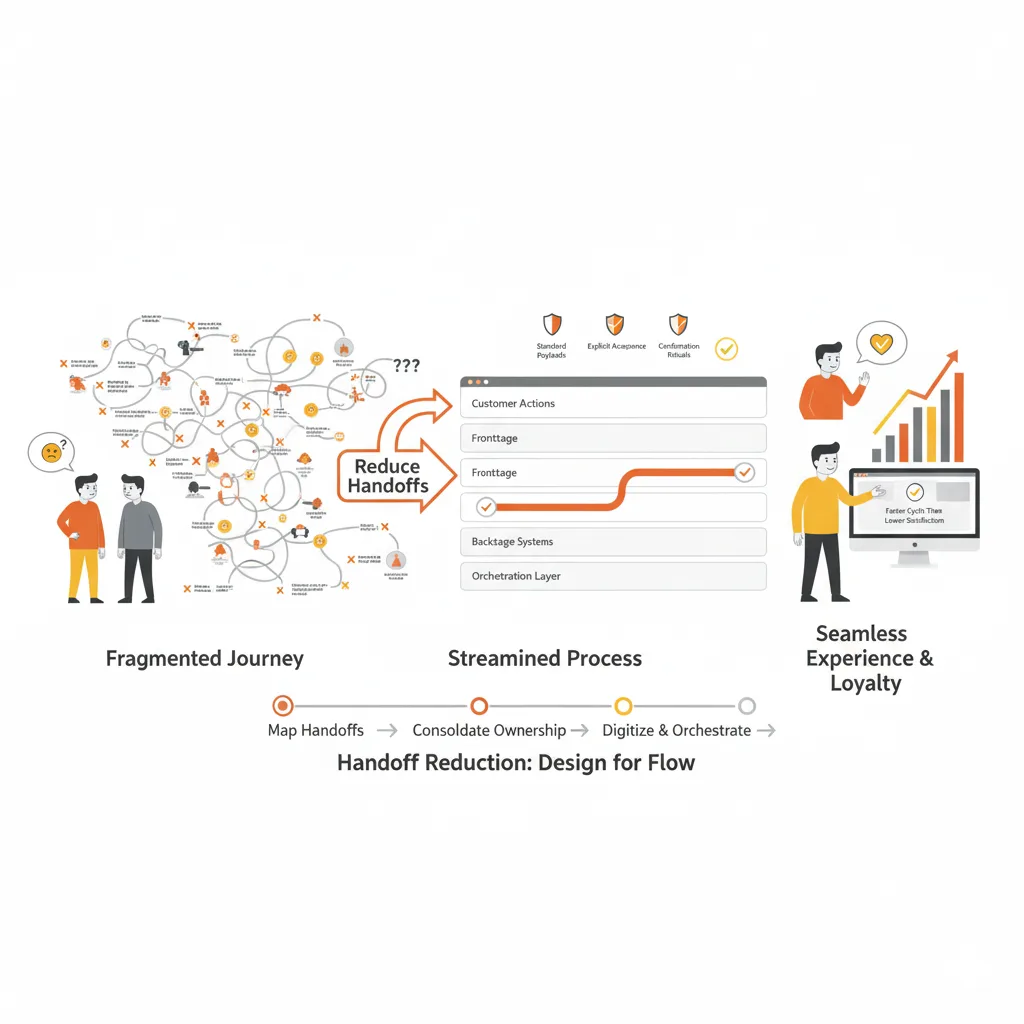
Why do handoffs break experiences and margins?
Executives face a simple truth: every unnecessary handoff creates friction, delay, and risk. Customer journeys degrade when work baton-passes across functions or channels without clarity, context, or continuity. Research across safety-critical environments shows that handoff failures drive a large share of communication errors, which is a useful proxy for risk in service operations as well.¹ Structured practices such as standardised handoff tools reduce errors when consistently applied, indicating that the problem is designable, measurable, and fixable.² Customer-journey thinking strengthens this point by showing that optimising isolated touchpoints often hides the cumulative cost of handoffs across the end-to-end experience.³ When leaders design journeys instead of silos, they reduce rework, accelerate cycle time, and protect trust.⁴
What is a “handoff” in service operations?
This playbook defines a handoff as any transfer of accountability, context, or work state between people, teams, or systems during a customer journey. Examples include sales-to-onboarding transitions, bot-to-agent escalations, L2-to-L3 technical routing, or a channel switch from web to phone. Handoffs differ from collaboration. Collaboration shares context while maintaining ownership; a handoff changes the owner. Lean operations treat handoffs as potential waste because they introduce queues, motion, and defects.⁵ In digital and agile settings, excessive handoffs are an anti-pattern that fragments communication and extends cycle time.⁶
How do handoffs show up in your customer journey map?
Leaders visualise handoffs by overlaying three layers on an existing journey map. First, mark every point where ownership changes. Second, capture the data and decision objects that must move with the work. Third, record the queueing conditions and SLAs at each boundary. The result reveals hidden hotspots: bottlenecks where requests pile up, error-prone rekeys where data is reentered, and brittle channel shifts where customers repeat information. Journey-level visibility matters because handoffs compound; a smooth experience requires continuity across steps, not excellence at one step.³
What is the mechanism of harm?
Handoffs harm service performance through four pathways. Fragmented context forces customers to repeat information, increasing effort and churn risk. Reinterpretation during every transition introduces error and rework, especially when signals are unstructured.¹ Queues accumulate between functional stages, extending cycle time and increasing abandonment. Finally, diluted accountability encourages follow-the-ticket behaviour instead of outcome ownership. In clinical settings, standardised tools such as I-PASS mitigate these risks by making the information structure explicit and closing the loop with the receiver’s synthesis.² Translating this to service operations requires a comparable pattern: structured payloads, explicit acceptance, and confirmation.
Where should you reduce handoffs versus strengthen them?
Not all handoffs are avoidable. Leaders make three decisions. Eliminate handoffs that exist only because of legacy org design, such as unnecessary tiers or duplicated checks. Consolidate handoffs by creating cross-functional cells or journey squads that keep ownership until value is realised. Strengthen essential handoffs with standard payloads, acceptance criteria, and confirmation rituals. Lean principles focus on removing non-value transfer, while agile practices emphasise durable team ownership to minimise baton-passing.⁵ ⁶
How do you redesign journeys to cut handoffs at the source?
Start at the journey level. Define the desired outcome and the smallest responsible team that can deliver it without external queues. Align incentives, metrics, and authority so the team resolves most work within its boundary. Digital orchestration helps by routing events and data through a common layer so transitions retain context. When journeys are digitised end to end, organisations both improve experience and reduce servicing cost, because fewer baton passes mean fewer contacts and corrections.⁴ ⁷
What standards make remaining handoffs safe?
Executives adopt a standard akin to I-PASS for service work. The payload should include state, severity or priority, summary of actions taken, the explicit next action list, risks and dependencies, and a receiver synthesis to confirm understanding. The sender remains accountable until the receiver explicitly accepts ownership, and systems log the acceptance event. Evidence from healthcare shows that structured handoff protocols reduce errors and adverse events; the same logic applies to service transitions that demand precision and speed.² ⁸
Which digital capabilities reduce handoffs without losing control?
Modern stacks can remove or streamline baton passes. Event-driven architectures synchronise customer state across channels so the next handler does not reconstruct context. Intelligent intake captures intent, identity, and entitlement at the edge, routing to the minimal capable resolver with full context. Workflow automation closes trivial loops without escalation. Mid- and last-mile handover digitisation in logistics illustrates how targeted technology at boundary points reduces waste and improves throughput.⁹ Orchestrated omnichannel journeys can deliver both better experience and lower cost when designed deliberately.⁷
How do you measure handoffs and prove impact?
Leaders make handoffs visible with six measures. Handoff rate per journey counts transitions normalised by resolution volume. Handoff quality score samples payload completeness and receiver synthesis quality. First contact or first-touch resolution indicates success in minimising transitions. End-to-end cycle time and queue time between stages quantify flow effects. Customer Effort Score and complaint rate capture perceived friction from repeated explanation. As organisations shift from touchpoint to journey metrics, executives see a clearer link between fewer handoffs, lower cost to serve, and higher satisfaction.³ ⁴
What risks accompany aggressive handoff reduction?
De-layering introduces concentration risk if controls relied on independent review. Leaders preserve control by moving checks in-flow and automating validations at the point of work. Eliminating tiers can also reduce specialisation capacity. Counter this by embedding specialists into journey squads with clear escalation playbooks. Finally, changing ownership boundaries threatens existing KPIs. Executives must reset incentives toward journey outcomes and guard against suboptimisation.
How do you execute a 90-day handoff reduction sprint?
Leaders run a focused initiative with visible targets. Weeks 1 to 3 map handoffs and build the baseline. Weeks 4 to 6 remove one structural handoff by consolidating ownership for a top journey. Weeks 7 to 9 standardise two essential handoffs with a simple payload and acceptance ritual. Weeks 10 to 12 industrialise wins by codifying patterns in orchestration, workflow, and training. This sequence aligns with established service-operations guidance that experience-led redesign and cross-functional operating models drive durable performance.¹⁰
How do contact centres and field operations apply this playbook?
Contact centres cut escalations by shifting authority left, expanding resolver libraries, and integrating knowledge into the agent desktop so fewer baton passes are needed. Bot-to-human transitions carry the full transcript and state. Field operations merge dispatch and fulfilment where possible and digitise site handovers to eliminate repeat visits. Logistics providers that targeted handover points with scanning, IoT, and track-and-trace reduced waste and improved productivity, showing the value of treating boundary moments as design objects.⁹
What is the business case that convinces a CFO?
CFOs respond to math grounded in journey metrics. Reducing average handoffs by even one per case cuts queue time, rework, and repeat contact costs. McKinsey’s work on digitising customer journeys shows that better journeys often coincide with lower servicing cost because the design reduces avoidable contacts and escalations.⁷ ⁴ Operations research and service-management literature further underline that standardising transitions improves reliability, which lowers the cost of quality.² ⁸ Combined, these effects produce margin gain while strengthening the customer promise.
How do you institutionalise handoff discipline?
Executives embed handoff standards into governance and tooling. Policies define when a handoff is allowed, what payload is mandatory, and how acceptance is confirmed. Platforms enforce payload schemas and log transfers as first-class events. Training makes sender and receiver behaviours explicit. Leadership reviews show handoff rate and quality alongside productivity and NPS. Agile and Lean ceremonies reinforce small-batch flow with minimal baton passes, consistent with guidance that handoffs undermine agility when left unchecked.⁶
What does good look like in the wild?
High-performing organisations operate journey squads with end-to-end accountability, digitise boundary conditions, and use structured handoff protocols for essential transitions. They treat handoffs as design decisions, not accidents. They measure what they change and broadcast the wins. In logistics, targeted digitisation at handover points reduces waste.⁹ In healthcare, standardised handoffs reduce adverse events.² In customer service, orchestrated omnichannel journeys deliver superior outcomes at lower cost when implemented intentionally and at scale.⁷ ⁴
FAQ
What is a handoff in the Customer Science context? A handoff is any transfer of accountability, context, or work state between people, teams, or systems during a customer journey. It differs from collaboration because ownership changes at a handoff, which adds friction and risk if not designed.⁵ ⁶
Why should Customer Science clients reduce handoffs across journeys? Fewer handoffs mean fewer queues, fewer errors, and faster cycle times. Evidence shows structured transitions reduce errors in safety-critical settings, and journey-level design links better experience with lower servicing cost.² ⁴ ⁷
Which standards improve handoff quality for contact centres and CX teams? Adopt a simple protocol modelled on I-PASS: include current state and priority, a concise summary, explicit next actions, risks, and a receiver synthesis to confirm acceptance. This pattern reduces miscommunication and rework.² ⁸
How does omnichannel orchestration at Customer Science cut handoffs? Orchestration captures intent and state at the edge, routes to the minimal capable resolver, and preserves context across channels. This reduces bot-to-agent thrash and sales-to-service friction while improving first-contact resolution.⁷
Which metrics prove that handoff reduction is working? Track handoff rate per journey, handoff quality score, first contact resolution, end-to-end cycle time, queue time between stages, and Customer Effort Score. Moving from touchpoint to journey metrics reveals compounding gains.³ ⁴
Who should own end-to-end outcomes at Customer Science clients? Create cross-functional journey squads with authority to resolve most work without external queues. Consolidating ownership removes structural handoffs and aligns incentives to customer outcomes.⁶ ¹⁰
Which industries demonstrate handoff gains relevant to Customer Science engagements? Healthcare shows error reduction from standardised handoffs, while logistics demonstrates waste reduction at handover points through digitisation. Both lessons transfer directly to service, CX, and contact centre contexts.² ⁹
Sources
-
The Joint Commission. “Reducing Handoff Communication Failures and Inequities in Healthcare.” 2024. The Joint Commission. https://www.jointcommission.org/en-us/knowledge-library/news/2024-08-reducing-handoff-communication-failures-and-inequities-in-healthcare
-
Starmer AJ et al. “Use of structured handoff protocols for within-hospital unit handoffs and cybersecurity interruptions: meta-analysis of I-PASS.” 2025. BMJ Quality & Safety. https://qualitysafety.bmj.com/content/qhc/early/2025/04/29/bmjqs-2024-018385.full.pdf
-
Maechler N, Neher K, Park R. “From touchpoints to journeys: Seeing the world as customers do.” 2016. McKinsey & Company. https://www.mckinsey.com/capabilities/growth-marketing-and-sales/our-insights/from-touchpoints-to-journeys-seeing-the-world-as-customers-do
-
McKinsey & Company. “Digitising customer journeys and processes.” 2017. McKinsey Digital. https://www.mckinsey.com/~/media/McKinsey/Business%20Functions/McKinsey%20Digital/Our%20Insights/Digitizing%20customer%20journeys%20and%20processes/Digitizing-customer-journeys-and-processes.ashx
-
Velaction. “Handoffs: The Waste of Handing Off Work.” 2009. Velaction Continuous Improvement. https://www.velaction.com/handoffs/
-
Hinshelwood M. “Why Handoffs Are Killing Your Agility.” 2025. Scrum.org. https://www.scrum.org/resources/blog/why-handoffs-are-killing-your-agility
-
McKinsey & Company. “Customer First: Personalising the Customer-Care Journey.” 2019. McKinsey Operations (PDF). https://www.mckinsey.com/~/media/mckinsey/business%20functions/operations/our%20insights/how%20to%20capture%20what%20the%20customer%20wants/customer-first-personalizing-the-customer-care-journey.pdf
-
Manser T, Foster S. “Clinical handover and handoff in healthcare: a systematic review of interventions to improve safety.” 2021. International Journal for Quality in Health Care. https://academic.oup.com/intqhc/article/33/1/mzaa170/6039082
-
Bhattacharjee D, Kamil A, Lukasiewicz M, Melnikov L. “Digitising mid- and last-mile logistics handovers to reduce waste.” 2024. McKinsey & Company. https://www.mckinsey.com/industries/logistics/our-insights/digitizing-mid-and-last-mile-logistics-handovers-to-reduce-waste
-
McKinsey & Company. “Growth through customer experience: Experience-led growth.” 2023. McKinsey Marketing & Sales. https://www.mckinsey.com/capabilities/growth-marketing-and-sales/our-insights/experience-led-growth-a-new-way-to-create-value