






























Why do escalation paths create friction in the first place?
Leaders design escalation models to protect quality, speed, and cost. Customers experience those models as handoffs, delays, and repeated explanations. Service organizations often treat escalation as a control mechanism rather than a customer outcome mechanism. The result is friction. Research on the Customer Effort Score shows that the ease of problem resolution is a stronger predictor of loyalty than satisfaction or Net Promoter Score, which means friction in escalation directly erodes loyalty.¹ The same research program underpins the book The Effortless Experience, which frames effort reduction as the central lever for service loyalty, not delight.² Escalation paths that reduce effort increase loyalty. Escalation paths that raise effort decrease loyalty. The premise is simple. The execution requires a disciplined design that aligns governance, roles, signals, and tooling around a single promise. Make it easy for the customer to get an accurate resolution on the first try.¹ ²
What is an escalation path and what makes it “without friction”?
An escalation path is a defined route for moving a customer issue to higher authority, deeper expertise, or broader capacity when the first handler cannot resolve it within policy or time limits. In IT service management, incident escalation rules specify the hierarchy and the triggers, typically tied to severity and resolution time.⁵ Frictionless escalation preserves context, compresses time, and minimizes customer effort. It does this by flowing the right information to the right person at the right moment, without the customer repeating details. ISO 10002 defines a complaints handling process that emphasizes fairness, transparency, and responsiveness, which provides a strong blueprint for escalation governance in any sector.³ ⁴ Frictionless escalation therefore means compliant governance with low effort in motion. It combines clear policies, crisp decision rights, and automatic context transfer that remove invisible work from customers and agents.³ ⁵
Where should escalation live inside a modern operating model?
Executives should place escalation at the intersection of customer operations, risk, and product ownership. Customer experience is everyone’s responsibility, and that statement becomes operational when escalation policies connect frontline teams, enabling functions, and product experts in a shared rhythm.⁷ Ownership must be explicit. Product leads own fix-forward decisions. Risk owns guardrails. Operations owns the runbook and the clock. This triad ensures that frontline teams can act within policy, that exceptions route quickly, and that systemic fixes enter product backlogs.⁷ The escalation system should feed continuous improvement. Cases that escalate mark knowledge gaps, policy defects, or product defects. A weekly triage across these owners reviews patterns, closes loops, and publishes updates to frontline guidance. The location of escalation in the org chart matters less than the clarity of decision rights and the habit of cross-functional collaboration that removes time and effort from journeys.⁷
How do you design trigger signals that prevent unnecessary handoffs?
Leaders should design triggers that prefer empowerment over pass-through. The Effortless Experience research shows that customers reward ease, not theatrics, which means the best escalation is often avoided by enabling first contact resolution.¹ ² Define three classes of triggers. First, authority triggers grant the frontline the ability to decide within documented limits, which reduces avoidable escalations. Second, expertise triggers programmatically route rare or complex issues to specialists based on metadata, not guesswork. Third, time triggers escalate automatically when service level timers breach, as modeled in ITIL incident management practices.⁵ For each trigger class, define the data needed, the decision owner, and the acceptable time to act. Document what “good” looks like for context quality. The handoff must always include the customer’s goal, the history of attempts, and the current hypothesis, so the next handler moves immediately to resolution.⁵
What policies and standards keep escalation humane and defensible?
Escalation grows humane and defensible when it borrows from standards that already codify fairness and transparency. ISO 10002 provides guidance on planning, operating, and improving complaints handling, with a focus on visible fairness for customers and measurable feedback loops for organizations.³ ⁴ This standard helps leaders codify what customers can expect, how evidence is collected, and how responses are communicated.³ In digital and technical contexts, incident management practices clarify severity, roles, and authority, which prevents chaotic handoffs and compresses time to restore service.⁵ When teams write escalation policies, they should also account for bias risks on the front line and in backline decision making. Research documents how subtle discrimination in service interactions can harm customers and brands, especially under pressure. Policies must define respectful behaviors, consent for call transfers, and monitoring practices that protect customers and employees.⁸ Standards make escalation principled and consistent.³ ⁵ ⁸
How do tools and runbooks remove repetition and rework?
Teams remove repetition by shifting from ticket notes to structured context packages. A context package is a standardized snapshot that includes customer goal state, authentication status, key facts, attempted steps, artifacts such as screenshots or logs, and a recommended next action. This artifact rides with the case through every hop. In modern incident workflows, an explicit escalation policy defines what happens when a handler cannot resolve an issue and requires a handoff to a colleague with different skills or authority.⁶ The policy describes who takes over, how they are notified, and what context is mandatory.⁶ Runbooks then encode consistent steps by scenario. A good runbook works like a recipe with clear inputs and outputs, plus time boxes that trigger help. Over time, teams use escalated cases to refine knowledge articles and bots so the next customer completes the same task without intervention. Escalation becomes a teacher.
How should leaders measure friction and loyalty impact through escalation?
Leaders should measure effort, time, and first contact resolution together, and they should assign improvement targets at the pathway level. The Customer Effort Score correlates with loyalty outcomes more strongly than traditional satisfaction measures, which makes it the right primary signal for friction.¹ The Effortless Experience literature frames effort as a philosophy rather than a project, so measurement should blend journey-level effort with operational timers and recontact rates.² ITIL practices add clarity on time to restore and breach-based escalations, so operations can manage the clock with rigor.⁵ ISO 10002 reinforces complaints resolution timeliness and fairness, so quality teams can audit the experience and the record.³ ⁴ Executives should publish a monthly narrative that ties effort trends to specific runbook fixes and product changes. This narrative closes the loop, shows accountability, and proves that escalation design moves loyalty, cost, and risk in the right direction.¹ ² ³ ⁵
What does a low-friction escalation look like in practice?
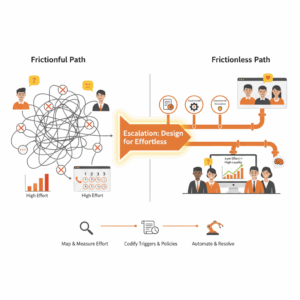
A customer contacts support to fix a failed payment. The agent authenticates and follows the “payment recovery” runbook. When the steps indicate a gateway mismatch, the agent packages the context and hits a single button that routes the case to the payments specialist queue. The context includes logs, customer goal, consent to transfer, and the exact attempts already made. The specialist receives an automatic notification, applies the fix, and uses a templated closure note that the original agent reviews with the customer. The case stays with the original agent for relationship continuity, and the specialist’s actions populate the knowledge base. The escalation policy made the route clear.⁶ The incident management practice set the time triggers.⁵ The complaints handling standard ensured a respectful, transparent communication sequence and a documented outcome.³ ⁴ The experience felt simple because the system carried the load, not the customer.¹ ²
What are the first moves to redesign escalation paths this quarter?
Executives should run a ninety-day program that targets one high-volume pathway. Start by mapping the current escalation journey and quantifying effort and recontact. Then codify authority triggers and deploy a standard context package. Align an escalation policy with explicit roles and timers, as defined in on-call and incident practices.⁶ Update complaints handling language and training to match ISO 10002, including consent scripts for transfers and closure communications.³ ⁴ Train leaders to coach effort behaviors and to watch for bias slip in pressured handoffs.⁸ Publish a simple scorecard that shows effort, first contact resolution, time to restore, and complaint timeliness, and tie each metric to a named owner. Reinforce the mindset that escalation is a service, not a shrug. When the customer does not feel the transfer, the design is working. When the organization learns from every transfer, the business compounding begins.¹ ² ³ ⁵
FAQ
What is a frictionless escalation path in customer experience?
A frictionless escalation path is a defined route for moving unresolved issues to higher authority or deeper expertise while preserving context, compressing time, and minimizing customer effort, aligned with ISO 10002 governance and ITIL incident practices.³ ⁴ ⁵
How does the Customer Effort Score relate to escalation design?
The Customer Effort Score predicts loyalty better than traditional satisfaction metrics, so escalation design should focus on reducing effort through context preservation, empowerment, and clean handoffs.¹
Which standards help make escalation fair and compliant?
ISO 10002 provides guidelines for complaints handling that emphasize fairness, transparency, and responsiveness, while ITIL practices clarify severity, roles, and authority for time-bound incident resolution.³ ⁴ ⁵
Who should own escalation across the enterprise?
Operations should own runbooks and timers, product should own fix-forward decisions, and risk should own guardrails, with all leaders treating customer experience as a shared responsibility.⁷
Why do clear escalation policies matter for on-call and specialist teams?
Clear policies specify who takes over, how they are notified, and what context rides with the case, which prevents chaotic handoffs and speeds resolution for customers and staff.⁶
What risks must leaders manage in frontline and backline escalations?
Leaders must manage bias and inconsistency during pressured interactions. Research shows subtle discrimination on the front line can harm customers and brands, so policies and training must define respectful behaviors and oversight.⁸
Which metrics show whether escalation is reducing friction?
Track Customer Effort Score, first contact resolution, time to restore or resolve, recontact rates, and complaint timeliness. Tie metrics to owners and publish a monthly narrative that links results to runbook and product changes.¹ ² ³ ⁵
Sources
“Stop Trying to Delight Your Customers,” Matthew Dixon, Karen Freeman, Nicholas Toman, 2010, Harvard Business Review. (Harvard Business Review)
The Effortless Experience: Conquering the New Battleground for Customer Loyalty, Matthew Dixon, Nicholas Toman, Rick DeLisi, 2013, Penguin. (Google Books)
“ISO 10002 — Customer Satisfaction: Guidelines for Complaints Handling,” 2025, BSI Group overview page. (BSI Group)
ISO 10002:2018 — Quality management, Customer satisfaction, Guidelines for complaints handling in organizations, International Organization for Standardization, 2018. (isocertification)
“Incident Management — ITIL terms and escalation rules,” IT Process Wiki, accessed 2025. (IT Process Wiki – the ITIL® Wiki)
“Escalation policies for effective incident management,” Atlassian, accessed 2025. (atlassian.com)
“Customer Experience Is Everyone’s Responsibility,” Janet Balis, 2023, Harvard Business Review. (Harvard Business Review)
“Fighting Bias on the Front Lines,” Tami Kim, 2021, Harvard Business Review. (Harvard Business Review)