













Why does the order between rearchitecture and automation matter?
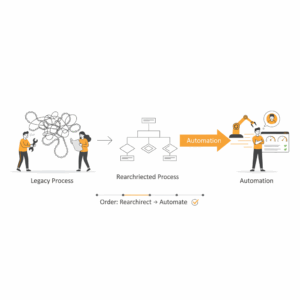
Executives pick the order and set the outcome. When organisations automate a broken process, they lock in waste and risk. When they rearchitect first, they remove friction, clarify decisions, and then let automation scale the new design. The sequence drives cost, experience, and control profiles for years. Process rearchitecture means redesigning how work flows to deliver value, not just documenting current steps. Automation means using software or machines to perform tasks with minimal human input, often through rules, APIs, or AI. Treated in the right order, these practices compound returns. Treated in the wrong order, they conflict and defer value.¹²
What is “process rearchitecture” in plain terms?
Leaders rebuild the process to create a new path from request to result. This unit reduces handoffs, simplifies decision rules, clarifies ownership, and sets measurable controls. Classic business process reengineering defined the intent as radical redesign for breakthrough outcomes, while modern lean practice emphasises customer value, flow, and pull. In both traditions, leaders remove non-value steps and shorten cycle time to what the customer will recognise and reward. A rearchitected process is stable, observable, and ready for change. It balances service quality, risk, and productivity so that automation can safely amplify it.¹³
What is “automation” in today’s CX and service context?
Teams use automation to execute stable, defined tasks at speed. Rules engines, robotic process automation, workflow orchestration, and AI assistants all sit under the automation banner. The common thread is the shift of execution from people to systems with predictable inputs and outputs. IEEE guidance places routine, structured tasks at the heart of software robotics, while orchestration coordinates people and bots across systems. Automation thrives when upstream variation is low, exception paths are explicit, and data quality is fit for purpose. In that environment, automation cuts handling time and error rates while improving service consistency.²
Rearchitecture vs automation: What sequence creates durable value?
Pragmatic leaders rearchitect first, then automate. Rearchitecture clarifies the target state, collapses steps, and defines decisions. Automation then scales the new design and frees human effort for judgment. The reverse sequence often hardwires legacy rules, multiplies exception logic, and inflates maintenance costs. Exceptions become code instead of being designed out. By sequencing rearchitecture first, teams reduce the automation surface area and increase testability. This order also aligns with lean’s “stabilise before optimise” principle and keeps customer outcomes central to the design.³
How do you decide the order when the clock and budget are tight?
Executives use a two-speed approach. They rearchitect the highest-volume journey slices while selectively automating small, stable tasks that sit at the edges. This approach protects near-term benefits without compromising the end state. Start with a thin slice through one customer request type, one channel, and one fulfilment path. Remove unnecessary handoffs and approvals, standardise inputs, and codify decisions. With that structure in place, apply targeted automation where inputs are clean and exceptions are rare. This sequencing gives the board visible progress while avoiding the trap of automating chaos.³
Where do canonical definitions and standards help?
Standards steer language, controls, and outcomes. ISO 9001 frames process control, ownership, and evidence. APQC’s Process Classification Framework provides a shared map of enterprise processes across industries. IEEE guidance defines the core terms for robotic and intelligent automation, which reduces confusion across vendors and functions. These references create a stable glossary and governance spine for design decisions. Teams that align definitions early spend less time debating labels and more time reducing customer effort and risk.²⁴⁵
How do you measure when to rearchitect, automate, or do both?
Leaders anchor choices in three signals. First, customer effort and failure demand show where friction lives and where to remove it. Second, process capability metrics, such as cycle time percentiles and right-first-time rates, reveal variation. Third, automation readiness indicators, such as input structure, exception volume, and API availability, signal feasibility. A process with high variation and opaque decisions needs rearchitecture before automation. A process with stable inputs and explicit rules can handle targeted automation. A process with both stability and clear value at stake merits parallel tracks with strict scope control.¹³⁴
What operating model changes keep the order intact?
Executives establish a joint design authority. This structure brings CX design, operations, risk, architecture, and automation engineering into one backlog with one definition of done. The authority defines decision rights, sets guardrails, and controls reuse of components. It enforces a “design gate” that requires simplified flows, standardised inputs, and explicit exception handling before any automation build. It also runs change management to prepare teams, using models such as ADKAR to build awareness, desire, knowledge, ability, and reinforcement. The governance is boring by design, which is why it works.⁶
How do you mitigate risks when automating redesigned processes?
Controls ride along with the flow. Leaders embed control points where risk concentrates, not where tradition placed a checkbox. They use segregation of duties, audit trails, and approval thresholds that are explicit and testable. They align with enterprise risk frameworks and map where AI or decision engines could drift. They borrow from emerging AI risk guidance to validate data quality, model performance, and human oversight. They also document fallback paths and practice recovery drills so that customer harm remains low even when automation fails.⁷
How do you compare pathways: rearchitecture-first vs automation-first?
Executives make the comparison tangible. A rearchitecture-first pathway reduces complexity before adding code, so the build is smaller and the change is cleaner. The primary risks are stakeholder patience and scope creep. An automation-first pathway accelerates visible activity but often pushes complexity into scripts and rules. The primary risks are brittle bots, rising exception work, and hidden tech debt. Both pathways demand disciplined measurement. The winning pathway ties measurable customer outcomes, like reduced time to resolution and lower abandonment, to process and financial measures that the CFO can track.¹³
What mechanism turns strategy into delivery week by week?
A cadence makes the order real. Leaders run a rolling, two-week design and decision rhythm that locks scope for the next thin slice and sets clear acceptance criteria. They pair a service designer with a process engineer to model flows, a data lead to map inputs and controls, and an automation engineer to define buildable components. They publish the next-best actions for each role and the defects removed in the last slice. They keep a living “exception ledger” that lists top reasons for breakage, then remove causes at the design gate before any new automation work begins. This loop keeps the sequence disciplined.³⁶
Which metrics prove impact to boards and regulators?
Boards ask for specific, auditable signals. Executives provide cycle time percentiles, customer effort scores, and failure demand rates by demand type. They publish automation coverage, exception rates, and mean time to recovery for incidents. They show control effectiveness through internal audit findings and right-first-time measures. They link these to cost per contact, revenue recovery, or working capital improvements. ISO-aligned documentation and change control bind the evidence. With this package, leaders can defend the order, the controls, and the business case in a single view.¹⁴⁶⁷
What next steps should a CX or service leader take this quarter?
Leaders commit to three moves. First, they select one customer journey slice with high volume and clear pain, such as “invoice query via email,” and map it to the target state with lean principles. Second, they stand up the design authority, publish the design gate, and align automation teams to enter only after the gate. Third, they launch a measurement pack that includes customer effort, process capability, and automation readiness. These moves reset the order without waiting for a transformation program. The work starts where the customer lives and proves value within one quarter.³⁴⁶
FAQ
What is the difference between process rearchitecture and automation in Customer Experience and Service Transformation?
Process rearchitecture redesigns how work flows to deliver value, removing waste and clarifying decisions before any tooling. Automation uses software, rules, or AI to execute tasks at speed once the process is stable and measurable.¹²³
Why should organisations rearchitect before they automate service processes?
Rearchitecture eliminates needless steps and variation, which reduces the automation surface area and prevents hardwiring legacy rules. Automation then scales the cleaner design for consistent CX and lower risk.³
Which standards support consistent process and automation outcomes?
ISO 9001 provides a quality management backbone for process control and evidence, while APQC’s Process Classification Framework offers a shared process map. IEEE guidance defines core terms for robotic and intelligent automation so teams speak the same language.²⁴⁵
How do leaders decide whether to rearchitect, automate, or do both?
Leaders assess customer effort, process capability, and automation readiness. High variation and unclear decisions point to rearchitecture first. Stable inputs and explicit rules open the door to targeted automation.¹³⁴
Which risks should be addressed when automating redesigned processes?
Key risks include exception sprawl, control weakness, and AI drift. Leaders embed testable controls, maintain audit trails, and align with AI risk frameworks to protect customers and the business.⁷
Who owns the sequencing across CX, operations, and technology?
A joint design authority owns the backlog, the design gate, and the definition of done. This group spans CX, operations, risk, architecture, and automation engineering and uses change management practices such as ADKAR.⁶
What metrics prove to boards that the chosen order works?
Boards look for cycle time percentiles, customer effort, failure demand, automation coverage, exception rates, and control effectiveness, linked directly to financial outcomes such as cost per contact.¹⁴⁶⁷
Sources
Hammer, Michael; Champy, James. Reengineering the Corporation (1993). HarperBusiness. https://en.wikipedia.org/wiki/Business_process_reengineering
IEEE Standards Association. IEEE Guide for Terms and Concepts in Intelligent Process Automation (IEEE 2755-2017). https://standards.ieee.org/standard/2755-2017.html
Womack, James P.; Jones, Daniel T. Lean Thinking overview. Lean Enterprise Institute. https://www.lean.org/explore-lean/what-is-lean/
APQC. Process Classification Framework (PCF), Cross-Industry Overview. APQC Resource Page. https://www.apqc.org/resource-library/resource-listing/apqc-process-classification-framework-pcf-cross-industry
ISO. ISO 9001:2015 Quality management systems — Requirements. International Organization for Standardization. https://www.iso.org/standard/62085.html
Prosci. The ADKAR Model Overview. Prosci Research. https://www.prosci.com/resources/articles/adkar-model-overview
National Institute of Standards and Technology (NIST). AI Risk Management Framework (AI RMF 1.0). U.S. Department of Commerce. https://www.nist.gov/itl/ai-risk-management-framework