


























Why do CX leaders need a unified automation value model now?
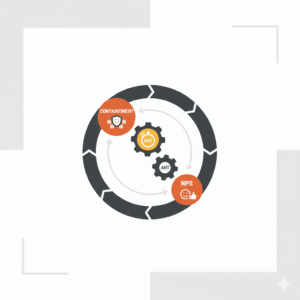
C-level executives face a simple mandate. Reduce cost to serve while lifting customer trust. Automation delivers on both when leaders measure the right things in the right order. An automation value model that aligns Containment, Average Handle Time, and Net Promoter Score gives executives a single lens to govern investments, prove impact, and tune experience quality. This model focuses automation on business value, not novelty, and it equips operational and design teams with the same scorecard. Containment shows how much work deflects to self service. AHT shows how efficiently people and machines resolve what remains. NPS shows whether customers reward the experience with advocacy. Together, these three metrics form a closed loop that turns service automation from a pilot factory into a growth engine.¹²³
What is “containment” and why does it anchor automation ROI?
Containment is the percentage of interactions fully resolved in self service without handoff to a human. Virtual agents, IVR flows, authenticated portals, and proactive messages all contribute to containment. A strong containment rate signals that journeys are simple, accurate, and trustworthy enough for customers to complete unaided. Most platforms and industry references define containment as the share of interactions completed in automated channels end to end, often reported by modality such as IVR containment or chatbot containment.²⁴¹² Containment anchors automation ROI because it reduces inbound volume, lowers staffing requirements, and shortens queues, while protecting human capacity for complex work.²⁹¹₂ Leaders should separate “technical containment” from “customer containment.” Technical containment counts any interaction that does not transfer. Customer containment requires resolution that meets intent and prevents bouncebacks to other channels.²⁴
How does Average Handle Time fit the picture?
Average Handle Time measures the average total time to resolve a contact, including talk or chat time, hold time, and after call work. The standard calculation divides the sum of talk time, hold time, and wrap time by the number of handled contacts.³¹¹²⁰ Reducing AHT is not an end in itself. It matters because it improves flow efficiency and unlocks scale as containment rises. When automation absorbs routine demand, remaining contacts skew complex. That complexity can push AHT up even as overall cost to serve drops. Executives should therefore track assisted AHT by intent cluster and pair it with resolution rate. This ensures the organization values right-first-time outcomes over speed alone.³¹¹²
What is Net Promoter Score and how does it validate automation quality?
Net Promoter Score is a customer loyalty measure derived from a single question that asks how likely a customer is to recommend a company on a 0–10 scale. Organizations categorize 9–10 as promoters, 7–8 as passives, and 0–6 as detractors, then subtract the percentage of detractors from the percentage of promoters to produce NPS.¹ NPS validates whether containment and AHT improvements translate into perceived value. Automation that shortens time to outcome, clarifies next steps, and reduces effort should lift NPS among both self service users and assisted customers. Leaders should segment NPS by journey, channel, and resolution status to avoid masking journey defects behind an aggregate score.¹
How do these three metrics work together in practice?
Executives use Containment, AHT, and NPS as a causal chain. Containment reduces assisted volume by resolving intent in-channel. Assisted AHT then reflects the efficiency of the remaining work that requires human judgment. NPS finally verifies whether customers experienced the change as better, faster, and clearer. If containment goes up while bouncebacks rise and NPS drops, automation likely solved the wrong intents or created friction in authentication. If AHT rises while NPS rises and total cost falls, automation likely shifted complexity to humans in a healthy way. A weekly review of the trio by intent, segment, and channel keeps strategy honest and adaptive.²³¹¹
How should leaders define and instrument “containment” correctly?
Teams should use a precise definition. Count an interaction as contained only when the automated flow fulfills the customer’s stated intent without human intervention, within a quality threshold such as no repeat contact within seven days. Product owners should implement platform-native containment tracking and validate it against interaction analytics and downstream events such as order updates or case closures. Major cloud contact center platforms and CX analytics suites provide out-of-the-box containment metrics and path tracing that surface where customers abandon the automated journey.²³¹₂¹⁰ Instrumentation should tag intents, authenticate identities, and capture outcome events to separate true self service completion from silent abandonment.²³¹₂
Where should automation target to move AHT the right way?
Operations should focus on three levers. First, reduce non-value time. Use knowledge retrieval, guided workflows, and real-time assistance to cut hold and wrap components of AHT.³¹¹ Second, increase first contact resolution on complex intents. Provide decisioning tools, next-best-action, and integrated data so agents and virtual agents complete more work in one interaction. Third, right-channel high-effort steps. Offer authenticated self service for predictable transactions and route exceptions to specialists. Average Handle Time will likely rise in specialized queues while falling overall as containment improves. Treat this as a designed outcome, not a failure.³⁸²⁰
Which comparisons help executives avoid metric traps?
Executives should compare containment by intent rather than channel only. A 60 percent containment rate in password resets means something different than 60 percent in billing disputes.²⁴ Compare assisted AHT by resolved versus unresolved contacts. Short AHT with low resolution indicates premature exits, not efficiency.³¹¹ Compare NPS among resolved versus unresolved journeys within self service and assisted channels. A rising NPS among resolved self service contacts with flat assisted NPS suggests room to reinvest in coaching and workflow simplification.¹ Finally, compare total cost to serve per resolved outcome, not per contact, to keep the organization aligned to resolution economics.
What risks can undermine the automation value model?
Several risks recur. Poor intent design inflates technical containment while depressing real resolution, which erodes trust and pushes customers to expensive channels.²⁹¹₂ Overemphasis on speed reduces investigative depth, increases rework, and hides behind a low AHT headline.³¹¹ Incomplete measurement obscures customer sentiment. If NPS is collected only after assisted contacts, leaders will miss the self service experience entirely and steer investment with a partial map.¹ Disconnected data systems also degrade containment and AHT. Without unified identity and context, automation cannot execute end-to-end tasks and agents repeat questions, both of which create friction that customers will remember.
How do you measure impact credibly across pilots and scale-up?
Executives can set baselines for containment, AHT, and NPS by intent family, then commit to lift targets and guardrails. Containment targets should specify both percentage and outcome quality, such as containment above 45 percent with repeat contacts below a threshold.²⁴ Assisted AHT targets should incorporate complexity tiers with expected ranges derived from historical distributions.³¹¹ NPS targets should be segmented by journey stage and by resolved status.¹ Use analytics platforms that connect transcripts, events, and outcomes to verify that automation improves resolution speed and satisfaction without increasing hidden failure demand.²³¹⁰ Publish results as cost per resolved outcome, time to outcome, and advocacy to keep the whole organization focused on customer value.
What actions move leaders from measurement to transformation?
Leaders can move quickly with a simple cadence. Define intents and outcomes with precision. Instrument containment with outcome validation. Automate one high-volume, low-variance intent end to end. Use real-time assistance to shave hold and wrap time on the next three complex intents. Measure assisted AHT by resolved status and provide targeted playbooks. Collect journey-level NPS in both automated and assisted channels and close the loop on detractor themes. Iterate weekly using a single executive dashboard that aligns Containment, AHT, and NPS. Use these results to secure investment for adjacent intents and to upgrade the data plumbing that unlocks more end-to-end automation.²³¹¹
What evidence supports these definitions and mechanisms?
Widely used sources define NPS as a single-question loyalty metric that subtracts detractors from promoters.¹ Recognized contact center bodies and vendors define AHT as talk or chat time plus hold plus after call work divided by contacts.³¹¹²⁰ Major cloud and analytics platforms publish containment concepts and provide instrumentation and path analysis features aligned to self service success and abandonment.²³¹₂¹⁰ Independent practitioner guides and industry communities document benchmarks and practical formulas to operationalize these measures.¹⁸²⁰ This evidentiary base gives executives confidence to adopt an Automation Value Model that will travel across teams, technologies, and quarters.
How should Customer Science teams apply this model in Australia-based enterprises?
Customer Science teams can adopt the model as a governance and design pattern. Use containment to prioritize intent automation and to size capacity shifts across contact centers and digital channels. Use AHT to target workflow simplification and agent assistance where complexity concentrates. Use NPS to validate customer outcomes and to identify journey steps for language, guidance, and policy fixes. Anchor OKRs to these three measures and publish intent-level scorecards. This creates a shared mechanism for operations, product, and design to decide what to automate next, how to redesign assisted work, and where to invest in experience quality. The result is a measurable lift in resolution speed, staff productivity, and customer advocacy.¹²³
FAQ
How do I calculate Average Handle Time in a contact center?
Calculate AHT by adding talk or chat time, hold time, and after call or wrap time, then dividing by the number of handled contacts. This equation provides the average total handling time per interaction.³¹¹²⁰
What is a good definition of containment for self service automation?
Define containment as the percentage of interactions fully resolved in automated channels without human intervention and without repeat contacts for the same intent within a set window. Instrumentation should validate outcomes, not just the absence of transfer.²⁴¹₂
Why should executives track NPS alongside containment and AHT?
NPS validates whether customers perceive automation and workflow changes as better and more valuable. Containment and AHT show operational performance, while NPS confirms loyalty impact and helps locate friction in specific journeys and channels.¹
Which tools help measure containment and path success in IVR and virtual agents?
Modern contact center analytics and cloud platforms provide containment metrics, journey path analysis, and conversation insights to detect abandonment points and validate self service outcomes.²³¹₂¹⁰
Which metric should I optimize first in service automation programs?
Start with containment on high-volume, low-variance intents, then optimize assisted AHT for remaining complex work, and validate customer perception with journey-level NPS. This order aligns investment with cost, flow, and loyalty outcomes.²³³¹¹
How can Customer Science apply this model to Australian enterprises?
Customer Science can define intent-level baselines for Containment, AHT, and NPS, automate priority intents end to end, deploy real-time assistance for complex work, and publish a weekly executive dashboard that shows movement across all three measures. This creates a shared operating system for transformation.
Sources
“Net promoter score,” Wikipedia editors, 2025, Wikipedia. https://en.wikipedia.org/wiki/Net_promoter_score
“IVR Containment Rate: Definition & How to Improve It,” Chona Esjay, 2023, Fit Small Business. https://fitsmallbusiness.com/ivr-containment-rate/
“ICMI’s Guide To Contact Center Metrics (1st Ed.),” Brad Cleveland and ICMI, 2017, ICMI eBook. https://www.bradcleveland.com/wp-content/uploads/2022/10/eBook-metrics.pdf
“Containment Insights,” NICE CXone Help, 2025, NICE. https://help.nice-incontact.com/content/selfserviceanalytics/containmentinsights.htm
“Conversational Insights,” Google Cloud Documentation, 2025, Google Cloud. https://cloud.google.com/contact-center/insights/docs
“Conversational Insights and Quality AI,” Google Cloud CCAI Platform Docs, 2025, Google Cloud. https://cloud.google.com/contact-center/ccai-platform/docs/conversational-insights
“What is average handle time (AHT) & why does it matter,” Aspect Software, 2025, Aspect Blog. https://www.aspect.com/resources/what-is-average-handle-time-contact-centers
“What Are the Industry Standards for Call Centre Metrics?” Call Centre Helper, 2024, Call Centre Helper. https://www.callcentrehelper.com/industry-standards-metrics-125584.htm
“What is IVR Containment and Why is It Important?” GetVoIP, 2023, GetVoIP Blog. https://getvoip.com/blog/ivr-containment/
“Conversational AI documentation,” Google Cloud Documentation, 2025, Google Cloud. https://cloud.google.com/conversational-ai/docs
“The Metrics of Contact Center Productivity,” Lori Bocklund, 2019, ICMI. https://www.icmi.com/resources/2019/the-metrics-of-contact-center-productivity
“Contact Center Glossary,” NICE, 2025, NICE. https://www.nice.com/glossary
“How to Measure Average Handling Time,” Call Centre Helper, 2024, Call Centre Helper. https://www.callcentrehelper.com/how-to-measure-average-handling-time-52403.htm