



























What is an agility benchmark and why should executives care?
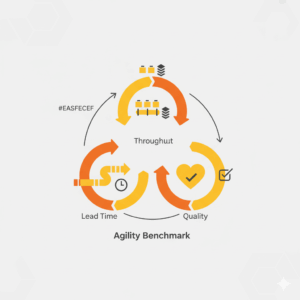
Executives set an agility benchmark to compare how fast, how much, and how well their service organisation delivers value. The benchmark anchors three core flow metrics: lead time, throughput, and quality. Lead time measures elapsed time from request to fulfilment. Throughput measures completed work per time period. Quality measures the reliability and fitness of outcomes for customers. These three metrics create a shared language for Customer Experience and Service Transformation, which reduces opinion-based debate and accelerates investment decisions. Well-designed benchmarks align strategy with operations by exposing where delay accumulates, where capacity is constrained, and where defects degrade trust. Leading practices in lean flow and DevOps show that measuring and improving these metrics correlates with better customer satisfaction and organisational performance.¹ ²
How do we define lead time, throughput, and quality for services?
Leaders define lead time as the total time a customer waits from request intake to resolution, not just “time in progress.” In service contexts this includes queue time, approvals, handoffs, and diagnostic delays. Agile and Kanban literature distinguishes lead time from cycle time, which captures only active work. Clear definitions prevent teams from optimising a subcomponent while the customer still waits.³ Throughput counts items completed per unit time such as resolved cases per day or releases per week. Little’s Law connects these with work in progress: WIP equals throughput multiplied by lead time, which allows leaders to diagnose bottlenecks using basic queuing theory rather than subjective judgment.⁴ Quality completes the triad with outcome measures that customers feel, such as first contact resolution, error rate, and service level objective compliance. SRE practice formalises this through service level indicators and error budgets that quantify reliability as an economic choice.⁵ ⁶
Where does this benchmark fit in Customer Experience and Service Transformation?
Customer Experience and Service Transformation requires disciplined service innovation. The agility benchmark provides the evidence layer. It translates customer commitments into measurable flow and reliability promises. When leaders agree on the canonical definitions for lead time, throughput, and quality, the organisation can compare teams with different tools and channels on equal footing. The benchmark adds integrity to portfolio sequencing, because long lead times and low throughput indicate economic waste. The same benchmark protects quality by balancing speed with error budgets, rather than allowing schedule pressure to push defects downstream to customers. DevOps research connects these mechanics to business performance, so transformation leaders can defend investments in automation, standardisation, and capability uplift with data rather than anecdotes.² ⁵
How should we measure lead time end to end without distortion?
Teams measure lead time end to end from the true customer trigger to the observable resolution event. For a contact centre, the trigger may be call arrival, chat initiation, or ticket creation. For a digital change, the trigger may be the merged pull request. For field service, it may be the service order creation. Leaders must include queue time and waiting states, because queues often dominate total delay. Kanban practice advises limiting work in progress to reduce waiting and context switching. Limiting WIP shortens lead time by applying Little’s Law in reverse: when WIP drops, lead time falls for a given throughput.³ ⁴ Instrumentation should therefore mark each state transition, not just start and finish, to enable Pareto analysis on delay sources such as approvals, supplier dependencies, or environment contention. This supports targeted experiments rather than blanket mandates.³
What mechanisms raise throughput without trading away quality?
Organisations raise throughput by removing non-value tasks, automating repetitive steps, and reducing rework. DevOps and continuous delivery practices show that smaller batch sizes, trunk-based development, and automated testing raise deployment frequency while improving stability.² Service operations see similar gains when teams standardise knowledge articles, automate triage, and route by capability rather than strict hierarchy. First contact resolution increases effective throughput because each resolved item releases capacity that would otherwise be spent on repeat contacts.⁶ SRE practices keep the system honest by imposing error budgets. When error rates breach budgets, work shifts to reliability improvements until the service returns to target.⁵ This mechanism prevents a toxic speed–quality trade and sustains customer trust over time.
How do we protect quality as we accelerate?
Leaders protect quality by defining service level objectives that encode what “good” means for the customer, then monitoring service level indicators that reveal real performance. Error budgets quantify how much unreliability the service can tolerate within an objective. When teams spend the budget too fast, they slow feature throughput and focus on stability. This provides an explicit contract between product and operations that aligns incentives and clarifies when to optimise for speed or robustness.⁵ Quality must also include customer-facing indicators such as first contact resolution for support, defect escape rate for changes, and right-first-time for fulfilment. These metrics connect system reliability to experience outcomes that executives can defend in a boardroom.⁶
How do we compare teams and vendors fairly with an evidentiary approach?
Executives compare teams, locations, or vendors using normalised definitions, time windows, and case-mix controls. Normalise lead time by scenario type and channel to avoid penalising complex work types. Normalise throughput by staffing level to reflect capacity rather than raw volume. Apply a common quality bar using SLOs and first contact resolution. Establish confidence intervals over a 90-day rolling window so seasonal spikes do not distort decisions. Publish a shared metric dictionary that aligns with trusted external references such as Kanban, DevOps Research and Assessment, ISO 9001 quality management, and SRE.² ³ ⁵ ⁷ This creates auditability. It also supports outcome-based contracts, because suppliers can be measured on flow and quality rather than activity counts.
How do we set a baseline and forecast impact?
Leaders establish a 30–90 day baseline by capturing current lead time, throughput, and quality at daily cadence. Use state transition data to build cumulative flow diagrams and age-of-work-in-progress views that reveal queue growth. Then apply simple interventions: limit WIP per team, reduce batch sizes, automate the slowest checks, and standardise the top three request types. Little’s Law supports forecasting. If a service removes 20 percent of WIP and holds throughput constant, expected lead time falls by roughly 20 percent.⁴ For change delivery, DORA metrics provide an empirical scaffold: high performers shorten lead time for changes and increase deployment frequency while maintaining stability, which creates plausible ranges for planning.² Executives can tie forecast improvements to customer promises, such as same-day resolution for top issues or weekly release trains for key digital journeys.⁵
What risks or anti-patterns can derail the benchmark?
Organisations risk metric theatre when they measure proxies that teams can game. Counting tickets closed without validating customer outcomes inflates throughput but hurts trust. Optimising average lead time while hiding long tails undercuts experience for complex cases. Running quality as an afterthought creates debt that later absorbs capacity. To avoid these traps, executives must publish clear definitions, collect data from systems of record, and review distributional metrics such as percentile lead times and error rates by scenario. Kanban and SRE sources emphasise transparency, lightweight policies, and an explicit speed–stability contract.³ ⁵ ISO 9001 reinforces process control, corrective action, and evidence requirements that keep the benchmark honest.⁷
How do we instrument the data without heavy tooling?
Teams can instrument with existing platforms. Ticketing systems provide state changes and resolution timestamps. Source control and CI tools provide change lead time and deployment counts. Incident and monitoring systems provide error rates and availability. The goal is to stitch these into a lightweight data model: items, states, timestamps, outcomes. From there, build a minimal dashboard that reports median and 85th percentile lead time, weekly throughput, WIP, first contact resolution, and SLO compliance. Practical guides from Scrum, Kanban, and Atlassian outline how to derive lead time, cycle time, and WIP from common tools.³ ⁸ SRE resources provide templates for SLOs and error budgets that can be adapted to service operations.⁵
What next steps convert the benchmark into transformation?
Executives should begin with three actions. First, ratify the metric dictionary for lead time, throughput, quality, and SLOs. Second, run a 60-day baseline across two or three high-volume services and one change stream. Third, choose two low-regret interventions per stream such as WIP limits, standardised work, or automated testing. Publish weekly progress and link results to customer promises. Reference an external framework such as DORA for software change and ISO 9001 for quality management to strengthen governance.² ⁷ When leaders ground decisions in an evidentiary benchmark, Customer Experience and Service Transformation shifts from aspiration to repeatable performance.
FAQ
What is the fastest way to baseline lead time, throughput, and quality in a service organisation?
Start with a 60-day snapshot of actual work items, capture state transitions and timestamps from existing ticketing and CI systems, and report percentile lead times, weekly throughput, WIP, and SLO compliance. Use this to identify the top delay sources and set initial WIP limits.
How does Little’s Law help executives reduce customer wait time?
Little’s Law states that work in progress equals throughput multiplied by lead time. If you reduce WIP while holding throughput constant, expected lead time falls. Use this to justify WIP limits and smaller batch sizes.
Which quality measures best protect customer trust during acceleration?
Use service level objectives with explicit error budgets for reliability, then add first contact resolution, defect escape rate, and right-first-time to connect system stability to customer outcomes.
Why do DORA metrics matter for service transformation, not just software delivery?
DORA research links shorter lead time and higher deployment frequency with better organisational performance. The same flow principles apply to service work when you use smaller batches, automation, and fast feedback.
Who should own the agility benchmark across Customer Experience and Service Transformation?
Assign joint ownership to the transformation office and operational leaders. Product or service owners supply data, SRE or quality leads define SLOs, and executives publish targets and remove systemic blockers.
What changes lift throughput without harming quality in contact centres and digital teams?
Standardise the most common requests, automate triage and checks, route work by capability, implement automated tests, and release in small batches. Couple these changes with SLOs and error budgets to keep quality stable.
Which sources should our metric dictionary align to for credibility?
Align definitions to Kanban and Scrum guidance for flow metrics, to DORA for software change performance, to ISO 9001 for quality management, and to SRE for SLOs and error budgets.
Sources
“Lean software development” – Atlassian Editorial Team – 2024 – Atlassian Work Management. https://www.atlassian.com/agile/lean
“DORA | DevOps Research and Assessment” – Nicole Forsgren, Jez Humble, Gene Kim et al. – 2024 – Google Cloud DevOps Research. https://cloud.google.com/devops
“Kanban Guide for Scrum Teams” – Scrum.org – 2020 – Scrum.org Resource. https://www.scrum.org/resources/kanban-guide-scrum-teams
“Little’s law” – Wikipedia Editors – 2025 – Wikipedia. https://en.wikipedia.org/wiki/Little%27s_law
“Service Level Objectives” – Beyer, Jones, Petoff, Murphy – 2016 – Google SRE Book. https://sre.google/sre-book/service-level-objectives/
“First contact resolution: what it is and how to improve it” – Zendesk – 2023 – Zendesk Library. https://www.zendesk.com/blog/first-contact-resolution/
“ISO 9001 – Quality management” – International Organization for Standardization – 2024 – ISO.org Overview. https://www.iso.org/iso-9001-quality-management.html
“Lead time vs. cycle time” – Atlassian Editorial Team – 2024 – Atlassian Agile Coach. https://www.atlassian.com/agile/project-management/lead-time-cycle-time