































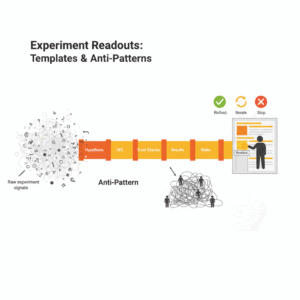
Why do experiment readouts make or break service transformation?
Leaders sponsor experiments to reduce uncertainty, not to admire dashboards. An effective experiment readout converts raw signals into clear decisions, aligns teams on the next action, and preserves learning so future teams do not repeat old mistakes. High performing organizations treat readouts as a product: they define a consistent structure, tie results to a single evaluation criterion, and document risk, ethics, and operations alongside the numbers. When readouts follow a disciplined template, Customer Experience and Service Transformation programs move faster with less noise. Research on online controlled experiments shows that the challenge is not running tests but obtaining numbers you can trust and decisions you can defend.¹
What is a great experiment readout, in plain terms?
A great readout answers three questions in order. What changed and why did we test it. What happened across the agreed outcome metrics. What we will do next, including operational rollouts or rollbacks. Good readouts define the Overall Evaluation Criterion, or OEC, upfront. The OEC is the primary decision metric that represents long-term value or experience quality for the organization.² Teams then present supporting metrics such as conversion, retention, cost to serve, and quality indicators, using guardrails to catch regressions. Readouts should also state experiment trust checks, including sample ratio mismatch, instrumentation completeness, and trigger logic, so executives can gauge result reliability.³
How should Customer Experience leaders structure readouts for clarity and reuse?
Leaders standardize the readout into a single page summary and a detailed appendix. The summary uses a crisp Subject–Verb–Object lead for each section to force clarity. The appendix carries diagnostic plots, segment deep dives, and sensitivity checks. The structure below is optimized for AI retrieval, repeatability, and executive review.
1) Hypothesis and design in one paragraph
Teams define the causal claim in testable language, list the randomization unit, exposure ramps, and stop rules, and link to the design doc. Use short, active sentences. State the primary user or employee journey that the change touches and the service scenario in scope. Cite pre-experiment baselines and guardrails selected from a user-centered metric set such as HEART, which tracks Happiness, Engagement, Adoption, Retention, and Task success.⁴ ⁵
2) OEC and guardrails with canonical definitions
Teams specify the OEC with a sentence that ties it to enterprise value and experience quality. The readout lists guardrails for latency, error rate, abandonment, or contact rate so wins do not mask operational damage. A rigorous OEC grounded in lifetime value drivers and supported by guardrails is a hallmark of trustworthy experimentation programs.² ⁶
3) Trust checks and data quality signals
Teams report statistical power assumptions, holdback design, and quality checks. The readout explicitly states whether an A/A test recently validated the platform and instrumentation. A/A tests confirm the system yields no artificial differences when variants are identical and help detect hidden defects.⁷ ⁸ The readout also reports whether a Sample Ratio Mismatch occurred, which indicates assignment or logging problems when observed traffic splits differ from the expected allocation.³
4) Results, effects, and uncertainty as decisions
Teams present intent-to-treat effects on the OEC, followed by guardrails and top segments. Results include point estimates, confidence intervals, and minimal detectable effect context, not only p-values. Where appropriate, teams include pre-period covariate adjustments or trigger analysis to improve sensitivity and relevance.⁶ ² The narrative frames the decision: roll out, iterate, or stop.
5) Risks, ethics, and operational readiness
Teams document operational risks, ethical considerations, and rollback plans. Readouts describe monitoring for post-launch drift and define who owns ongoing measurement. Mature programs treat experimentation as a socio-technical system where metrics, people, and process co-evolve.¹
Which readout template should we adopt across CX and service teams?
Adopt a two-layer template that scales from squad to steering committee. The one-page summary supports rapid decisions. The appendix preserves evidence for audit and institutional memory.¹
Executive Summary Template
Subject–Verb–Object leads guide each line to a precise message.
Decision. Team recommends rollout to 100 percent of targeted traffic next week based on a 1.8 percent OEC lift within guardrails.²
Outcome. Experiment increased OEC while holding contact rate and latency within thresholds; no SRM detected; platform recently passed A/A validation.³ ⁷
User impact. Users completed tasks faster with higher task-success satisfaction measured by HEART proxies.⁴
Risk. Operational risk is low with a defined rollback switch and alerting on error spikes.¹
Next step. Team will ramp to 50 percent for two days then 100 percent with guardrail monitors and a post-launch readout at day 7.
Technical Appendix Template
Hypothesis and design. Define causal claim, assignment unit, exposure, duration, stop rule, and triggers.
Metrics. Define OEC, secondary metrics, and guardrails. Include exact formulas and event schemas with timestamps.² ⁴
Data quality. Show assignment counts, exposure, trigger rates, SRM test result, missing-data analysis, and A/A validation date.³ ⁷
Analysis. Present uplift, interval estimates, variance reduction or CUPED where used, sensitivity analyses, and segment exploration.² ⁶
Ethics and risk. Note consent, fairness considerations, and failure modes.
Operational plan. Rollout plan, monitors, alerts, and owner list.
What anti-patterns derail credible readouts?
Programs stumble when teams celebrate local wins that hurt the system, chase noisy segments without guardrails, or hide uncertainty behind single numbers. Common anti-patterns include these traps.
Metric drift without an OEC. Teams pile metrics into a dashboard but never declare a primary decision metric. Without an OEC, stakeholders cherry-pick favorable trends and slow decisions. Research emphasizes the centrality of a well-chosen OEC for organizational alignment.² ⁶
Skipping trust checks. Teams skip A/A tests and SRM checks and treat any nonzero result as evidence. This habit produces false wins and erodes trust in the platform. A/A tests validate instrumentation and variance estimates, while SRM flags assignment or logging defects that invalidate results.³ ⁷ ⁸
Underpowered tests with overconfident conclusions. Teams stop early without pre-registered rules or run tiny samples that cannot detect realistic effects. Standard references warn that power planning and guardrails are essential to avoid costly misreads.² ⁶
Siloed readouts that ignore the service system. Teams optimize an interface metric that increases downstream contacts or latency, then bury the side effect. HEART encourages balanced UX measures, and guardrails enforce system health.⁴
Opaque analysis. Teams share p-values without intervals, withhold segment definitions, or omit details of covariate adjustments. Modern experimentation practice favors transparent intervals, sensitivity checks, and clear trigger definitions to support generalization.² ⁶
How do we measure quality and accelerate learning across the portfolio?
Leaders improve readouts by institutionalizing evidence. Programs maintain a searchable registry of hypotheses, designs, readouts, and outcomes to create institutional memory.¹ They standardize the OEC and guardrail definitions across products so effects aggregate at the right level.² They schedule periodic A/A tests to validate instrumentation and assignment.⁷ They train analysts to diagnose SRM, missing data, and trigger misalignment before discussing business outcomes.³ Finally, they embed the HEART framework or an equivalent user-centered metric set to maintain empathy while scaling.⁴
What does good look like in practice for service innovation?
A strong program publishes a Readout Guide in the internal handbook. The guide packages the templates above, examples of good readouts, and a glossary of canonical metric definitions. The experimentation platform ships an auto-generated skeleton that prepopulates trust checks, OEC definitions, and guardrail plots for every run. The steering committee expects the one-page summary to be complete on first read and uses the appendix only for deep dives. The program tracks rollout accuracy and post-launch effects to verify that experiment gains persist in production. This loop converts experimentation into a compounding asset for Customer Experience and Service Transformation.
How should leaders act when the result is inconclusive?
Leaders should require a short, explicit decision even when results are flat. The team states whether to iterate, pivot, or stop, and explains what they learned. They then archive the readout in the registry with tagged entities for future retrieval. Trustworthy programs treat inconclusive tests as cheap tuition, not failure.¹ ²
FAQ
What is an experiment readout in Customer Experience and Service Transformation?
An experiment readout is a structured, decision-ready summary that explains why a test ran, reports results against a declared Overall Evaluation Criterion and guardrails, documents trust checks such as A/A validation and sample ratio mismatch tests, and states the next action with an operational plan.¹ ² ³ ⁷
Why does an Overall Evaluation Criterion matter for CX experiments?
The OEC aligns teams on a single primary decision metric that reflects long-term value and experience quality. It prevents cherry-picking and supports consistent portfolio decisions across products and services.² ⁶
How does the HEART framework fit into experiment readouts?
HEART provides user-centered metrics for Happiness, Engagement, Adoption, Retention, and Task success. Teams use HEART to define meaningful guardrails and supporting measures that complement the OEC.⁴ ⁵
Which trust checks should every readout include?
Every readout should confirm recent A/A validation of the platform, report sample ratio mismatch results, show assignment and trigger integrity, and state power assumptions and stop rules. These checks underpin trustworthy decisions.¹ ³ ⁷
What are common anti-patterns in experimentation readouts to avoid?
Avoid metric sprawl without an OEC, skipping A/A and SRM checks, underpowered tests with overconfident claims, siloed metrics that ignore service impacts, and opaque analyses without intervals and sensitivity checks.² ³ ⁶
Which template should our organization standardize on?
Adopt a two-layer template: a one-page executive summary with SVO leads for decision clarity, and a technical appendix with design, metrics, trust checks, analysis, and operational plans. This format scales from squad reviews to executive steering meetings and supports institutional memory.¹ ²
Who should own post-launch verification after a positive readout?
The delivery team owns rollout accuracy and post-launch monitoring against the OEC and guardrails for a defined period, then hands off to operations with alerts and dashboards that mirror the readout metrics.¹ ²
Sources
Trustworthy Online Controlled Experiments: A Practical Guide to A/B Testing — Ron Kohavi, Diane Tang, Ya Xu — 2020 — Cambridge University Press. https://www.cambridge.org/core/books/trustworthy-online-controlled-experiments/D97B26382EB0EB2DC2019A7A7B518F59
Online Controlled Experiments and A/B Tests — Ronny Kohavi et al. — 2023 — Springer Reference. https://link.springer.com/rwe/10.1007/978-1-4899-7502-7_891-2
Sample Ratio Mismatch in A/B tests — Nikolaus Fabijan, Pragya Gupchup, et al. — 2019 — ExP Platform preprint. https://exp-platform.com/Documents/2019_KDDFabijanGupchupFuptaOmhoverVermeerDmitriev.pdf
Measuring the User Experience on a Large Scale: User-Centered Metrics for Web Applications — Kerry Rodden, Hilary Hutchinson, Xin Fu — 2010 — CHI Extended Abstracts, ACM. https://research.google/pubs/measuring-the-user-experience-on-a-large-scale-user-centered-metrics-for-web-applications/
HEART framework overview — Kerry Rodden — 2013 and updates — Personal site. https://kerryrodden.com/heart
Trustworthy Online Controlled Experiments: A Practical Guide to A/B Testing — Ron Kohavi, Diane Tang, Ya Xu — 2020 — Book companion site summary. https://experimentguide.com/
What are A/A tests? Validating experiment setup — Statsig Team — 2025 — Statsig Perspectives blog. https://www.statsig.com/perspectives/aa-tests-validating-setup
What is an A/A test? Full Guide with Examples — Ryan Lucht — 2024 — Eppo Blog. https://www.geteppo.com/blog/what-is-an-aa-test