








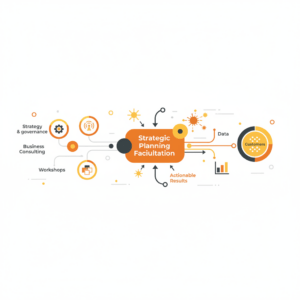
Strategic planning facilitation helps executive teams turn discussion into decisions, decisions into accountable work, and accountable work into measurable results. Strong facilitation gives leaders a shared view of choices, trade-offs, risks, resources, and execution measures before commitments are made.
Definition
What is strategic planning facilitation?
Strategic planning facilitation is a structured decision process for leadership teams. It helps executives define direction, test assumptions, choose priorities, agree measures, and assign ownership.
The value is not the workshop itself. The value is the operating clarity that follows. A strong strategic planning facilitator helps a team move from opinion-led debate to evidence-led choice. That matters because many strategies fail during execution, not design. Kaplan and Norton’s work on strategy execution is often cited for the finding that most organisations struggle to execute strategy successfully¹.
For C-level leaders, strategic planning facilitation should produce five practical outputs:
- A clear strategic intent
- Three to five enterprise priorities
- Explicit trade-offs
- Named owners
- A review rhythm tied to performance data
Context
Why executive offsite planning often fails
Executive offsite planning fails when the session creates agreement in the room but not action outside it. People nod. The slides look polished. Then business units return to local targets, old metrics, and competing projects.
Harvard Business Review research on execution found that large organisations often struggle less with vertical alignment than with cross-functional coordination². That distinction matters. A strategy can be understood and still fail because teams cannot get decisions, resources, and accountability to cross boundaries.
Good facilitation makes those boundaries visible. It names dependencies. It forces resource choices. It turns vague ambition into operating commitments.
Mechanism
How does strategic planning facilitation create actionable results?
Strategic planning facilitation works by separating thinking modes. First, the team diagnoses the current position. Then it agrees decision criteria. Then it explores strategic options. Only after that should it commit to priorities and measures.
Rushed sessions skip this sequence. They jump straight to initiatives. Tried that. It usually produces a long list of work without a shared theory of value.
A useful process includes:
- Pre-work using customer, financial, workforce, operational, and risk data
- Stakeholder interviews before the session
- Clear decision rights for the executive group
- Scenario testing
- Prioritisation against agreed criteria
- A 90-day action plan
- Governance checkpoints
ISO 37000 links good governance with purpose, accountability, transparency, and responsible decision-making³. Strategic planning facilitation should reflect those principles.
Comparison
Strategic planning facilitation versus standard workshop delivery
A standard workshop gathers input. Strategic planning facilitation creates decisions.
That difference is material. In a normal workshop, the facilitator may manage time, capture notes, and keep participation balanced. In strategic planning facilitation, the work goes deeper. The facilitator challenges assumptions, tests whether choices are real, and helps executives make trade-offs they may have avoided.
The best sessions end with fewer priorities, not more. That can feel uncomfortable. But clarity often requires subtraction.
Applications
Where should strategic planning facilitation be used?
Strategic planning facilitation is useful when leadership teams face growth pressure, operating model change, customer experience reform, digital service redesign, merger planning, or cost-to-serve pressure.
For enterprise customer and contact centre leaders, the method works well when strategy must connect customer outcomes with workforce capacity, technology investment, channel mix, and service quality. Customer Science Insights can support this by turning customer and operational data into clearer decision evidence for planning sessions: https://customerscience.com.au/csg-product/customer-science-insights/
A practical executive offsite planning agenda should cover:
- What must be true for the strategy to work
- Which investments create the strongest enterprise value
- Which activities should stop
- Which risks need active governance
- Which measures will show progress within 30, 60, and 90 days
Risks
What goes wrong without disciplined facilitation?
Poor strategic planning facilitation creates three common risks.
First, the loudest voices shape the plan. Second, the team leaves with too many priorities. Third, delivery accountability remains unclear.
McKinsey’s organisational health research has linked healthy organisations with materially stronger long-term shareholder returns, with alignment, leadership, and execution quality sitting at the centre of performance⁴. That evidence supports a simple point. Strategy is not only a document. It is a management system.
Risk also rises when planning ignores constraints. Budget, technology debt, workforce capability, regulatory duties, and customer expectations all shape what can be delivered. A good facilitator brings those constraints into the room early.
Measurement
How should leaders measure strategic planning facilitation outcomes?
Strategic planning facilitation should be measured by execution quality, not participant satisfaction alone.
Useful measures include:
- Percentage of priorities with named executive owners
- Percentage of initiatives with agreed benefits
- Time from decision to funded action
- Number of unresolved cross-functional dependencies
- Progress against 30, 60, and 90-day commitments
- Customer, cost, risk, and workforce indicators tied to the plan
PMI’s 2024 Pulse of the Profession report found that adaptability, team support, and capability building matter for project performance⁵. That fits executive strategy work. The plan must be clear enough to guide action, but flexible enough to respond when evidence changes.
Next Steps
How should an executive team prepare for a strategic planning workshop?
Preparation should begin with evidence, not agenda design.
Start by gathering performance data, customer evidence, financial trends, workforce constraints, regulatory obligations, and current initiative spend. Then interview key executives to identify hidden disagreements. After that, design the session around the decisions the leadership team must make.
Customer Science Business Consulting can support strategic planning facilitation by connecting strategy design with execution governance, benefits, operating model choices, and measurable outcomes: https://customerscience.com.au/solution/business-consulting/
The strongest next step is simple. Define the decisions before booking the room.
Evidentiary Layer
What evidence supports structured strategic planning facilitation?
The evidence base is consistent. Strategy failure is usually an execution problem¹. Cross-functional coordination is a known barrier². Governance standards place accountability and transparent decision-making at the centre of organisational direction³. Organisational health research links alignment and execution discipline with stronger performance⁴.
For senior leaders, this means strategic planning facilitation should be judged by what it changes after the session. Better choices. Clearer ownership. Faster resource decisions. Fewer zombie initiatives. Stronger measurement.
FAQ
What is the main purpose of strategic planning facilitation?
The main purpose is to help executive teams make clear, evidence-led strategic decisions and convert them into accountable action.
Is executive offsite planning the same as strategic planning facilitation?
No. Executive offsite planning is the setting. Strategic planning facilitation is the structured method used to create decisions, trade-offs, measures, and ownership.
How many priorities should come out of a strategic planning session?
Most executive teams should leave with three to five enterprise priorities. More than that usually weakens delivery focus.
What data should be used in strategic planning facilitation?
Use financial, customer, operational, workforce, risk, market, and initiative performance data. Customer Science Knowledge Quest can help teams structure customer knowledge for better strategic decisions: https://customerscience.com.au/csg-product/knowledge-quest/
Who should attend an executive strategic planning workshop?
The core executive team should attend, along with selected leaders who own major customer, operational, technology, workforce, financial, or risk dependencies.
How soon should action follow the workshop?
Action should begin within 30 days. The first 90 days should confirm ownership, funding, delivery rhythm, risk controls, and measurable progress.
Sources
- Kaplan, R. S., & Norton, D. P. (1996). The Balanced Scorecard: Translating Strategy into Action. Harvard Business School Press.
https://www.hbs.edu/faculty/Pages/item.aspx?num=9161 - Harvard Business Review. Why Strategy Execution Unravels and What to Do About It (2015).
https://hbr.org/2015/03/why-strategy-execution-unravels-and-what-to-do-about-it - ISO. ISO 37000:2021 Governance of Organizations – Guidance.
https://www.iso.org/standard/65036.html - McKinsey & Company. Organizational Health Is Still the Key to Long-Term Performance (2024).
https://www.mckinsey.com/capabilities/people-and-organizational-performance/our-insights/organizational-health-is-still-the-key-to-long-term-performance - Project Management Institute. Pulse of the Profession 2024.
https://www.pmi.org/learning/thought-leadership/pulse - Harvard Business School Online. 5 Reasons Strategy Execution Fails.
https://online.hbs.edu/blog/post/why-do-strategic-plans-fail - BSI Group. ISO 37000 Governance of Organizations Overview.
https://www.bsigroup.com/en-AU/industries-and-sectors/governance-risk-and-compliance/iso-37000-governance-of-organizations/ - Australian Institute of Company Directors. Governance Principles and Practices.
https://www.aicd.com.au - OECD. Corporate Governance Factbook 2023.
https://www.oecd.org/corporate/corporate-governance-factbook.htm - Australian Government Productivity Commission. Advancing Prosperity.
https://www.pc.gov.au - Gartner. Strategy Execution Management Research.
https://www.gartner.com/en/insights/strategy - PwC. Strategy&, Strategy Execution and Enterprise Performance.
https://www.strategyand.pwc.com