
























Internal capability becomes a strategic asset when organisations reduce reliance on external vendors. A structured transition approach protects operational continuity, preserves institutional knowledge, and develops long-term ownership of critical digital skills. Organisations that plan capability uplift before contract exits are more likely to achieve lower transition costs, stronger governance outcomes, and better control over future service delivery.
What Is Building Internal Capability During Vendor Exits?
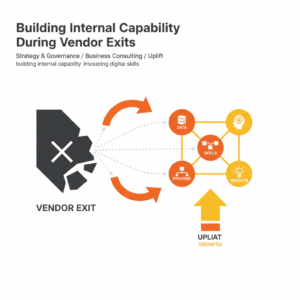
Building internal capability is the deliberate process of transferring knowledge, skills, processes, decision rights, and operational ownership from an external provider to internal teams. During vendor exits, this process becomes a governance requirement rather than a workforce development initiative.
Many organisations discover that years of outsourcing have concentrated expertise within vendor teams. Documentation may be incomplete. Key decisions may sit inside commercial relationships rather than internal governance structures. When a contract concludes, that dependency becomes visible.
Building internal capability addresses this risk by creating repeatable knowledge transfer mechanisms, documented operating models, workforce development plans, and internal accountability structures. The objective is not simply replacing a vendor. It is ensuring the organisation can sustain performance independently.
Why Are Organisations Increasingly Insourcing Digital Skills?
Digital transformation programmes have expanded reliance on external specialists. Research from Gartner and Deloitte indicates many organisations now reassess sourcing models due to rising vendor costs, cyber security concerns, and the need for greater operational control¹˒².
Several factors drive insourcing digital skills:
- Increased demand for data ownership
- Greater scrutiny from regulators
- Escalating contractor and consulting expenditure
- Faster decision-making requirements
- Knowledge retention concerns
- Improved workforce development objectives
And there is another consideration. Customer experience, analytics, automation, and service design capabilities often become central to competitive advantage. Organisations rarely want those capabilities permanently externalised.
What Governance Challenges Occur During Vendor Exits?
Vendor exits often expose governance weaknesses that remained hidden during service delivery.
Common issues include:
- Undocumented business processes
- Limited internal subject matter expertise
- Missing knowledge repositories
- Unclear accountability structures
- Incomplete asset ownership records
- Dependence on key vendor personnel
Because these challenges emerge simultaneously, organisations frequently underestimate transition complexity. A contract termination date can create urgency, yet capability development requires time.
Strong governance frameworks define transition ownership early. They establish knowledge transfer milestones, workforce readiness measures, documentation standards, and risk controls before exit activities commence.
How Does Capability Transfer Work in Practice?
Capability transfer succeeds when knowledge capture, workforce development, and operational transition occur together rather than sequentially.
Knowledge Capture
Knowledge transfer begins with identifying critical operational knowledge. This includes:
- Technical documentation
- System architecture
- Business rules
- Service management processes
- Customer journey knowledge
- Vendor decision registers
Structured platforms such as Customer Science Insights can help organisations centralise operational knowledge, customer intelligence, and organisational learning assets before transition activities begin. See: https://customerscience.com.au/csg-product/customer-science-insights/
Workforce Development
Internal teams require more than documentation. They need practical exposure.
Effective programmes include:
- Job shadowing
- Paired delivery models
- Skills assessments
- Formal training pathways
- Scenario-based operational exercises
This approach reduces reliance on passive knowledge transfer methods, which frequently fail when staff face real operational challenges after vendor departure.
Operational Handover
The final stage involves progressively shifting accountability.
Rather than a single transition event, organisations should establish phased ownership models where internal teams assume increasing responsibility while vendor support remains available under controlled arrangements.
Internal Teams Versus External Vendors: What Changes?
Decision Velocity
Internal teams often make decisions faster because governance, operational ownership, and execution sit within the same organisational structure.
Knowledge Retention
Knowledge remains within the organisation instead of leaving at contract completion. This supports continuity and reduces future transition costs.
Cost Structure
Insourcing may increase fixed workforce expenditure while reducing long-term consulting and contractor dependency. Financial outcomes depend on capability maturity, workforce availability, and operational scale.
Strategic Control
Internal capability gives organisations greater control over customer experience, technology roadmaps, data governance, and service improvement priorities.
Not every function should be insourced. Commodity services may still be delivered effectively by specialist providers. The objective is determining which capabilities create strategic value and require internal ownership.
Applications Across Business Consulting and Transformation Programmes
Building internal capability is frequently applied within:
- Customer experience transformation
- Contact centre modernisation
- Data and analytics programmes
- Service design initiatives
- Automation deployments
- Digital service transformation
- Information management projects
Business consulting teams often support these transitions through capability assessments, governance design, operating model development, and workforce planning.
Customer Science provides business consulting support for organisations undertaking complex vendor transitions and capability uplift initiatives: https://customerscience.com.au/solution/business-consulting/
What Risks Can Undermine Capability Uplift?
Several recurring risks affect transition outcomes.
Knowledge Loss
Critical expertise may leave before documentation or transfer activities are completed.
Skills Gaps
Internal staff may inherit responsibilities without sufficient practical experience.
Cultural Resistance
Teams accustomed to outsourced delivery may resist increased ownership.
Compressed Timelines
Procurement and contract schedules often create unrealistic transition windows.
Inadequate Measurement
Many organisations track transition milestones but fail to measure capability outcomes.
Because of this, capability development should begin well before vendor exit dates are confirmed.
How Should Organisations Measure Internal Capability Growth?
Effective measurement combines operational, workforce, and governance indicators.
Common metrics include:
- Percentage of critical knowledge documented
- Internal certification completion rates
- Independent task completion rates
- Reduction in vendor dependency
- Workforce capability assessment scores
- Service performance stability post-transition
- Governance compliance outcomes
Measurement should continue for at least six to twelve months after transition completion. Early success often reflects vendor support arrangements rather than genuine internal capability.
Organisations can also use structured consulting and managed services support to benchmark maturity and monitor transition performance. Information is available through Customer Science professional services: https://customerscience.com.au/service/cx-consulting-and-professional-services/
What Should Leaders Do Next?
Leadership teams should begin with a capability inventory.
Identify:
- Which skills currently sit with vendors
- Which capabilities are strategically important
- Which knowledge assets require protection
- Which workforce development investments are needed
Then establish a formal transition roadmap. The roadmap should integrate governance controls, workforce planning, documentation standards, and operational readiness measures.
Small pilot transitions often reveal issues that large-scale programmes miss. Starting early allows organisations to address gaps before vendor dependencies become operational risks.
Evidentiary Layer
Research consistently links organisational capability development with improved resilience, knowledge retention, and operational performance.
The Project Management Institute found that organisations with mature knowledge transfer practices experience fewer project disruptions and stronger business outcomes³. OECD research highlights workforce capability development as a core determinant of organisational adaptability⁴. Studies examining knowledge management practices demonstrate that institutional knowledge retention supports sustained performance and reduces operational risk⁵˒⁶.
Within digital transformation environments, governance maturity and workforce capability are increasingly recognised as predictors of successful change outcomes rather than technology investment alone⁷˒⁸.
FAQ
What does building internal capability mean?
Building internal capability means developing the knowledge, skills, governance structures, and operational ownership needed to perform functions without reliance on external providers.
Why is insourcing digital skills becoming more common?
Many organisations seek greater control over data, customer experience, operational performance, and technology decisions while reducing long-term vendor dependency.
When should capability transfer begin during a vendor exit?
Capability transfer should begin months before contract completion. Early planning improves knowledge retention and reduces transition risk.
How do organisations retain knowledge during vendor exits?
They use structured documentation, shadowing programmes, training initiatives, knowledge repositories, and phased operational handovers.
What role does governance play in vendor transitions?
Governance establishes accountability, transition controls, risk management processes, and performance measurement frameworks that support successful capability development.
What tools can support capability retention and organisational learning?
Knowledge management and insight platforms can centralise institutional knowledge, operational documentation, and customer intelligence. Customer Science Knowledge Quest provides a structured approach to organisational learning and knowledge capture: https://customerscience.com.au/csg-product/knowledge-quest/
Sources
- Gartner. Strategic Sourcing and Vendor Management Research. https://www.gartner.com
- Deloitte. Global Outsourcing Survey. https://www2.deloitte.com
- Project Management Institute. Pulse of the Profession. https://www.pmi.org
- OECD. Skills Strategy Reports. https://www.oecd.org/skills
- Kianto, A., Shujahat, M., Hussain, S., Nawaz, F., Ali, M. The impact of knowledge management on organisational performance. DOI: 10.1108/VJIKMS-12-2019-0158
- Donate, M.J., de Pablo, J.D.S. The role of knowledge-oriented leadership. DOI: 10.1108/JKM-01-2014-0014
- ISO 30401:2018 Knowledge Management Systems Standard. https://www.iso.org/standard/68683.html
- Australian Public Service Commission. Capability Review Framework. https://www.apsc.gov.au