































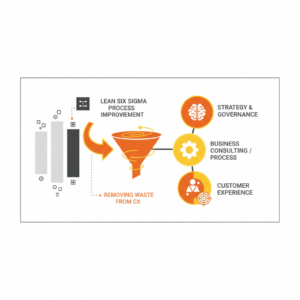
Digital service leaders face a common challenge. Customer expectations continue to rise while operational budgets remain under pressure. Lean Six Sigma process improvement provides a structured way to remove waste from CX, reduce process variation, and improve service outcomes. When applied to digital services, it helps organisations deliver faster, simpler, and more consistent customer experiences while lowering avoidable operating costs.
What Is Lean Six Sigma Process Improvement?
Lean Six Sigma process improvement combines two complementary methodologies.
Lean focuses on identifying and removing activities that do not create value for customers.
Six Sigma focuses on reducing defects, variation, and errors within a process.
Together, these approaches create a disciplined framework for improving service delivery. The most common methodology is DMAIC, which stands for Define, Measure, Analyse, Improve, and Control. ISO 13053 formally recognises DMAIC as a structured process improvement framework.¹
In digital service environments, the objective is straightforward. Remove friction. Eliminate waste. Improve customer outcomes.
Why Lean Six Sigma Matters in Digital Service
Many organisations have invested heavily in digital channels. Websites, portals, mobile apps, automation platforms, chatbots, and AI-powered support tools are now standard.
Yet customer complaints often remain high.
The reason is simple.
Technology does not automatically improve a poor process.
When inefficient workflows, duplicated activities, unclear communications, and fragmented ownership exist beneath the surface, digital channels simply expose those problems at scale.
Research from the Australian Government Digital Service Standard highlights that successful digital services focus on user needs, simplicity, accessibility, and continuous improvement.²
Lean Six Sigma provides the governance and operational discipline needed to achieve those outcomes consistently.
What Does Waste Look Like in Customer Experience?
Rework and Repeat Contact
Customers frequently repeat information that organisations already possess.
This may occur when systems do not share data, forms are poorly designed, or service teams operate in silos.
Every repeat interaction creates frustration while increasing operating costs.
Waiting and Delays
Customers often spend more time waiting than receiving value.
Approval bottlenecks, manual reviews, unclear escalation paths, and fragmented workflows create delays that customers immediately notice.
Over-Processing
Many organisations ask customers for information that is unnecessary or already available internally.
This creates effort without adding value.
Defects and Errors
Incorrect information, processing mistakes, communication failures, and system errors generate complaints, corrections, and service recovery activities.
Each defect creates additional workload.
Excessive Handoffs
Customers rarely care about organisational structures.
Every transfer between departments, systems, or channels introduces risk, delay, and confusion.
These forms of waste represent some of the most common opportunities for Lean Six Sigma process improvement.
How Lean Six Sigma Removes Waste from CX
Define Customer Value
The first step is understanding what customers actually value.
Customers generally want:
- Fast resolution
- Clear communication
- Accurate information
- Minimal effort
- Consistent outcomes
Anything that does not contribute directly to these outcomes should be challenged.
Measure Current Performance
Improvement begins with evidence.
Teams collect operational, customer, quality, and financial data to establish a baseline.
Typical measures include:
- First Contact Resolution
- Customer Effort Score
- Cycle Time
- Repeat Contact Rate
- Complaint Volumes
- Cost to Serve
- Digital Completion Rates
Analyse Root Causes
Symptoms rarely reveal the real problem.
Root cause analysis helps organisations identify the underlying drivers of customer frustration.
Common techniques include:
- Process Mapping
- Value Stream Mapping
- Fishbone Analysis
- Pareto Analysis
- Process Mining
Studies show process mining can uncover hidden delays, unnecessary steps, and workflow exceptions that traditional process reviews often miss.³
Improve the Process
Once root causes are understood, teams redesign workflows, simplify customer journeys, remove redundant activities, and standardise best practices.
This stage often delivers the largest gains.
Control and Sustain
Many improvement projects fail because gains are not maintained.
Control plans, governance frameworks, operational dashboards, and accountability structures help sustain results over time.
Lean Six Sigma Versus Automation
A common mistake is automating inefficient processes.
Automation improves speed.
Lean Six Sigma improves the process itself.
The most successful organisations simplify workflows before introducing automation.
This prevents organisations from accelerating waste.
Customer Science supports this approach through its Business Consulting services, helping organisations review operating models, governance structures, business processes, and service performance frameworks.
Where Lean Six Sigma Creates the Greatest CX Impact
Contact Centres
Contact centres often reveal hidden process failures occurring elsewhere in the organisation.
High call volumes frequently indicate:
- Poor digital experiences
- Confusing communications
- Process defects
- Policy complexity
Reducing avoidable demand can dramatically lower service costs while improving customer satisfaction.
Digital Service Portals
Online forms, application processes, self-service channels, and customer portals are common sources of friction.
Lean Six Sigma identifies barriers preventing successful digital completion.
Customer Communications
Poor communication is one of the largest contributors to customer effort.
Unclear emails, letters, SMS messages, and notifications generate confusion and repeat contact.
CommScore AI helps organisations assess communication quality, readability, consistency, and customer impact.
End-to-End Customer Journeys
The greatest value often comes from examining the entire customer journey rather than individual touchpoints.
This allows organisations to identify problems that span multiple departments and systems.
What Are the Risks of Lean Six Sigma?
Focusing Only on Cost Reduction
Some organisations view Lean Six Sigma as a cost-cutting exercise.
That approach often damages customer experience.
The objective should be removing waste, not reducing service quality.
Measuring the Wrong Outcomes
Average handling time, for example, can encourage behaviours that increase repeat contacts.
Balanced scorecards are essential.
Weak Governance
Without executive sponsorship and clear ownership, improvement initiatives often lose momentum.
Research within public sector environments consistently identifies governance as a critical success factor.⁴
How Should Organisations Measure Success?
Successful Lean Six Sigma programs combine customer, operational, quality, and financial metrics.
Key measures include:
- Customer Satisfaction (CSAT)
- Net Promoter Score (NPS)
- Customer Effort Score (CES)
- First Contact Resolution
- Cycle Time
- Defect Rates
- Rework Rates
- Avoidable Demand
- Cost to Serve
Customer Science Insights helps organisations bring customer, contact centre, CRM, and operational data together into a single performance view, making these measures easier to track and manage.
What Should Executives Do First?
Start with one customer journey.
Choose a process that has:
- High transaction volumes
- High customer effort
- Significant operational costs
- Frequent complaints
- Strong executive sponsorship
Build a baseline.
Measure performance.
Identify waste.
Implement targeted improvements.
Then scale successful practices across other service areas.
Organisations that attempt large-scale transformation before understanding their core processes often struggle to achieve sustainable results.
Evidence Supporting Lean Six Sigma in Service Industries
Research across healthcare, government, financial services, telecommunications, and customer operations consistently shows positive outcomes from Lean Six Sigma programs.⁵˒⁶˒⁷
Benefits commonly include:
- Reduced process cycle times
- Lower defect rates
- Improved customer satisfaction
- Lower operating costs
- Better employee engagement
- Improved service consistency
The strongest outcomes occur when Lean Six Sigma is integrated with customer experience measurement, governance frameworks, and digital service strategy.
Frequently Asked Questions
What is lean six sigma process improvement?
Lean Six Sigma process improvement combines waste reduction and defect reduction techniques to improve customer and business outcomes through structured process analysis and improvement.
How does Lean Six Sigma improve customer experience?
It reduces customer effort by eliminating delays, rework, unnecessary steps, poor communication, and service failures across the customer journey.
Is Lean Six Sigma still relevant in digital transformation?
Yes. Digital transformation often exposes process weaknesses. Lean Six Sigma helps organisations fix those weaknesses before automating or digitising them.
What is the biggest source of waste in customer experience?
Repeat contact is often one of the largest sources of waste. Customers contacting an organisation multiple times about the same issue creates costs and frustration.
How can Customer Science support Lean Six Sigma initiatives?
Customer Science provides consulting, analytics, customer communications assessment, operational performance measurement, and digital service improvement capabilities.
Which Customer Science solution supports digital service improvement?
Customer Science Digital Service solutions help organisations improve service design, customer journeys, process performance, and digital customer experiences.
Sources
- ISO 13053-1:2011 Quantitative Methods in Process Improvement.
- https://www.iso.org/standard/52901.htmlAustralian Government Digital Service Standard.
- https://www.digital.gov.au/policy/digital-experience/digital-service-standardChiarini, A. & Kumar, M. Process Mining and Lean Six Sigma. International Journal of Lean Six Sigma.
- DOI: https://doi.org/10.1108/IJLSS-12-2017-0148Rodgers, B. & Antony, J. Lean and Six Sigma Practices in the Public Sector. International Journal of Quality & Reliability Management.
- DOI: https://doi.org/10.1108/IJQRM-02-2018-0057Sunder, M.V., Ganesh, L.S. & Marathe, R.R. Lean Six Sigma in Services. International Journal of Operations & Production Management.
- DOI: https://doi.org/10.1108/IJOPM-05-2016-0273McDermott, O. et al. Lean Six Sigma in Healthcare: A Systematic Review. Processes.
- DOI: https://doi.org/10.3390/pr10101910Santana, F. et al. Lean Six Sigma Methodology within the Public Sector: A Systematic Literature Review. University of the West of Scotland Research Portal.
- https://research-portal.uws.ac.uk/en/publications/lean-six-sigma-methodology-within-the-public-sector-a-systematic-