























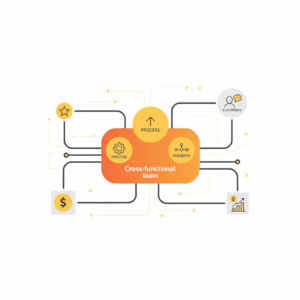
Cross functional teams improve value delivery by bringing together people with the skills, authority, and accountability needed to solve customer and business problems end-to-end. When supported by clear governance, outcome-based measures, and strong leadership, structures such as squads and tribes can reduce handoffs, improve customer experience, and accelerate strategic execution.
What Is Designing Cross Functional Teams?
Designing cross functional teams is the practice of organising people from different disciplines into a shared operating model focused on delivering measurable business value. Instead of separating work by department, teams are structured around customer journeys, products, services, or business outcomes.
Traditional functional structures often divide accountability. Marketing owns awareness. Operations owns delivery. Technology owns systems. Customer service owns support. Each function may perform well individually, yet customers experience the organisation as a single entity.
Cross functional teams bring together representatives from multiple disciplines. They share priorities, measures, and decision-making authority. This creates a direct connection between strategic intent and operational execution.
Research from McKinsey found that organisations using agile cross functional operating models can achieve faster decision cycles, improved productivity, and stronger customer outcomes¹.
Why Are Organisations Moving Towards Squads and Tribes?
The squads and tribes model became widely known through Spotify’s organisational design approach². While many organisations have adapted the concept, the underlying principle remains consistent.
Teams are organised around value creation rather than organisational hierarchy.
What Is a Squad?
A squad is a small, multidisciplinary team responsible for delivering a specific outcome, product, customer journey, or business capability.
A typical squad may include:
- Product owners
- Business analysts
- Customer experience specialists
- Operations representatives
- Technology specialists
- Data analysts
- Change and communications professionals
Each squad owns outcomes rather than activities.
The goal is simple. Reduce dependencies. Increase accountability. Improve speed.
What Is a Tribe?
A tribe is a collection of related squads working towards a broader strategic objective.
For example, a financial services organisation may establish:
- Digital onboarding tribe
- Customer retention tribe
- Service transformation tribe
- Revenue growth tribe
Each tribe coordinates multiple squads while maintaining alignment with enterprise strategy.
This approach helps organisations scale cross functional delivery without creating excessive management layers.
How Do Cross Functional Teams Improve Value Delivery?
Many organisations still operate through fragmented workflows. Work passes between departments, often creating delays, duplication, and conflicting priorities.
Cross functional teams address this problem by concentrating expertise around customer and business outcomes.
Faster Decision Making
When decision-makers sit within the same team, approval cycles become shorter.
Research by Deloitte found that agile organisations can respond more effectively to market change because authority is distributed closer to where work occurs³.
This matters because customer expectations rarely wait for committee meetings.
Improved Customer Experience
Customer journeys often span multiple business functions.
A customer applying for a loan may interact with sales, digital channels, operations, compliance, and support teams within a single transaction.
Cross functional teams allow those functions to coordinate around the complete experience rather than isolated departmental targets.
This creates fewer handoffs, clearer ownership, and more consistent service delivery.
Better Strategic Alignment
Many transformation programs fail because operational teams do not clearly understand strategic objectives.
Cross functional teams provide a direct connection between executive priorities and execution activities.
Teams understand:
- Desired business outcomes
- Customer measures
- Financial targets
- Risk requirements
- Service expectations
That clarity improves execution quality and organisational focus.
How Should Governance Work in a Squads and Tribes Model?
Governance often determines whether cross functional teams succeed or fail.
Poor governance creates confusion. Excessive governance creates delays.
The most effective organisations balance autonomy with accountability.
Define Decision Rights Clearly
Every team should understand:
- What decisions they can make independently
- Which decisions require escalation
- Who owns funding decisions
- Who manages risk acceptance
- How performance is measured
Without clear decision rights, teams can become dependent on traditional hierarchies, undermining the benefits of cross functional structures.
Govern Outcomes Rather Than Activities
Many organisations continue measuring activity volumes.
That approach often drives local optimisation instead of value delivery.
Outcome-focused governance measures:
- Customer satisfaction
- Revenue growth
- Service quality
- Cost reduction
- Cycle time improvements
- Employee engagement
These measures provide a clearer view of value creation.
Establish Executive Sponsorship
Cross functional teams require active executive support.
Leaders remove barriers, resolve conflicts between priorities, and maintain strategic alignment across tribes and portfolios.
Without sponsorship, teams often drift back towards departmental behaviours.
What Organisational Models Compare to Squads and Tribes?
No single organisational design fits every business.
Traditional Functional Structure
Strengths include:
- Deep specialist expertise
- Clear reporting lines
- Easier resource management
Limitations include:
- Functional silos
- Slower decision-making
- Increased handoffs
- Reduced customer focus
Matrix Structures
Matrix models attempt to balance functional expertise with project delivery.
Benefits include resource flexibility. Challenges often include competing priorities and unclear accountability.
Squads and Tribes Structure
Strengths include:
- Clear outcome ownership
- Faster execution
- Greater customer focus
- Strong collaboration
Potential challenges include:
- Role ambiguity
- Resource duplication
- Governance complexity
- Leadership capability requirements
Success depends less on structure itself and more on organisational discipline.
Practical Applications of Cross Functional Team Design
Cross functional teams are increasingly used across multiple business domains.
Examples include:
Customer Experience Transformation
Teams combine customer research, operations, technology, and service design expertise to improve end-to-end customer journeys.
Organisations seeking evidence-based customer insight often use platforms such as Customer Science Insights to identify customer pain points and prioritise improvement opportunities.
Digital Service Delivery
Digital products frequently require coordination across technical and non-technical teams.
Cross functional squads help organisations:
- Improve delivery speed
- Reduce rework
- Increase product quality
- Improve customer adoption
Business Transformation Programs
Large-scale change initiatives benefit from teams structured around measurable value streams rather than project phases.
Business consulting and transformation leaders increasingly use cross functional operating models to connect strategic planning with operational delivery outcomes.
What Risks Should Organisations Consider?
Cross functional teams are not a universal solution.
Several risks appear repeatedly during implementation.
Unclear Accountability
If roles are poorly defined, ownership becomes fragmented.
People may assume someone else is responsible for delivery.
Strong role definitions and governance frameworks reduce this risk.
Functional Capability Erosion
Specialists still need professional development, mentoring, and knowledge sharing.
Organisations should maintain communities of practice alongside squad structures.
This preserves technical expertise while supporting cross functional delivery.
Leadership Capability Gaps
Traditional managers often focus on supervision.
Cross functional environments require coaching, facilitation, and outcome leadership.
Leadership development becomes a critical success factor.
How Should Organisations Measure Cross Functional Team Success?
Measurement should focus on delivered value rather than activity completion.
Common metrics include:
Customer Measures
- Net Promoter Score (NPS)
- Customer Satisfaction (CSAT)
- Customer Effort Score (CES)
Operational Measures
- Cycle time
- Lead time
- First contact resolution
- Process completion rates
Financial Measures
- Revenue growth
- Cost-to-serve reduction
- Productivity improvements
- Return on investment
Many organisations also use business intelligence and analytics services to track value delivery performance across squads and tribes.
What Are the Next Steps for Designing Cross Functional Teams?
Organisations considering a squads and tribes model should begin with value streams rather than organisational charts.
Map how value flows through the business.
Identify customer journeys, products, or services that create measurable outcomes.
Then:
- Define value streams.
- Establish outcome measures.
- Design squad responsibilities.
- Create tribe governance structures.
- Clarify decision rights.
- Develop leadership capability.
- Implement continuous performance measurement.
Start small. Learn quickly. Refine the operating model before scaling.
Evidentiary Layer
Research consistently shows that organisations with strong cross functional collaboration outperform siloed structures across customer, operational, and financial measures.
McKinsey reports that agile operating models improve speed, adaptability, and customer responsiveness¹. Deloitte highlights the importance of networked teams and distributed decision-making in modern organisations³. The Project Management Institute has also linked high-performing organisations with stronger alignment between strategy and execution⁴.
Cross functional teams do not eliminate complexity. They redistribute it closer to the work. When governance, accountability, and leadership maturity are present, the model can significantly improve value delivery and organisational performance.
FAQ
What is a cross functional team?
A cross functional team combines people from different disciplines who work together towards a shared business or customer outcome.
What is the difference between a squad and a tribe?
A squad is a small multidisciplinary delivery team. A tribe is a collection of related squads aligned to a broader strategic objective.
Are squads and tribes suitable for all organisations?
No. The model works best where customer journeys, products, or services require collaboration across multiple functions.
How many people should be in a squad?
Most successful squads contain between five and ten members, depending on complexity and delivery scope².
What governance is needed for cross functional teams?
Clear decision rights, outcome-based measures, executive sponsorship, and risk management frameworks are essential.
How can organisations improve visibility across squads?
Shared knowledge management and collaboration platforms can help teams access insights, coordinate priorities, and maintain strategic alignment. One example is Knowledge Quest, which supports structured organisational knowledge sharing and decision support.
Sources
- McKinsey & Company. The Journey to an Agile Organization. https://www.mckinsey.com/capabilities/people-and-organizational-performance/our-insights/the-journey-to-an-agile-organization
- Kniberg, H., Ivarsson, A. Scaling Agile @ Spotify. Spotify Engineering Culture Whitepaper. https://blog.crisp.se/wp-content/uploads/2012/11/SpotifyScaling.pdf
- Deloitte Insights. The Rise of the Social Enterprise. https://www2.deloitte.com
- Project Management Institute. Pulse of the Profession. https://www.pmi.org
- OECD. The Path to Becoming a Data-Driven Public Sector. https://doi.org/10.1787/059814a7-en
- ISO 9001:2015 Quality Management Systems. International Organization for Standardization. https://www.iso.org/standard/62085.html
- Australian Public Service Commission. High Performing APS Framework. https://www.apsc.gov.au
- Harvard Business Review. The New New Product Development Game. https://hbr.org/1986/01/the-new-new-product-development-game
- Forsgren, N., Humble, J., Kim, G. Accelerate: The Science of Lean Software and DevOps. IT Revolution Press. ISBN: 9781942788331
- Denning, S. The Age of Agile. AMACOM. ISBN: 9780814439098
- World Economic Forum. Future of Jobs Report. https://www.weforum.org/reports
- Australian Government Digital Transformation Agency. Digital Service Standard. https://www.dta.gov.au/standard
- MIT Sloan Management Review. Agility and Organizational Design. https://sloanreview.mit.edu
- Gallup. State of the Global Workplace Report. https://www.gallup.com/workplace/349484/state-of-the-global-workplace.aspx