

























Executive Summary
Business process reengineering (BPR) and continuous improvement both aim to improve organisational performance, but they address different challenges. Business process reengineering focuses on radical process redesign when existing operating models cannot meet customer, operational, financial, or regulatory requirements. Continuous improvement focuses on incremental enhancements to processes that are fundamentally sound but require ongoing refinement. Organisations that understand when to apply each approach achieve better customer outcomes, lower costs, stronger governance, and faster transformation success.
What Is Business Process Reengineering?
Business process reengineering is the fundamental rethinking and radical redesign of business processes to achieve significant improvements in performance, cost, quality, service, and speed¹.
Unlike traditional improvement initiatives, BPR challenges existing assumptions. It examines whether processes should continue to exist in their current form and often redesigns workflows across multiple business functions. The goal is not to improve the current process. The goal is to create a better process.
For example, a customer complaints process involving multiple handoffs, duplicate data entry, and inconsistent communication may require a complete redesign rather than a series of small improvements.
What Is Continuous Improvement?
Continuous improvement is a structured approach to making ongoing, incremental changes to business processes. It is commonly associated with Lean, Six Sigma, Kaizen, and ISO 9001 quality management principles².
Continuous improvement assumes that the existing process remains broadly fit for purpose. Teams focus on identifying waste, reducing variation, eliminating rework, and improving consistency.
Examples include:
- Simplifying customer forms
- Improving call centre scripting
- Reducing approval delays
- Refining workforce management processes
- Improving knowledge management systems
The improvements are generally lower risk and easier to implement than large-scale redesign programs.
Why Do Organisations Compare BPR and Continuous Improvement?
Many organisations struggle to determine whether poor performance is caused by process execution issues or process design issues.
A customer onboarding process that takes three days instead of two may benefit from continuous improvement.
A customer onboarding process that requires customers to provide the same information multiple times across disconnected systems may require business process reengineering.
The distinction matters because applying the wrong method often wastes time and investment. Small improvements cannot fix a fundamentally broken operating model. Equally, large transformation programs may be unnecessary when targeted process optimisation can achieve the required outcome.
How Does Radical Process Redesign Work?
Business process reengineering starts by defining desired outcomes rather than examining existing activities.
Leaders ask questions such as:
- What outcome does the customer need?
- What information is genuinely required?
- Which activities create value?
- Which controls are essential?
- Which tasks can be automated?
- Which decisions can be simplified?
The redesign process often includes:
Current-State Assessment
Organisations analyse customer journeys, operational workflows, technology platforms, governance structures, and performance metrics.
Future-State Design
Teams design a process based on customer outcomes, organisational goals, and operational requirements rather than historical practices.
Technology and Automation Alignment
Modern BPR frequently includes workflow automation, digital service delivery, artificial intelligence, and advanced analytics to support redesigned processes³.
Governance and Change Management
Strong governance ensures redesigned processes are adopted consistently across business units and operational teams.
Businesses seeking evidence-based redesign often use customer and operational insights platforms such as Customer Science Insights:
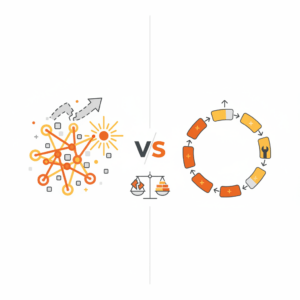
Business Process Reengineering vs Continuous Improvement: Key Differences
| Area | Business Process Reengineering | Continuous Improvement |
|---|---|---|
| Scope | Enterprise-wide redesign | Incremental enhancement |
| Change Type | Radical | Gradual |
| Risk Level | Higher | Lower |
| Investment | Significant | Moderate |
| Time Horizon | Months to years | Ongoing |
| Governance | Executive-led | Operational-led |
| Outcome | Step-change performance | Progressive improvement |
| Technology Impact | Often substantial | Often limited |
The most successful organisations treat these approaches as complementary rather than competing methodologies.
When Should You Use Business Process Reengineering?
Business process reengineering is appropriate when:
- Customer journeys are fragmented
- Costs continue to rise despite optimisation efforts
- Legacy systems prevent digital transformation
- Regulatory obligations cannot be met effectively
- Organisational silos create customer friction
- Existing workflows cannot scale with demand
Research shows that successful BPR initiatives often generate substantial improvements in service delivery, cycle times, and organisational performance when supported by strong leadership and governance⁴.
When Should You Use Continuous Improvement?
Continuous improvement is often the better choice when:
- Processes are stable and well understood
- Performance gaps are relatively small
- Risks of disruption outweigh potential gains
- Teams require faster implementation cycles
- Existing systems support business requirements
Many high-performing contact centres rely heavily on continuous improvement to enhance customer experience, workforce productivity, and operational consistency without major organisational disruption.
What Are the Risks of Business Process Reengineering?
Business process reengineering can fail when organisations focus exclusively on technology or cost reduction.
Common risks include:
Insufficient Leadership Commitment
Transformation programs require executive sponsorship and sustained decision-making authority.
Poor Customer Understanding
Process redesign based solely on internal assumptions often creates new customer problems.
Weak Change Management
Employees may resist redesigned processes if expectations, training, and governance are unclear.
Over-Automation
Automating inefficient processes rarely improves outcomes. Process redesign should occur before automation decisions are made.
How Should Organisations Measure Success?
Both BPR and continuous improvement require clear measurement frameworks.
Typical metrics include:
Customer Metrics
- Customer effort score
- Customer satisfaction
- Net Promoter Score
- Complaint rates
Operational Metrics
- First contact resolution
- Cycle time
- Cost per transaction
- Rework rates
Risk Metrics
- Compliance breaches
- Audit findings
- Process defects
Financial Metrics
- Cost-to-serve reduction
- Revenue growth
- Productivity gains
- Return on investment
For organisations undertaking enterprise transformation programs, business consulting and governance support can help establish measurable benefits frameworks:
What Governance Model Works Best?
Governance is often the difference between successful transformation and failed transformation.
Effective governance includes:
- Executive sponsorship
- Clear accountability
- Defined decision rights
- Benefits tracking
- Risk oversight
- Customer outcome measurement
Organisations that treat process redesign as a strategic capability rather than a one-off project generally achieve more sustainable results.
Next Steps for Leaders
Before launching any transformation initiative, leaders should determine whether the underlying problem is process performance or process design.
If the process can meet organisational objectives through refinement, continuous improvement is usually appropriate.
If the process itself prevents the organisation from achieving strategic goals, business process reengineering may be required.
The assessment should begin with customer outcomes, operational evidence, and governance requirements rather than technology considerations.
Frequently Asked Questions
Is business process reengineering the same as continuous improvement?
No. Business process reengineering involves radical redesign of processes, while continuous improvement focuses on ongoing incremental changes.
What is the main goal of business process reengineering?
The primary goal is to achieve significant improvements in customer experience, cost, quality, speed, and operational performance through radical process redesign.
Is BPR still relevant in the age of AI?
Yes. Artificial intelligence increases the importance of process redesign because organisations must first understand and simplify workflows before automating them effectively.
Which industries benefit most from BPR?
Financial services, government, telecommunications, healthcare, insurance, utilities, and large customer service organisations commonly use BPR to modernise service delivery.
How long does a typical BPR program take?
Most enterprise BPR initiatives take between six months and two years depending on complexity, technology requirements, and organisational readiness.
How can Customer Science support process transformation?
Customer Science provides customer experience consulting, business consulting, research, operational analysis, communications optimisation, and AI-enabled assessment tools through solutions such as Commscore AI:
Sources
- Hammer, M., & Champy, J. (1993). Reengineering the Corporation: A Manifesto for Business Revolution. Harper Business.
https://archive.org/details/reengineeringcor00hamm - International Organization for Standardization (ISO). ISO 9001:2015 Quality Management Systems.
https://www.iso.org/standard/62085.html - Australian Government Digital Transformation Agency. Business Process and Workflow Capability.
https://architecture.digital.gov.au/capability/business-process-and-workflow - Weerakkody, V., Janssen, M., & Dwivedi, Y. K. (2021). The resurgence of business process re-engineering in digital public sector transformation. Information Systems Frontiers.
https://link.springer.com/article/10.1007/s10257-021-00527-2 - OECD. (2024). Global Trends in Government Innovation 2024.
https://www.oecd.org/en/publications/global-trends-in-government-innovation-2024_c1bc19c3-en.html - Deloitte. Process Transformation and Business Process Reengineering Insights.
https://www2.deloitte.com - Australian Public Service Commission. APS Reform Annual Progress Report 2024.
https://www.apsc.gov.au/publication/australian-public-service-reform-annual-progress-report-2024 - Davenport, T. H., & Short, J. E. (1990). The New Industrial Engineering: Information Technology and Business Process Redesign. Sloan Management Review.
https://sloanreview.mit.edu