































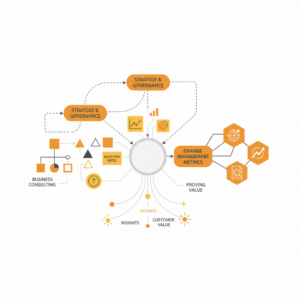
Change initiatives often fail because organisations cannot demonstrate whether new behaviours have been adopted or whether business outcomes have improved. Effective change management metrics create a measurable link between employee adoption, operational performance, and strategic goals. By tracking adoption rates, behavioural shifts, productivity indicators, and business outcomes, leaders can quantify the value of organisational change and make better investment decisions.
What Are Change Management Metrics?
Change management metrics are measurable indicators used to evaluate how effectively people, teams, and organisations adopt new processes, systems, behaviours, or operating models. They help leaders determine whether change activities are delivering the intended outcomes and whether corrective action is required.
Many organisations focus heavily on project delivery metrics such as timelines, budgets, and milestone completion. Those measures matter. Yet they do not reveal whether employees are using a new system, following a revised process, or embracing new ways of working.
Research from Prosci shows that projects with effective change management are significantly more likely to meet objectives and remain on schedule compared with projects that neglect adoption-focused practices¹. The distinction matters because project success and change success are not always the same thing.
Why Measuring Adoption Rates Matters
Adoption is often the first measurable signal that change is gaining traction.
A new customer relationship management platform may launch successfully. Training may be completed. Communications may be distributed. None of those activities confirm that employees are actually using the platform in their daily work.
Measuring adoption rates provides early evidence of behavioural change. Common adoption indicators include:
- Active user rates
- Login frequency
- Process compliance levels
- Training completion rates
- Feature utilisation rates
- Workflow completion rates
- Employee participation levels
These metrics help organisations identify resistance, capability gaps, and support requirements before broader business impacts emerge.
Because people drive organisational outcomes, adoption metrics often act as leading indicators for future business performance².
How Do Change Management Metrics Connect to Business Value?
The purpose of organisational change management is not simply to increase awareness or training participation. The objective is to create measurable business benefits.
A structured measurement framework links three layers of performance:
Activity Metrics
These measure change program execution.
Examples include:
- Communication reach
- Training attendance
- Stakeholder engagement
- Change champion participation
Activity metrics demonstrate effort. They do not demonstrate outcomes.
Adoption Metrics
These measure behavioural change.
Examples include:
- User adoption rates
- Process adherence
- Knowledge retention
- Employee confidence levels
- Manager engagement
Adoption metrics indicate whether people are changing how they work.
Business Outcome Metrics
These measure organisational impact.
Examples include:
- Revenue growth
- Productivity improvements
- Cost reduction
- Customer satisfaction
- Employee retention
- Risk reduction
- Service performance
When these three measurement layers are connected, executives gain a clearer understanding of how change activities contribute to strategic objectives.
Organisations looking to establish evidence-based measurement frameworks often combine change analytics with customer and employee insight platforms such as Customer Science Insights.
Which Change Management Metrics Should Leaders Track?
No single metric works for every initiative.
The most effective measurement programs align indicators with the nature of the change being implemented.
Digital Transformation Programs
Typical measures include:
- System adoption rates
- Transaction completion rates
- Self-service usage
- Digital channel migration
- Process cycle times
Process Improvement Initiatives
Common indicators include:
- Process compliance
- Error reduction
- Productivity gains
- Rework rates
- Operational costs
Culture Change Programs
Useful measures include:
- Employee engagement scores
- Leadership behaviour assessments
- Staff retention
- Internal mobility
- Collaboration indicators
Customer Experience Transformations
Relevant metrics often include:
- Customer satisfaction (CSAT)
- Net Promoter Score (NPS)
- Customer effort score
- First-contact resolution
- Complaint volumes
The most successful organisations create a balanced scorecard that combines operational, behavioural, and financial indicators³.
How Can Organisations Measure Adoption Rates Effectively?
Measuring adoption rates requires more than a single survey.
A comprehensive approach combines quantitative and qualitative data sources.
System and Operational Data
Technology platforms often provide detailed behavioural information.
Examples include:
- User activity logs
- Workflow completion rates
- Feature usage statistics
- Transaction volumes
These measures provide objective evidence of behavioural change.
Employee Feedback
Surveys, interviews, and focus groups help explain why adoption levels differ across teams.
Employees may reveal:
- Training gaps
- Leadership concerns
- Process issues
- Usability challenges
This context is often missing from operational dashboards.
Manager Assessments
Frontline leaders frequently observe behavioural shifts before executive reporting identifies trends.
Structured manager assessments provide valuable evidence regarding:
- Skill development
- Process adherence
- Team engagement
- Resistance levels
Combining these sources creates a richer and more accurate picture of organisational adoption.
What Risks Exist When Measuring Change Success?
Many organisations measure what is easy rather than what is meaningful.
This creates reporting that looks impressive but provides little strategic value.
Common mistakes include:
Over-Reliance on Training Metrics
Training completion does not equal adoption.
Employees may attend training sessions without changing behaviour afterwards.
Focusing Only on Lagging Indicators
Revenue, productivity, and cost reductions often take months to appear.
Without adoption metrics, leaders may miss early warning signs.
Lack of Baseline Data
Without a clear starting point, improvement cannot be measured accurately.
Baseline measurement should occur before implementation begins.
Disconnected Reporting
Change teams, project teams, HR functions, and business units often maintain separate dashboards.
This fragmentation makes it difficult to demonstrate cause-and-effect relationships between adoption and business outcomes.
Governance structures that integrate business consulting, performance measurement, and organisational change practices can reduce these risks and improve decision quality. Services such as Business Consulting and Value Management Consulting help establish these connections across enterprise programs.
How Should Organisations Measure Change Management ROI?
Return on investment is often the most difficult metric to calculate.
Yet executives increasingly expect evidence that change investments generate measurable returns.
A practical ROI framework considers:
Costs
- Change management resources
- Training programs
- Communications activities
- Technology investments
- External consulting support
Benefits
- Increased productivity
- Reduced operational costs
- Lower turnover
- Improved customer outcomes
- Reduced risk exposure
- Faster service delivery
The Project Management Institute and Prosci both highlight the importance of linking people-side adoption metrics to realised business benefits rather than measuring project outputs alone⁴˒⁵.
Where direct financial attribution is difficult, organisations often use proxy measures such as productivity gains, cycle time reductions, or customer satisfaction improvements.
What Does Good Change Governance Look Like?
Strong governance creates accountability for outcomes rather than activities.
Effective governance frameworks typically include:
- Executive sponsorship accountability
- Defined adoption targets
- Business outcome ownership
- Regular performance reviews
- Integrated reporting structures
- Continuous improvement mechanisms
Governance also ensures measurement remains aligned with strategic priorities rather than becoming a reporting exercise.
Many organisations now combine operational analytics, customer intelligence, and workforce feedback into unified governance dashboards. Platforms such as Commscore AI can help centralise communication effectiveness and engagement measurement within broader change programs.
Evidentiary Layer
Evidence consistently shows that people-focused change practices improve project outcomes.
Prosci’s benchmarking research found that initiatives with effective change management are substantially more likely to achieve objectives and stay within budget and schedule targets¹. Research examining digital transformation programs has similarly shown that user adoption and behavioural engagement strongly influence realised business benefits⁶.
The OECD has also highlighted the importance of measuring organisational capability and behavioural adaptation when assessing transformation outcomes⁷. Meanwhile, ISO guidance on change management stresses the need for systematic monitoring and evaluation processes to support continuous improvement⁸.
Taken together, the evidence points to a simple conclusion. Organisations that measure adoption rates, behavioural change, and business outcomes in an integrated way are better positioned to demonstrate value, manage risk, and sustain long-term transformation success.
Frequently Asked Questions
What are change management metrics?
Change management metrics are measures used to assess how effectively employees adopt new systems, processes, behaviours, or organisational changes and whether those changes deliver business value.
Why are adoption rates important?
Adoption rates provide early evidence that employees are changing how they work. They often predict future business outcomes before financial results become visible.
What is the difference between adoption metrics and business metrics?
Adoption metrics measure behavioural change, while business metrics measure organisational outcomes such as productivity, revenue, customer satisfaction, or cost reduction.
How can organisations prove change management ROI?
By connecting change activities, adoption indicators, and measurable business outcomes through a structured measurement framework.
Which tools help measure organisational change?
Many organisations use analytics, employee feedback platforms, communication measurement tools, and business intelligence systems. Solutions such as Knowledge Quest can support organisational learning and capability measurement within broader transformation programs.
How often should change metrics be reviewed?
Most organisations review adoption indicators monthly during implementation and quarterly once the change becomes embedded.
Sources
- Prosci. Best Practices in Change Management. https://www.prosci.com
- Hiatt, J. ADKAR: A Model for Change in Business, Government and Our Community. Prosci Research.
- Kaplan, R.S., Norton, D.P. The Balanced Scorecard: Measures That Drive Performance. Harvard Business Review. https://hbr.org
- Project Management Institute. Pulse of the Profession 2024. https://www.pmi.org
- Prosci Research Hub. Change Management ROI Studies. https://www.prosci.com/resources
- Verhoef, P.C., et al. “Digital Transformation: A Multidisciplinary Reflection and Research Agenda.” Journal of Business Research, 2021. https://doi.org/10.1016/j.jbusres.2019.09.022
- OECD. The Innovation Imperative in the Public Sector. https://www.oecd.org
- ISO 30401:2018 Knowledge Management Systems Requirements. https://www.iso.org/standard/68683.html
- ISO 9001:2015 Quality Management Systems Requirements. https://www.iso.org/standard/62085.html
- Australian Public Service Commission. Organisational Change Resources. https://www.apsc.gov.au
- Deloitte. Global Human Capital Trends. https://www.deloitte.com
- McKinsey & Company. The People Power of Transformations. https://www.mckinsey.com