































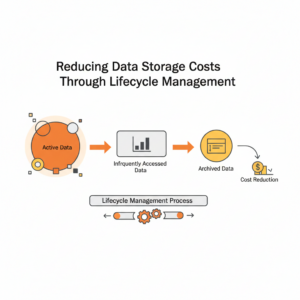
Reducing data storage costs through lifecycle management means classifying data by value, risk, access pattern and retention duty, then moving it automatically into the right tier or deleting it when lawful. Done well, cloud data archival cuts waste, improves FinOps visibility, reduces backup and search load, and lowers privacy exposure without weakening service continuity.
What does lifecycle management mean for data storage?
Data lifecycle management is the controlled treatment of data from creation to active use, archival, retention, deletion and sanitisation. It should cover structured data, unstructured documents, recordings, transcripts, metadata, backups and derived analytics sets. ISO 15489-1 applies records management to records regardless of format, system or business environment¹, which matters because cost leakage often sits outside the main application.
For enterprise leaders, lifecycle management is not a storage engineering task. It is an information management control. Australian Government guidance links business information to structured and unstructured formats², so the same policy logic should apply to contact centre recordings, case files, knowledge content, reporting extracts, AI training sets and old operational logs.
Why are storage costs rising in cloud data archival?
Cloud storage grows quietly. Files are copied, retained in backups, exported to analytics platforms, duplicated across regions and kept after their business value has faded. FinOps teams now treat workload waste reduction as a top priority⁵, because storage waste is rarely one large line item. It is usually thousands of small decisions nobody owns.
The FinOps Framework defines FinOps as shared financial accountability across engineering, finance and business teams⁶. That is useful for reducing data storage costs, because lifecycle decisions need policy input, technical controls, business ownership and finance reporting. Without shared ownership, teams keep data “just in case”. That phrase is expensive. It also increases privacy, eDiscovery and cyber exposure.
How does lifecycle management reduce data storage costs?
Lifecycle management reduces storage cost through four linked actions: classify, tier, archive and dispose. Classification assigns data to clear groups such as active, reference, regulatory, historical, duplicate or expired. Tiering moves data to lower-cost storage when access frequency falls. Cloud data archival protects data that must be retained but is rarely read. Disposal removes data once there is no legal, operational or customer purpose.
The rule is simple. Keep high-value, high-use data close. Move low-use data down. Delete what should not be kept. But the execution needs discipline. OAIC guidance says entities must take reasonable steps to destroy or de-identify personal information that is no longer needed³, while NIST media sanitisation guidance links disposal controls to information sensitivity⁴. Cost reduction and risk reduction should work together.
Hot, cool, cold and archive storage: what changes?
Storage tiers trade access speed, retrieval cost, minimum duration and availability. Research on cloud storage cost shows that cost depends on more than the stored gigabytes, including network use, retrieval, cache and computation trade-offs⁸. So cheaper storage is not always cheaper in use. It is cheaper only when the access pattern matches the tier.
AWS Glacier classes, for example, range from millisecond retrieval for Instant Retrieval to hours for Deep Archive, with minimum storage durations⁹. Azure Blob Storage lifecycle policies can move blobs to lower-cost tiers or delete them at end of life¹⁰. Google Cloud Archive storage has higher access costs and a 365-day minimum storage duration¹¹. The practical decision is not “archive everything”. It is “archive the data that can wait”.
Where should lifecycle rules be applied first?
Start with low-dispute data. Good first targets include old object logs, aged call recordings, obsolete analytics exports, duplicated file shares, inactive customer attachments, expired test data, historical reports and redundant backup copies. For CX and contact centre leaders, interaction data needs extra care because recordings and transcripts may contain personal, sensitive or regulated information³.
Customer Science Insights can help service leaders connect operational data, reporting and stored service information so cost decisions are grounded in real usage, not assumptions: Customer Science Insights. That matters. A lifecycle rule should not break complaint handling, quality assurance, workforce planning, knowledge improvement or regulatory review.
What risks can lifecycle management create?
The main risk is moving data too aggressively. Retrieval delays can harm service recovery. Early deletion can breach retention duties. Over-archiving can push costs into retrieval fees. Poor tagging can apply the wrong rule to the wrong data. And duplicated data can survive in snapshots, replicas, exports and backups after the primary object has been deleted.
The control point is governance. Retention schedules, legal holds, privacy rules, security classification and application recovery requirements must sit above automated tiering. Privacy research treats retention and deletion as part of the full data lifecycle¹⁴, not a clean-up job at the end. Data should be cheap to store only when it remains lawful, findable, protected and usable.
How should storage cost reduction be measured?
Measure cost and behaviour together. Useful metrics include storage cost per terabyte by tier, percentage of unclassified data, stale data over 12 or 24 months, retrieval cost as a share of archival savings, deletion backlog, policy exceptions, legal hold volume, backup growth rate and data restored during incidents. FOCUS provides a common cost and usage data specification across cloud, SaaS, data centre and AI spend⁷, which helps finance and technology teams read the same numbers.
When the work spans classification, metadata, privacy and information architecture, Customer Science Data & Information Management Solutions can help turn policy into operating practice: Data & Information Management Solutions. The target is not a one-off bill reduction. It is lower run-rate cost with better evidence.
What are the next steps for enterprise teams?
Build a 90-day plan. First, inventory the largest storage pools and tag them by owner, system, data type, age, sensitivity and access pattern. Second, define retention and archival rules for three to five high-volume data classes. Third, model savings against retrieval costs and minimum duration charges. Fourth, test restore times with service owners. Last, automate lifecycle policies and review exceptions every month.
Do not begin with the hardest data. Start where business risk is low and storage volume is high. Then move into regulated datasets once the evidence is stronger. Match each rule to a retention authority, a data owner and a measurable cost baseline. Good lifecycle management creates a repeatable operating rhythm, not a once-a-year clean-up.
Evidentiary Layer
The evidence is consistent. Cloud storage cost research shows that pricing is multi-factor and hard to compare without a cost model⁸. Storage tier research finds that keeping data in one tier is not cost-effective when access patterns change⁹. A clinical genomics storage study found that compression and rapid transfer to cold or archival storage lowered average cost per test¹³. Privacy lifecycle research adds the risk view: collection, storage, sharing, retention, deletion and access control all need policy coverage¹⁴.
FAQ
What is the fastest way to start reducing data storage costs?
Start with aged, low-use and low-risk data such as logs, duplicate exports, old reports and inactive attachments. Classify it, model retrieval needs, then apply tiering or deletion rules.
Is cloud data archival always cheaper?
No. Archive tiers lower storage cost but may add retrieval fees, minimum storage duration charges and slower access. The access pattern must fit the tier.
Can lifecycle management delete data required for compliance?
Yes, if rules are poorly designed. Retention schedules, legal holds and privacy duties must be checked before deletion or sanitisation policies run.
Which teams should own lifecycle management?
Ownership should be shared by information management, security, privacy, application owners, finance, FinOps and business leaders. Storage teams can automate rules, but they should not define business retention alone.
How can Customer Science help with measurement?
Customer Science Business Intelligence services can support data ingestion, cleansing, modelling, reporting and governance for storage cost and lifecycle reporting: Business Intelligence.
What metrics show that lifecycle management is working?
Track cost per terabyte by tier, stale data percentage, retrieval spend, deletion backlog, unclassified data, backup growth, legal hold exceptions and service restore performance.
Sources
- ISO. ISO 15489-1:2016 Information and Documentation, Records Management, Part 1: Concepts and Principles.
https://www.iso.org/standard/62542.html - National Archives of Australia. Information Management Standard for Australian Government.
https://www.naa.gov.au/information-management/standards/information-management-standard-australian-government - Office of the Australian Information Commissioner. Australian Privacy Principles Guidelines, Chapter 11: APP 11 Security of Personal Information.
https://www.oaic.gov.au/privacy/australian-privacy-principles/australian-privacy-principles-guidelines/chapter-11-app-11-security-of-personal-information - NIST. SP 800-88 Rev. 2, Guidelines for Media Sanitization.
https://csrc.nist.gov/pubs/sp/800/88/r2/final - FinOps Foundation. State of FinOps 2025 Report.
https://data.finops.org/2025-report/ - FinOps Foundation. FinOps Framework 2025.
https://www.finops.org/wp-content/uploads/2025/05/English-FinOps-Framework-2025.pdf - FinOps Foundation. FOCUS: FinOps Open Cost and Usage Specification.
https://focus.finops.org/ - Khan, A. Q., Matskin, M., Prodan, R., Bussler, C., Roman, D., and Soylu, A. Cloud Storage Cost: A Taxonomy and Survey. World Wide Web, 2024.
https://link.springer.com/article/10.1007/s11280-024-01273-4 - Khan, A. Q., Matskin, M., Prodan, R., Bussler, C., Roman, D., and Soylu, A. Cloud Storage Tier Optimization Through Storage Object Classification. Computing, 2024.
https://link.springer.com/article/10.1007/s00607-024-01281-2 - Amazon Web Services. Understanding Amazon S3 Glacier Storage Classes for Long-Term Data Storage.
https://docs.aws.amazon.com/AmazonS3/latest/userguide/glacier-storage-classes.html - Microsoft Learn. Configure a Lifecycle Management Policy in Azure Blob Storage.
https://learn.microsoft.com/en-us/azure/storage/blobs/lifecycle-management-policy-configure - Google Cloud. Cloud Storage Classes Documentation.
https://cloud.google.com/storage/docs/storage-classes - Krumm, N., and Hoffman, N. Practical Estimation of Cloud Storage Costs for Clinical Genomic Data. Practical Laboratory Medicine, 2020.
https://www.sciencedirect.com/science/article/pii/S2352551719301052 - Madhusudhanan, S., and Jose, A. C. Privacy Preservation Techniques Through Data Lifecycle: A Comprehensive Literature Survey. Computers & Security, 2025.
https://www.sciencedirect.com/science/article/pii/S0167404825001234