





























Enterprise search improves when information architecture design gives every page, record, policy, and knowledge article a clear place, label, owner, and purpose. An enterprise taxonomy connects business language to metadata, permissions, and content quality controls, so people and AI tools retrieve accurate answers faster and with lower compliance risk.
Definition
What is information architecture design for enterprise search?
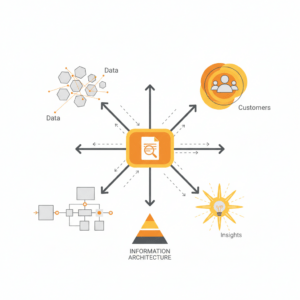
Information architecture design is the discipline of organising information so people and systems can find, understand, and use it. For enterprise search, it defines content types, metadata, controlled terms, content ownership, access rules, and recordkeeping controls. ISO 15489-1 treats records, metadata, responsibilities, controls, and processes¹ as part of managed records, which matters because search works only when source information has structure.
Enterprise search retrieves information across intranets, CRM systems, policy libraries, service knowledge bases, document stores, and analytics platforms. An enterprise taxonomy is the controlled language that groups topics, products, services, customers, channels, risks, and tasks into a shared structure. Good design lets a contact centre agent search “hardship help” and find eligibility rules, scripts, case notes, and escalation steps, even when each source uses different words.
Context
Why does enterprise search fail in large organisations?
Enterprise search usually fails because content grows faster than governance. Teams create documents in different systems. They use local acronyms. They duplicate policy. They forget review dates. Permissions get copied from old folders. Then leaders add a stronger search engine and expect a better result. The problem is rarely the search box.
A widely cited McKinsey Global Institute benchmark found that interaction workers spent nearly 20 percent of the workweek looking for internal information or tracking colleagues, and that searchable internal knowledge could reduce time spent searching by up to 35 percent¹³, which explains why search quality affects cost, service speed, and employee confidence. The National Archives of Australia also links well-managed business information to decision-making, accountability, risk control, and trusted reuse², so enterprise search is an operating discipline, not a technical afterthought.
Mechanism
How does an enterprise taxonomy improve retrieval?
An enterprise taxonomy improves retrieval by translating messy language into governed relationships. It handles preferred terms, synonyms, broader topics, narrower topics, related terms, and excluded meanings. ISO 25964 gives recommendations for thesauri built for information retrieval and vocabulary interoperability⁴, while SKOS provides a common data model for sharing taxonomies, thesauri, classification schemes, and subject headings⁵ across systems.
That structure helps search rank content by meaning, not only by exact words. “Payment issue”, “benefit claim”, and “eligibility appeal” may sit under one service category while still keeping local labels for frontline teams. The taxonomy becomes a bridge between customer language, employee language, policy language, and machine-readable metadata. Search then improves because the organisation has agreed what its content means.
Comparison
Enterprise taxonomy vs metadata vs ontology
Taxonomy is the controlled business vocabulary. It defines the concepts people search for and the relationships between those concepts⁴, such as “complaints”, “billing”, “eligibility”, or “technical support”.
Metadata is the set of attributes attached to content. The Australian Government Recordkeeping Metadata Standard describes information assets and the context in which agencies capture and use them³, including details that help people judge meaning, status, ownership, and trust.
Ontology is a more formal model of relationships. It can describe how customers, cases, policies, products, risks, and obligations relate to each other. Most enterprises should start with taxonomy and metadata before they add ontology. Ontology suits high-value domains where relationships drive decisions, such as clinical pathways, insurance claims, complaints handling, or regulated service eligibility.
Applications
Where should enterprises apply information architecture design first?
Start where search failure touches customers. Contact centre knowledge, complaints, policy interpretation, workforce help, and digital self-service expose weak labels quickly. For customer operations, Customer Science Knowledge Quest (https://customerscience.com.au/csg-product/knowledge-quest/) can support AI-powered knowledge gap detection, article drafting grounded in interactions, quality checks, provenance, and connection to service platforms.
The practical work is still human-led. Map the top customer intents. Audit failed searches. Merge duplicate articles. Tag content owners. Add eligibility, sensitivity, channel, and lifecycle metadata. Set review rules. This turns information architecture design into daily service control rather than a static classification exercise. The value is concrete: fewer dead ends, fewer escalations, faster onboarding, and more consistent answers across digital and human channels.
Risks
What goes wrong when taxonomy governance is weak?
Weak governance creates four risks. First, staff may trust the wrong document. Second, protected information may appear in results where it should not. Third, stale content may survive because no owner receives an action. Fourth, AI assistants may retrieve poor source material and turn it into a polished but wrong answer.
The OAIC Australian Privacy Principles cover collection, use, disclosure, quality, security, access, and correction of personal information⁷, while ISO/IEC 27001 defines requirements for information security management¹¹ across people, process, and technology. Generative AI adds another layer. Retrieval-augmented generation, or RAG, combines a language model with retrieved external content⁹, so weak indexing becomes an answer-quality risk. Long-context research also shows that models can miss relevant material depending on where it appears in the prompt¹⁰, so sending more text is not a safe substitute for better retrieval design.
Measurement
How do you measure enterprise search quality?
Measurement should combine search analytics, task testing, content governance, and service outcomes. Customer Science Information Management & Protection (https://customerscience.com.au/solution/information-management-protection/) can help design the operating model for information lifecycle, data quality, metadata, and business ownership.
Track zero-result rate, reformulation rate, top-three result success, answer acceptance, duplicate content, stale content age, protected-content exposure, content owner response time, and time to resolution. Tie these measures to operational KPIs such as first-contact resolution, average handle time, self-service containment, complaint reopen rate, and employee confidence. ISO 30401 frames knowledge management as a managed system with review and improvement requirements⁶, while the Australian Government Data Governance Framework treats data as an asset that must be accurate, accessible, secure, and responsibly managed⁸, which makes measurement part of governance rather than a reporting ritual.
Next Steps
What is a practical implementation roadmap?
Start small. Pick one high-volume domain where search failure is visible, such as contact centre knowledge, employee policy, complaints, or customer self-service. Then work through six steps.
- Define the user groups, decisions, and search tasks.
- Inventory source systems, content types, and content owners.
- Build the first enterprise taxonomy around real customer and employee language.
- Add mandatory metadata, including content type, owner, system of record, last review date, sensitivity, lifecycle state, and customer intent³.
- Test with real queries, failed searches, and frontline scenarios.
- Set a governance rhythm for new terms, retired terms, duplicate content, permission changes, and content quality actions.
This roadmap keeps architecture close to operational value. It also creates a foundation for safer AI retrieval, because the AI layer can only answer well when the underlying information estate is labelled, governed, and trusted.
Evidentiary Layer
What evidence supports information architecture design?
The evidence is strongest when search is treated as a control system. Records standards define how information should be created, captured, governed, and managed¹. Australian government standards show why metadata, context, and information ownership matter²˒³. Vocabulary standards explain how controlled terms improve retrieval across repositories⁴˒⁵. AI retrieval research shows why provenance, source quality, and context placement now matter for enterprise AI search⁹˒¹⁰.
FAQ
What is the difference between information architecture design and enterprise taxonomy?
Information architecture design is the full structure for organising enterprise information. Enterprise taxonomy is one part of that structure: the controlled vocabulary used to classify content and connect related terms.
How does enterprise taxonomy help AI search?
Enterprise taxonomy gives AI search better retrieval signals. It links synonyms, business topics, service categories, and metadata, so AI tools can retrieve stronger source material before generating an answer.
Which Customer Science product supports contact centre knowledge search?
Knowledge Quest supports contact centre knowledge management by detecting gaps, drafting knowledge articles from interactions, checking quality, and helping teams close the loop between customer questions and knowledge content.
Which Customer Science service helps with information governance?
Information Management & Protection helps enterprises manage information lifecycle, data quality, metadata, ownership, and controls. It is relevant when search issues stem from fragmented information, weak governance, or unclear ownership.
What should executives measure first?
Start with zero-result rate, top-three result success, duplicate content, stale content age, and time to resolution. Then connect those measures to first-contact resolution, self-service containment, complaint reopen rate, and average handle time.
How can analytics show whether enterprise search is improving?
Analytics should show whether staff and customers find the right answer faster, use fewer search attempts, trust the answer source, and complete the task. Customer Science Insights (https://customerscience.com.au/csg-product/customer-science-insights/) can help CX leaders connect operational data, dashboards, and action loops for contact centre performance.
Sources
¹ ISO 15489-1:2016, Information and documentation, Records management, Part 1: Concepts and principles.
https://www.iso.org/standard/62542.html
² National Archives of Australia, Information Management Standard for Australian Government.
https://www.naa.gov.au/information-management/standards/information-management-standard-australian-government
³ National Archives of Australia, Australian Government Recordkeeping Metadata Standard Version 2.2.
https://www.naa.gov.au/information-management/standards/australian-government-recordkeeping-metadata-standard
⁴ ISO 25964-1:2011 and ISO 25964-2:2013, Thesauri and interoperability with other vocabularies.
https://www.iso.org/standard/53657.html
⁵ W3C, SKOS Simple Knowledge Organization System Reference.
https://www.w3.org/TR/skos-reference/
⁶ ISO 30401:2018, Knowledge management systems, Requirements.
https://www.iso.org/standard/68683.html
⁷ Office of the Australian Information Commissioner, Australian Privacy Principles Guidelines.
https://www.oaic.gov.au/privacy/australian-privacy-principles/australian-privacy-principles-guidelines
⁸ Australian Government Department of Finance, Australian Government Data Governance Framework.
https://www.finance.gov.au/government/data-and-digital-government/data/government-data-governance-framework
⁹ Lewis et al., Retrieval-Augmented Generation for Knowledge-Intensive NLP Tasks, NeurIPS 2020.
https://proceedings.neurips.cc/paper/2020/hash/6b493230205f780e1bc26945df7481e5-Abstract.html
¹⁰ Liu et al., Lost in the Middle: How Language Models Use Long Contexts, Transactions of the Association for Computational Linguistics, 2024.
https://aclanthology.org/2024.tacl-1.9/
¹¹ ISO/IEC 27001:2022, Information security, cybersecurity and privacy protection, Information security management systems, Requirements.
https://www.iso.org/isoiec-27001-information-security.html
¹² NIST, Artificial Intelligence Risk Management Framework (AI RMF 1.0).
https://www.nist.gov/itl/ai-risk-management-framework
¹³ McKinsey Global Institute, The Social Economy: Unlocking Value and Productivity Through Social Technologies.
https://www.mckinsey.com/industries/technology-media-and-telecommunications/our-insights/the-social-economy