












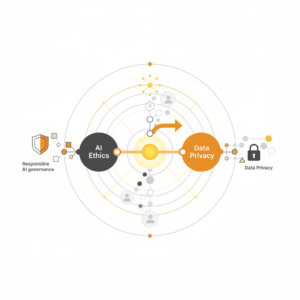
AI ethics and data privacy work best when they are designed as one operating model. Leaders need clear purpose, data minimisation, human review, vendor control, transparent notices, and measurable assurance. This balance lets enterprises use AI for customer service and decision support while reducing privacy harm, bias, data leakage, and trust damage.
Definition
What does AI ethics and data privacy mean?
Artificial intelligence, or AI, refers to software that can classify, predict, generate, recommend, or support decisions. AI ethics is the discipline of deciding whether an AI system should be used, who may be affected, and what safeguards are needed. Data privacy is the lawful, fair, and controlled handling of personal information. Responsible AI governance is the operating model that turns these ideas into roles, decisions, evidence, and review.
This distinction matters. An AI model can be technically accurate and still be unacceptable if it uses excessive personal information, affects vulnerable customers, or hides the reason for a decision. Floridi and Cowls describe ethical AI through beneficence, non-maleficence, autonomy, justice, and explicability¹⁰, which helps leaders test whether AI creates value without unreasonable harm. The OAIC states that privacy obligations apply to personal information entered into an AI system and to AI output when it contains personal information¹, so governance must cover prompts, transcripts, CRM fields, summaries, scores, and recommendations.
Context
Why does AI governance now depend on privacy trust?
Enterprise AI is moving faster than traditional information management. Contact centres now test AI for call summarisation, quality scoring, sentiment detection, knowledge search, routing, complaint triage, and agent coaching. Each use can improve speed and consistency. Each use can also expose personal information, infer sensitive traits, or make customers feel that decisions are being made without a fair hearing.
Public expectations are clear. The OAIC found that 96% of Australians want conditions before AI is used to make decisions that might affect them⁸, with human review, notice, privacy rules, challenge rights, explanation, bias testing, and third-party validation among the leading expectations. The same survey found that 47% of Australians had been told their information was involved in a data breach in the prior year⁸, and 76% of those affected experienced harm⁸, which makes privacy trust a board-level issue rather than a narrow compliance task.
Australian law is also moving. The Privacy and Other Legislation Amendment Act 2024 introduces privacy policy transparency for substantially automated decisions that significantly affect individuals’ rights or interests¹³, with the relevant automated decision provisions commencing after the 24-month period set out in the Act. So leaders should treat AI ethics and data privacy as a combined readiness program now, not a future legal clean-up.
Mechanism
How does responsible AI governance balance AI value and privacy restraint?
The mechanism is lifecycle control. A responsible AI governance model starts before procurement or model build. It asks why the system is needed, whether AI is the right method, which personal information is required, how long data is retained, who can see outputs, and how humans can intervene. The OAIC warns that AI products should not be used simply because they are available¹, which is a useful test for every proposed use case.
Three controls create the balance. First, purpose control limits the AI system to a defined customer, employee, or operational outcome. Second, data control reduces personal information to what the use case genuinely needs. Publicly available data is not automatically lawful for training or fine-tuning generative AI², so data source review must be part of model approval. Third, assurance control measures performance, privacy risk, bias, drift, complaints, and human override.
ISO/IEC 42001 gives organisations a management system for responsible AI⁴, while ISO/IEC 27701:2025 gives a privacy information management system for personally identifiable information⁵. NIST’s AI Risk Management Framework also frames AI risk through governance, mapping, measurement, and management⁶. Together, these sources support a practical pattern: decide, document, test, monitor, and improve.
Comparison
What is the difference between AI ethics, data privacy, and information management?
AI ethics asks whether the AI use is fair, explainable, safe, and human-centred. It looks at human impact, not just system performance.
Data privacy asks whether personal information is collected, used, disclosed, retained, and protected in a lawful and reasonable way. It covers inputs and outputs, including inferred or generated personal information¹.
Information management asks whether data is findable, accurate, classified, governed, retained, deleted, and fit for its purpose. Without sound information management, AI inherits old data quality problems and can make them more visible.
Responsible AI governance joins these disciplines. It turns policy into named ownership, registers, risk tiers, approvals, privacy impact assessments, testing, customer notice, human review, and incident response⁴˒⁶˒¹² across the full AI lifecycle.
Applications
Where should enterprises apply the balance first?
Start where AI touches customers, employees, or regulated decisions. In a contact centre, that means call recordings, chat transcripts, knowledge articles, identity checks, quality assurance, workforce coaching, complaint handling, and vulnerability detection. These are high-value use cases because they sit close to customer experience. They are also privacy-sensitive because they often contain names, account details, health information, financial hardship signals, or emotional distress.
Solution pattern for CX and contact centres
A practical solution is to create a governed AI use-case register for CX and contact centre operations. Each entry should record the business purpose, customer impact, personal information used, vendor involvement, model type, testing results, human review point, retention rule, and complaint path. For evidence and reporting, Customer Science Insights: https://customerscience.com.au/csg-product/customer-science-insights/ can help teams inspect CX data, performance patterns, and decision outcomes under a governed view.
The impact is practical. Leaders can approve low-risk use cases faster, pause high-risk use cases earlier, and explain AI decisions with evidence. Agents get tools that help them serve customers. Customers keep notice, dignity, and review rights. Compliance teams get records that show what changed, who approved it, and how risk was controlled.
Risks
What goes wrong when AI ethics and data privacy are separated?
The first risk is shadow AI. The University of Melbourne and KPMG found that 58% of employees intentionally use AI tools at work⁹, while 70% of employees who use AI tools at work use free, publicly available AI tools⁹. Yet only 34% report a workplace policy guiding generative AI use⁹, which leaves a large gap between behaviour and control.
The second risk is invisible disclosure. Staff may paste customer records, complaint notes, claim details, or call transcripts into a public tool. Once personal information enters some AI systems, it can be hard to track, control, or remove¹, which makes prevention more reliable than recovery. The third risk is unfair automation. A model may score customers, prioritise service, or flag risk using proxies that create unfair outcomes. That risk rises when no one tests for bias, validates accuracy, or checks whether customers can challenge the result.
Measurement
How should leaders measure responsible AI governance?
Measurement should prove that the organisation has control. A useful AI ethics and data privacy scorecard should track:
• Use-case register coverage, including owner, purpose, and risk tier.
• Privacy impact assessment completion for AI handling personal information.
• Data minimisation evidence, including fields removed before AI processing.
• Vendor due diligence, including data use, retention, security, and training restrictions.
• Human review rate for decisions that affect rights, access, eligibility, complaints, or vulnerability.
• Bias, accuracy, drift, and error testing before release and during operation.
• Customer notice, challenge, and complaint handling performance.
• Incident response time for AI privacy events, misuse, or unsafe outputs.
ISO/IEC 27701:2025 sets requirements for a privacy information management system⁵, while the NIST Privacy Framework describes privacy risk management as an enterprise discipline⁷. For organisations that need help joining policy, records, controls, and operating evidence, Customer Science Information Management & Protection: https://customerscience.com.au/solution/information-management-protection/ supports the service layer behind responsible AI governance.
Next Steps
What should C-level leaders do next?
Set a clear decision rule. No AI system should go live unless the organisation can explain its purpose, data inputs, customer impact, human review point, vendor terms, and monitoring plan. That rule should apply to pilots as well as production systems, because pilots often use real data.
Then build the minimum operating model. Create an AI use-case register. Classify risk. Map personal information flows. Update privacy notices for AI use. Require procurement checks for AI vendors. Train staff on safe prompting and prohibited data. Test outputs before launch. Record decisions. Review systems after go-live. Australia’s Voluntary AI Safety Standard gives 10 guardrails³, and those guardrails can be turned into a practical approval workflow for enterprise AI.
Evidentiary Layer
Evidence base for AI ethics and data privacy
The evidence points in one direction. Australians want conditions before AI decisions affect them⁸, so trust must be designed into service channels. Regulators expect privacy by design, due diligence, transparency, and ongoing review¹, which means one-off approval is not enough. Standards such as ISO/IEC 42001⁴ and ISO/IEC 27701⁵ turn AI and privacy into management systems, not loose policies.
Academic research also warns against principle-only governance. Mittelstadt argues that principles alone cannot guarantee ethical AI¹¹ because accountability, professional norms, and translation into practice are often weak. Mikalef and colleagues frame responsible AI governance through structural, relational, and procedural practices¹², which fits the enterprise need for ownership, cross-functional review, and repeatable controls.
FAQ
What is the right balance between AI ethics and data privacy?
The right balance lets the organisation use AI for clear business and customer outcomes while limiting personal information, testing risks, keeping humans involved, and explaining decisions when people are affected.
Is responsible AI governance the same as privacy compliance?
No. Privacy compliance is one part of responsible AI governance. Responsible AI governance also covers fairness, safety, accuracy, transparency, accountability, human oversight, and ongoing monitoring.
Do contact centres need specific AI governance rules?
Yes. Contact centres handle sensitive customer conversations, identity data, complaints, vulnerability signals, and performance data. AI rules should cover transcripts, recordings, summaries, quality scores, agent coaching, and customer-facing bots.
How can Customer Science products support this work?
Customer Science Insights can help leaders inspect CX data and service outcomes under a governed reporting model. Commscore AI: https://customerscience.com.au/csg-product/commscore-ai/ can support AI-assisted scoring and quality review when teams need clearer evidence around customer communications.
What should be measured first?
Start with the AI use-case register, privacy impact assessments, data minimisation, vendor controls, human review, customer notice, output accuracy, and complaint trends. These measures show whether governance is working in daily operations.
Who should own AI ethics and data privacy?
Ownership should sit with an executive sponsor, but delivery must be shared. Data, privacy, risk, legal, cyber, operations, CX, contact centre, and technology teams all need defined roles.
Sources
¹ Office of the Australian Information Commissioner. Guidance on privacy and the use of commercially available AI products. 2024.
https://www.oaic.gov.au/privacy/privacy-guidance-for-organisations-and-government-agencies/guidance-on-privacy-and-the-use-of-commercially-available-ai-products
² Office of the Australian Information Commissioner. Guidance on privacy and developing and training generative AI models. 2024.
https://www.oaic.gov.au/privacy/privacy-guidance-for-organisations-and-government-agencies/guidance-on-privacy-and-developing-and-training-generative-ai-models
³ Australian Government Department of Industry, Science and Resources. Voluntary AI Safety Standard. 2024.
https://www.industry.gov.au/publications/voluntary-ai-safety-standard
⁴ ISO/IEC 42001:2023. Information technology, artificial intelligence, management system.
https://www.iso.org/standard/81230.html
⁵ ISO/IEC 27701:2025. Information security, cybersecurity and privacy protection, privacy information management systems, requirements and guidance.
https://www.iso.org/standard/71670.html
⁶ National Institute of Standards and Technology. Artificial Intelligence Risk Management Framework. 2023.
https://www.nist.gov/itl/ai-risk-management-framework
⁷ Boeckl, K. and Lefkovitz, N. NIST Privacy Framework: A Tool for Improving Privacy Through Enterprise Risk Management, Version 1.0. NIST, 2020.
https://www.nist.gov/privacy-framework
⁸ Office of the Australian Information Commissioner. Australian Community Attitudes to Privacy Survey 2023.
https://www.oaic.gov.au/engage-with-us/research-and-training-resources/research/australian-community-attitudes-to-privacy-survey/australian-community-attitudes-to-privacy-survey-2023
⁹ Gillespie, N., Lockey, S., Ward, T., Macdade, A. and Hassed, G. Trust, attitudes and use of artificial intelligence: A global study 2025. University of Melbourne and KPMG.
https://minerva-access.unimelb.edu.au/items/dfc0f405-f7e4-4c81-bf0d-08bcbef4e1c4
¹⁰ Floridi, L. and Cowls, J. A Unified Framework of Five Principles for AI in Society. Harvard Data Science Review, 2019.
https://hdsr.mitpress.mit.edu/pub/l0jsh9d1
¹¹ Mittelstadt, B. Principles alone cannot guarantee ethical AI. Nature Machine Intelligence, 2019.
https://www.nature.com/articles/s42256-019-0114-4
¹² Mikalef, P., Conboy, K., Lundström, J. E. and Popovič, A. Responsible artificial intelligence governance: A review and research framework. Journal of Strategic Information Systems, 2024.
https://www.sciencedirect.com/science/article/pii/S0963868724000157
¹³ Australian Government Federal Register of Legislation. Privacy and Other Legislation Amendment Act 2024, No. 128, 2024.
https://www.legislation.gov.au/C2024A00128/latest/text