




























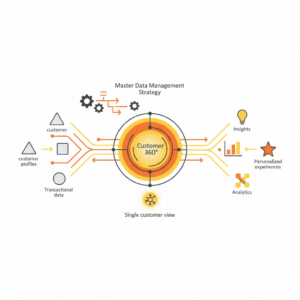
A Master Data Management strategy gives Customer 360 a governed identity foundation, not another dashboard. It defines owners, identity matching, data quality rules, privacy controls, and measures so single customer view data can be trusted across contact centres, digital channels, analytics, and executive reporting. Good MDM turns scattered records into safer personalisation, faster service, and lower rework.
Definition
What is a Master Data Management strategy for Customer 360?
A Master Data Management strategy is the enterprise plan for creating and maintaining trusted customer master data. Master data means core business facts about people, organisations, accounts, products, locations, and relationships. For Customer 360, it covers customer identifiers, names, contact details, consent status, household or business relationships, service history, channel preferences, and vulnerability flags where lawful and necessary. MDM research describes the discipline as a way to improve customer data¹ by bridging silos between business units and information systems. That matters because Customer 360 only works when front-office, back-office, and analytics teams mean the same thing by “customer”.
A single customer view is more than data copied into a warehouse. It is the governed output of identity resolution, data quality controls, stewardship, metadata, and access rules. ISO 8000-100 treats master data quality at the smallest meaningful property value³, which is a useful test. If the email, address, consent date, account link, or source timestamp is wrong, the whole customer view can mislead.
Context
Why does Customer 360 fail without master data governance?
Customer 360 programs often fail at ordinary service moments: an agent cannot verify the caller, a digital form creates another duplicate record, a marketing audience includes opted-out customers, or a complaint team cannot see related cases across brands. The Australian Bureau of Statistics Data Quality Framework uses seven quality dimensions⁴, including relevance, timeliness, accuracy, coherence, interpretability, and accessibility. Those dimensions shift the discussion away from “is the platform live” toward “can people trust this customer record for the decision in front of them”.
Bad data has a cost. Peer-reviewed work on poor data quality describes it as a material cost factor⁵, not a cosmetic issue. Customer expectations add pressure. McKinsey found that 71%¹¹ of consumers expect personalised interactions and 76%¹¹ get frustrated when they do not receive them. But personalisation without data control can create privacy risk. The OAIC received 532⁸ notifiable data breach reports in January to June 2025, with malicious or criminal attacks at 59%⁸. Customer 360 must earn trust before it scales.
Mechanism
How does MDM create a single customer view?
MDM creates single customer view data through four linked mechanisms. First, it defines the customer entity. That sounds simple. It rarely is. A bank may need individuals, households, trusts, businesses, signatories, beneficiaries, and advisers. A utility may need residents, account holders, properties, landlords, and concessions. The strategy must define each entity, its attributes, and its permitted uses.
Second, MDM resolves identity. Deterministic matching uses exact identifiers such as customer number, email, verified phone, or government-issued references where appropriate. Probabilistic matching uses confidence scores when records partly match. The system then stores source keys, match logic, survivorship rules, and exceptions. Third, governance sets decision rights. Khatri and Brown’s five data governance domains² include data principles, data quality, metadata, data access, and data lifecycle. Fourth, stewards work exceptions. Alhassan, Sammon, and Daly found that data governance needs business-driven strategies⁶, which is why MDM cannot sit only inside technology teams.
Comparison
How is MDM different from CRM, CDP, data warehouse, and BI?
CRM manages relationship activity, pipeline, cases, and frontline workflow. A customer data platform assembles behavioural and marketing profiles. A data warehouse stores analytical history. BI reports patterns and performance. MDM sits underneath these tools as the governed identity and definition layer. It decides which record represents the customer, which source is trusted for each attribute, who can change it, and how long it should be retained.
The difference matters for investment choices. Replacing CRM will not fix duplicate identities if registration, billing, case, and marketing systems keep creating customer records in different ways. Buying BI will not make service data coherent if account hierarchies and contact permissions conflict. A good Master Data Management strategy creates the rules and operating model that allow those platforms to share meaning.
Applications
Where should enterprises apply Customer 360 first?
Start where data defects damage customers or staff every day. Contact centre identity and verification is often the right first domain because duplicate records, weak account relationships, and stale contact data show up immediately as longer calls, repeat contacts, and failed handoffs. Complaints, hardship, member servicing, claims, onboarding, and high-value B2B account management are also strong candidates.
Where contact centre data is part of the Customer 360 problem, Customer Science Insights can connect and collect real-time contact centre and service data, surface dashboards, and feed BI, AI, digital, and human workforces: https://customerscience.com.au/csg-product/customer-science-insights/. That product role is practical. MDM defines trusted customer identity and data rules. Operational insight shows whether those rules improve service behaviour, channel movement, and leader decisions. Start with one use case, one customer domain, and a measurable service outcome. Trying everything at once usually stalls.
Risks
What risks can weaken a Master Data Management strategy?
The first risk is treating MDM as a tool purchase. Tools can match, merge, and publish records, but they cannot decide business meaning. The second risk is over-centralisation. A Customer 360 record that collects too much personal information can increase harm if access controls, retention rules, and purpose limits are weak. OAIC guidance says APP 11 requires reasonable steps to protect personal information⁷ from misuse, interference, loss, unauthorised access, unauthorised modification, and unauthorised disclosure. The same guidance expects destruction or de-identification⁷ when personal information is no longer needed.
A third risk is bad matching. Over-matching can combine two people into one record. Under-matching leaves duplicates in place. Both can harm customers. NIST describes privacy risk management¹⁰ as an enterprise practice, not only a compliance function. That principle fits MDM: match logic, stewardship queues, model thresholds, audit logs, and appeal paths need ownership before automation scales.
Measurement
How should leaders measure single customer view data?
Measure Customer 360 like a service asset, not a database. Track duplicate customer rate, match confidence, survivorship exceptions, verified contact coverage, consent conflict rate, address freshness, glossary completeness, access exceptions, and data retention compliance. Then connect those measures to CX and operations: first contact resolution, authentication time, transfers, complaint reopen rate, repeat digital form submissions, failed proactive contact, and executive report reconciliation effort.
For structured support, Customer Science Data & Information Management Solutions cover data and information strategy, architectures, classification, data analytics, quality, dictionaries, metadata, privacy, and cyber advisory: https://customerscience.com.au/solution/information-management-protection/. That matters because measurement needs both technical profiling and business judgement. The ABS quality dimensions⁴ give a useful frame, while Haug and colleagues show that quality improvement should target the level that reduces business cost⁵ rather than chase perfection.
Next Steps
What should executives do in the first 90 days?
In the first 30 days, select one customer domain and one journey, then name the accountable executive, data owner, steward group, privacy lead, and technology owner. Define the customer entity and the top ten attributes that matter. Include consent, source, timestamp, and permitted use. In days 31 to 60, profile source systems, quantify duplicates, document metadata, and agree survivorship rules. Keep the language plain. Nobody should need a data dictionary to understand the word “customer”.
In days 61 to 90, run a controlled pilot. Test match logic, exception handling, access controls, and downstream reporting. Compare the pilot against baseline service metrics. Khatri and Brown’s decision domains² can structure the governance forum, while Alhassan and colleagues’ work on data governance success factors⁶ supports a business-led model. Scale only after the operating model works in production conditions.
Evidentiary Layer
What evidence supports a Customer 360 MDM investment?
The strongest evidence points in one direction: MDM is an operating discipline. Vilminko-Heikkinen and Pekkola found that MDM improves important data by bridging organisational and system silos¹, but also found challenges in data ownership, definitions, granularity, and legislation-driven requirements. ISO 8000-100³ reinforces the need to manage master data quality at attribute level. Khatri and Brown² show why decision rights matter. The OAIC evidence⁸ shows why customer data concentration needs privacy and security controls. The Australian Government’s 2030 service vision is simple, secure, connected public services⁹, which is the same pattern many enterprise leaders now need: trusted data, safer use, and better outcomes.
FAQ
Does MDM replace CRM?
No. CRM manages service, sales, and relationship workflows. MDM governs identity, definitions, access, quality, and lifecycle decisions² so CRM and other systems can use consistent customer data.
What is single customer view data?
Single customer view data is a governed representation of a customer across systems. It includes identity links, trusted attributes, source records, consent, relationships, and quality signals.
Is Customer 360 mainly an analytics project?
No. Analytics is one use. Customer 360 also supports service verification, complaints, digital onboarding, proactive care, privacy controls, and executive reporting.
How does MDM support AI?
AI needs trusted inputs. MDM improves data definitions, provenance, matching, and quality signals³ so models and copilots can rely on customer context with fewer preventable errors.
Which Customer Science product supports knowledge outcomes after MDM?
Customer Science Knowledge Quest can use live customer interactions to detect knowledge gaps, govern article quality, and produce accurate service answers once customer and interaction context are trusted: https://customerscience.com.au/csg-product/knowledge-quest/.
How should a C-level sponsor start?
Start with one high-friction customer journey, assign decision rights, baseline data quality, set privacy controls, and prove one measurable service outcome before scaling.
Sources
- Vilminko-Heikkinen, R., and Pekkola, S. 2017. Master data management and its organizational implementation: an ethnographical study within the public sector. Journal of Enterprise Information Management, 30(3), 454–475.
DOI: https://doi.org/10.1108/JEIM-07-2015-0070 - Khatri, V., and Brown, C. V. 2010. Designing data governance. Communications of the ACM, 53(1), 148–152.
DOI: https://doi.org/10.1145/1629175.1629210 - International Organization for Standardization. ISO 8000-100:2016 Data quality, Part 100: Master data: Exchange of characteristic data: Overview.
https://www.iso.org/standard/62392.html - Australian Bureau of Statistics. ABS Data Quality Framework.
https://www.abs.gov.au/websitedbs/D3310114.nsf/home/Quality:+The+ABS+Data+Quality+Framework - Haug, A., Zachariassen, F., and van Liempd, D. 2011. The costs of poor data quality. Journal of Industrial Engineering and Management, 4(2), 168–193.
https://www.jiem.org/index.php/jiem/article/view/232
DOI: https://doi.org/10.3926/jiem.2011.v4n2.p168-193 - Alhassan, I., Sammon, D., and Daly, M. 2019. Critical success factors for data governance: a telecommunications case study. Journal of Decision Systems, 28(1), 41–61.
https://research.ucc.ie/en/publications/critical-success-factors-for-data-governance-a-telecommunications/
DOI: https://doi.org/10.1080/12460125.2019.1633226 - Office of the Australian Information Commissioner. Chapter 11: APP 11, Security of personal information.
https://www.oaic.gov.au/privacy/australian-privacy-principles/australian-privacy-principles-guidelines/chapter-11-app-11-security-of-personal-information - Office of the Australian Information Commissioner. 2025. OAIC launches new dashboard for data breaches.
https://www.oaic.gov.au/news/media-centre/oaic-launches-new-dashboard-for-data-breaches - Digital Transformation Agency. Data and Digital Government Strategy.
https://www.dta.gov.au/our-initiatives/data-and-digital-government-strategy - National Institute of Standards and Technology. NIST Privacy Framework.
https://www.nist.gov/privacy-framework - McKinsey & Company. 2021. The value of getting personalization right or wrong is multiplying.
https://www.mckinsey.com/capabilities/growth-marketing-and-sales/our-insights/the-value-of-getting-personalization-right-or-wrong-is-multiplying - Customer Science. Customer Science Insights.
https://customerscience.com.au/csg-product/customer-science-insights/ - Customer Science. Information Management & Protection Solutions.
https://customerscience.com.au/solution/information-management-protection/ - Customer Science. Knowledge Quest.
https://customerscience.com.au/csg-product/knowledge-quest/