































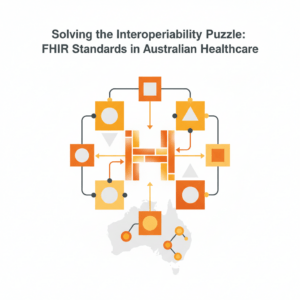
A practical interoperability strategy in Australian healthcare uses HL7 FHIR APIs plus national implementation guides, identity, and terminology. The goal is consistent data exchange between clinical, consumer, and administrative systems without losing meaning or privacy. Success depends on governance, conformance testing, and security controls, not just “turning on” an API. Done well, FHIR reduces integration cost, improves care coordination, and makes outcomes measurable.
Definition
What are FHIR standards and why do they matter in Australia?
HL7 Fast Healthcare Interoperability Resources (FHIR) is a standard for exchanging healthcare data using modular “resources” and web-style APIs. FHIR commonly uses REST over HTTP and standard interactions such as read, search, create, and update.³ In Australian settings, “FHIR standards” usually means core HL7 FHIR plus Australian constraints and profiles that make data consistent across jurisdictions and vendors.¹²
In practice, FHIR becomes interoperable when two systems agree on the same profiles, terminologies, identifiers, and security model. That is why national implementation guides and conformance statements matter as much as the base specification.
Context
Why is interoperability still hard in Australian healthcare?
Australian healthcare is a multi-ecosystem environment: primary care, hospitals, pathology, imaging, pharmacy, aged care, and payer workflows operate with different data models, consent patterns, and identifiers. Fragmentation creates predictable failure modes: duplicated data entry, missing context at handover, slow referrals, and reporting inconsistencies.
National programs reduce friction, but they also raise the bar for compliance. For example, the My Health Record system has access controls that let individuals restrict who can access their record and which documents can be viewed.⁶ Those controls mean systems must handle partial visibility and still remain clinically safe.
What national building blocks must your FHIR design respect?
Interoperability is not only “data formats”. Australian implementations typically rely on:
National implementation guidance for My Health Record FHIR artefacts (R4).¹
AU Core and AU Base profiles to align Australian data representation and capability requirements.²⁷
Healthcare Identifiers (IHI and related identifiers) to reduce patient mismatching risk.⁴⁵
National Clinical Terminology Service and SNOMED CT-AU and AMT to keep meaning consistent.⁶
These building blocks create a shared language for identity, meaning, and exchange patterns across organisations.
Mechanism
How does FHIR actually move data between systems?
FHIR interoperability usually follows a repeatable flow:
A client discovers server capabilities via conformance metadata.
The client requests data using standard search parameters and resource reads.
The server returns structured resources that match an agreed profile and terminology bindings.
Access and audit controls enforce least privilege, traceability, and consent constraints.
The My Health Record FHIR Gateway is an example of this approach, using REST-based APIs to support consumer-targeting apps and products that connect to the national system.⁸
What makes “Australian FHIR” different from generic FHIR?
Australia uses the same underlying standard, but constrains it through implementation guides to reduce ambiguity. The My Health Record FHIR Implementation Guide states it is based on HL7 FHIR R4 artefacts authored and maintained by the Australian Digital Health Agency.¹ AU Core similarly exists to provide an implementable working specification for local system producers.²
This matters because unconstrained FHIR allows many valid representations for the same concept. The Australian constraints reduce variation so that downstream systems can interpret data safely.
Comparison
FHIR vs CDA and document exchange: what changes for executives?
FHIR is often positioned as “API-first”, while CDA is commonly used for clinical documents and bundles. In Australia, modernisation efforts have explicitly referenced upgrading clinical document architecture and enabling FHIR-based access patterns alongside existing approaches.¹¹
For executives, the key differences are operational:
Document exchange optimises for publishing and viewing discrete documents.
FHIR APIs optimise for granular data access, workflow integration, and re-use by multiple applications.
Hybrid models are normal during transition, and governance must cover both representations.
A practical interoperability roadmap treats FHIR as the incremental layer that makes data re-usable while maintaining regulated document pathways where required.
Applications
Where does FHIR deliver the fastest interoperability wins?
Most organisations see early ROI when FHIR is applied to “high-friction, high-volume” processes:
Referrals and care transitions: reduce missing information and repeated tests.
Consumer access and care navigation: enable app experiences and patient-held data flows.⁸
Medication and problem lists: improve consistency through SNOMED CT-AU and AMT bindings.⁶
Provider directories and identity: reduce misrouting and patient matching errors using HI Service patterns.⁴⁵
A large literature base describes FHIR opportunities and implementation challenges, which reinforces that benefits appear when interoperability is coupled with strong governance and validation practices.⁹
How do you operationalise FHIR programmes across product, CX, and clinical teams?
Interoperability is as much a customer and clinician experience challenge as it is technical. A useful pattern is to treat each exchange as a “journey”: define the decision that exchange supports, define minimum safe data, then design governance, validation, and measurement around that.
For a CX and operational lens, Customer Science Insights can be used to structure outcome-focused measurement and insight loops across cross-organisation journeys: https://customerscience.com.au/csg-product/customer-science-insights/
Risks
What can go wrong with FHIR implementations in Australian healthcare?
The most common failure modes are predictable and manageable:
Semantic drift: systems exchange “valid” data that carries different meaning because terminology bindings or value sets diverge.⁶
Identifier mismatch: patient matching errors increase when HI Service integration is incomplete or local identifiers are poorly mapped.⁴⁵
Security gaps: token scope design, auditability, and access segmentation are under-specified, leading to over-broad access.
Partial visibility issues: access controls restrict some data, and workflows must remain safe when a record is incomplete.⁶
Vendor divergence: custom extensions multiply without governance, increasing integration cost later.
Cyber and privacy risk is not theoretical. OAIC statistics for 2024 reported 1,113 data breach notifications, a 25% increase from 2023.¹² In the health-adjacent ecosystem, the MediSecure incident highlighted the scale that a single breach can reach, with government statements noting around 12.9 million individuals potentially affected.¹³
Measurement
How do you measure interoperability outcomes, not just “interfaces delivered”?
Measure interoperability on three layers:
Technical conformance: profile validation pass rate, terminology validation pass rate, and failed call rates by endpoint.
Workflow performance: referral turnaround time, admission-to-discharge information completeness, and duplicate test rates.
Risk and trust: least-privilege coverage, audit completeness, and time-to-detect anomalies aligned to your security program.
National plans also emphasise benefits measurement as a priority area.¹⁰ A mature programme ties these measures to service-level objectives for patient flow, safety events, and staff time recovered.
To harden measurement for regulated environments, align controls to a recognised security management system such as ISO/IEC 27001.¹⁴
Next Steps
What is a pragmatic FHIR roadmap for Australian health organisations?
A pragmatic approach avoids “big bang” replacement:
Pick two or three high-value exchanges and define AU Core-aligned profiles and terminology bindings.²⁷
Implement conformance testing in CI and reject non-conformant payloads early.
Design security with explicit scopes, audit, and segmentation suitable for sensitive clinical contexts.¹⁵
Establish an extension governance process so you can deprecate local customisations over time.
Scale to additional exchanges once measurement shows stable conformance and workflow improvement.
For organisations that need a managed uplift in privacy, risk, and information governance around interoperability programmes, Customer Science Information Management & Protection can support the control framework and operating model: https://customerscience.com.au/solution/information-management-protection/
Evidentiary Layer
What evidence supports FHIR as an interoperability foundation?
Systematic and scoping reviews describe both the promise of FHIR and the recurring implementation pitfalls, especially around governance, validation, and consistent modelling.⁹¹⁶ SMART on FHIR literature also shows how standards-based authorisation patterns can support scalable app ecosystems when implemented with proper security and context controls.¹⁷
Australia’s ecosystem has also matured rapidly, with active national guidance for My Health Record FHIR artefacts, AU Core, and a national interoperability plan that frames identity, standards, information sharing, innovation, and benefits measurement as linked priorities.¹²¹⁰
FAQ
Does adopting FHIR automatically make two systems interoperable?
No. Interoperability requires shared profiles, terminologies, identifiers, and conformance testing, not just a FHIR endpoint.¹²
Which Australian FHIR guides matter most for implementation?
Most organisations start with AU Core and the My Health Record FHIR Implementation Guide, then add use-case specific constraints.¹²
How should consent and access controls be handled?
Systems must support My Health Record access controls and keep workflows safe under partial visibility conditions.⁶
What is the fastest way to reduce clinical meaning loss?
Bind key clinical concepts to SNOMED CT-AU and AMT through national terminology services and validate payloads.⁶
How can we make interoperability improvements visible to executives?
Define journey-level outcomes, then track conformance, workflow performance, and risk indicators together, aligned to national benefit measurement intent.¹⁰
Which Customer Science capability helps teams communicate change across stakeholders?
Customer Science CommsCore AI can help create consistent, governed communications for change programs and service updates across channels: https://customerscience.com.au/csg-product/commscore-ai/
Sources
Australian Digital Health Agency. My Health Record FHIR Implementation Guide (current). (Developer Portal). (developer.digitalhealth.gov.au)
Australian Digital Health Agency. AU Core Implementation Guide. (developer.digitalhealth.gov.au)
HL7. FHIR RESTful API specification (HTTP). (hl7.org)
Australian Government Department of Health and Aged Care. Healthcare Identifiers and HI Service overview (Dec 2025). (Health and Ageing Dept. Australia)
Services Australia. Individual Healthcare Identifiers (Dec 2025). (Services Australia)
Australian Digital Health Agency. SNOMED CT-AU with AMT January 2026 release (NCTS). (Digital Health Australia)
HL7 Australia. AU Core Data for Interoperability (AUCDI) page (Jan 2025). (hl7.org.au)
Australian Digital Health Agency. My Health Record FHIR Gateway overview. (developer.digitalhealth.gov.au)
Ayaz M, et al. The Fast Health Interoperability Resources (FHIR) Standard: Systematic Review. Journal of Medical Internet Research (2021). (PMC). (PMC)
Australian Digital Health Agency. Connecting Australian Healthcare: National Healthcare Interoperability Plan 2023–2028 (Jan 2026). (Digital Health Australia)
Healthcare IT News. Telstra Health contract to modernise My Health Record architecture (Aug 2025). (healthcareitnews.com)
OAIC. Statistics show record year for data breaches (2024). (OAIC)
Australian Government Department of Home Affairs. MediSecure cyber security incident statement (Jul 2024). (Department of Home Affairs Website)
ISO. ISO/IEC 27001:2022 overview page. (ISO)
Australian Digital Health Agency. My Health Record participation obligations and security policy requirements (Rule 43 reference). (Digital Health Australia)
Gazzarata R, et al. Scoping review on HL7 FHIR and Implementation Guides in digital healthcare ecosystems (2017–2023). International Journal of Medical Informatics (2024). (ScienceDirect)
Mandel JC, et al. SMART on FHIR: standards-based apps platform for EHRs. Journal of the American Medical Informatics Association (2016). (PMC). (PMC)