



























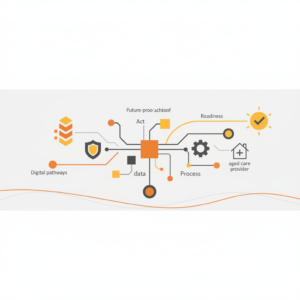
Digital readiness under the New Aged Care Act is a compliance and care quality requirement, not an IT project. Providers need reliable identity and access, accurate data capture, secure information handling, and operational reporting across government platforms. The fastest path is to map Act obligations to digital workflows, fix data quality at the source, and prove performance through auditable reporting and cyber security controls.
Definition
What does “digital readiness” mean for aged care providers?
Digital readiness is the provider’s ability to run compliant services using the government and regulator digital ecosystem without manual workarounds, data loss, or privacy breaches. Under the new settings, readiness includes access to the right portals, staff trained in system tasks, clear data ownership, and dependable integrations that support claiming, reporting, quality monitoring, and regulatory interactions. The Department’s guide frames readiness around the digital systems that enable operations under the new Act, including provider management, service portals, provider reporting, and Business to Government processes.¹
Which digital systems matter most under the new Act?
For most providers, “mission critical” digital dependencies cluster into four areas: provider registration and management, service delivery and client interactions, reporting and compliance evidence, and payments or claiming. The Department’s digital changes guidance and checklist emphasise readiness activities tied to these systems ahead of the Act’s commencement.¹ ² In practice, providers should treat these systems as part of one operating model, because errors in one area often create downstream risks in reporting, quality indicators, and audits.
Context
What changed when the new Aged Care Act commenced?
The new Aged Care Act commenced on 1 November 2025, shifting the regulatory model toward clearer provider obligations and stronger accountability.³ That shift increases the need for timely, accurate, and traceable digital records. Digital readiness becomes the mechanism that converts policy intent into daily operations, especially where providers must demonstrate consistent processes across sites, contractors, and associated providers.
How do Support at Home and “Places to People” change operational data?
Reforms such as Support at Home and “Places to People” increase the volume and sensitivity of client-level information that must be kept consistent across assessments, service agreements, delivery records, and funding outcomes. “Places to People” assigns residential care places to older people rather than providers, which changes how demand, occupancy, and onboarding data flows must work.⁴ That, in turn, raises the bar for master data management, client identity matching, and document control across teams.
Mechanism
How do providers translate legal obligations into digital workflows?
Start by converting obligations into a simple obligation-to-workflow map. Each obligation should have: a trigger, a data capture point, an approver, a storage location, and an audit trail. The Department’s digital readiness checklist provides structured activities that providers can align to internal owners and deadlines.² This approach reduces the risk of fragmented compliance where teams “do the work” but cannot reliably prove it.
What are the minimum digital capabilities to protect consumers and staff?
Minimum capabilities include role-based access control, strong authentication, device and patch management, secure messaging, and monitored backups, because aged care holds high-value personal and health information. The Australian Cyber Security Centre reports high volumes of cybercrime reports and material costs, including rising average self-reported costs for small business incidents.⁵ Privacy impact also matters, with the OAIC reporting hundreds of breach notifications per period and the health sector among the highest reporting sectors.⁶ Providers should treat cyber security and privacy controls as core care-enablers, because a breach can disrupt service delivery and damage trust.
Comparison
What is the difference between “portal access” and true digital readiness?
Portal access is necessary but insufficient. A provider can have logins and still fail readiness if staff re-enter data, quality indicator submissions require spreadsheet stitching, or incident reporting is delayed because records are incomplete. True readiness means the provider can produce accurate reporting without heroic effort, because data is captured once, validated early, and reused safely. This is a data quality problem as much as a systems problem, and health agencies emphasise data quality principles and assurance to support governance and integrity.⁹
How does digital maturity affect quality and safety outcomes?
Evidence across health settings shows that electronic record implementations can deliver benefits, but outcomes depend heavily on adoption, workflow redesign, and governance. Systematic reviews of EHR implementation report persistent barriers and variable realised benefits when change management is weak.¹¹ In aged care, the same pattern appears as documentation quality and operational consistency drive whether digital tools actually reduce risk and improve continuity of care.
Applications
What should providers prioritise in the first 90 days?
Focus on three high-impact streams.
First, stabilise identity, access, and permissions across all systems so staff can complete tasks without shared accounts or unclear responsibilities. This reduces privacy risk and improves auditability against the strengthened accountability model.³ ⁶
Second, fix “source-of-truth” data for clients, workforce, and services. When client demographics, approvals, and service details disagree across systems, reporting becomes unreliable and providers lose time reconciling errors. The AIHW shows the scale of movement through aged care services, which makes accuracy at intake and transitions operationally critical.⁷
Third, make reporting repeatable. Standardise data definitions, validation checks, and sign-off routines for mandatory submissions, including quality indicator data where applicable, because the program depends on consistent quarterly data.¹⁰
How can providers reduce reporting risk while improving decision-quality?
Treat reporting as an operational product. Define reporting owners, implement automated checks, and track exceptions as work items. Use a single metrics layer that connects service delivery records to compliance evidence and executive oversight. If you need a fast way to unify operational, experience, and risk signals, consider a CX and operational intelligence layer such as Customer Science Insights: https://customerscience.com.au/csg-product/customer-science-insights/ . A well-governed insights layer reduces duplication by creating consistent definitions for complaints, incidents, service timeliness, and quality measures, which also improves board reporting.
Risks
Where do providers typically fail digital readiness?
Common failure points include unclear accountability for data fields, incomplete staff training, and reliance on manual reconciliations close to reporting deadlines. The Department’s readiness materials exist because these failures are predictable and widespread, especially when reforms force multiple concurrent changes in claims, portals, and provider management.¹ ² Providers also underestimate integration risk between clinical documentation, workforce rostering, and finance systems, which can create mismatches between delivered services and claimed services.
What are the highest-risk privacy and cyber security scenarios?
High-risk scenarios include credential sharing, unmanaged contractor access, phishing leading to mailbox compromise, and insecure file transfer of consumer records. The OAIC data shows breach volumes remain elevated, and health services are a consistently high reporting sector.⁶ The ACSC reports sustained threat levels, significant incident response workload, and measurable cost impacts.⁵ Providers should operationalise ISO/IEC 27001-style controls for information security management, especially around access control, supplier risk, incident response, and continuous improvement.⁸
Measurement
What KPIs prove digital readiness in an audit or incident?
Use measures that demonstrate capability, not intention.
Operational measures: percentage of services captured digitally at point of care, claim or submission error rates, and rework hours per reporting cycle.
Assurance measures: access review completion rate, time to revoke leaver access, backup restore test success, and incident mean time to contain.
Data quality measures: completeness, validity, and timeliness scores for core datasets, aligned to a data quality framework approach.⁹
Outcome measures: complaint and incident trend stability after system changes, and timeliness of quality indicator submissions where required.¹⁰
Next Steps
How should executives sequence the program to avoid disruption?
Sequence work as: governance first, then data, then workflow, then automation. Governance establishes decision rights and risk appetite under the new Act’s stronger accountability expectations.³ Data work removes friction and reduces reporting risk. Workflow redesign ensures systems reflect actual care delivery. Automation should come last, because automating broken processes scales failure.
If you need external support to design the operating model, build the data governance layer, and run change safely across multiple sites, use a structured CX and operational transformation service such as https://customerscience.com.au/service/cx-consulting-and-professional-services/ . The key is to connect compliance, service quality, and digital workflow into one measurable program, rather than separate projects.
What should providers ask software vendors and integrators right now?
Ask for three proofs: interoperability, auditability, and resilience. Interoperability should align to modern health data exchange directions, including progressive adoption of standards that improve data accuracy and real-time exchange across the digital health ecosystem.¹² Auditability requires event logs, clear role permissions, and exportable evidence packs. Resilience requires tested backups, incident response procedures, and supplier commitments for security updates and support during peak reporting periods.
Evidentiary Layer
What evidence should be kept to demonstrate compliance over time?
Maintain an evidence library that is easy to produce on demand: training records tied to system roles, access review logs, incident register entries with root cause and actions, data dictionary and change logs, and signed-off reporting packs. Store evidence in a controlled repository with versioning and retention rules. This reduces the risk of “compliance by memory” and supports continuity during leadership or staff turnover, which is common during reform cycles.
FAQ
Which government resources should providers use first?
Use the Department’s “guide to digital changes” and the “digital readiness checklist” as the baseline for a provider-owned plan, because both are designed to align activities to the Act’s operational requirements.¹ ²
Is cyber security a legal risk or an operational risk?
It is both. A cyber incident can trigger privacy obligations and regulator attention, while also disrupting care delivery and reporting. OAIC breach volumes and ACSC threat reporting support treating security as core operational capability.⁵ ⁶
How do we avoid “double handling” data across teams?
Define a single source of truth for each dataset, enforce validation at capture, and stop spreadsheet-based re-keying wherever possible. A formal data quality approach improves integrity and reduces reconciliation work.⁹
What is the fastest way to lift staff capability across digital tasks?
Build role-based training tied to real workflows, then measure completion and error rates. Reinforce with simple job aids for high-risk tasks such as reporting submissions and incident workflows.²
How can we monitor communications quality across channels under reform pressure?
Track contact drivers, response time, resolution quality, and consumer sentiment as a closed loop with service delivery and complaints. A practical option is Commscore AI: https://customerscience.com.au/csg-product/commscore-ai/ , which can help standardise evaluation and coaching across phone, email, and digital channels.
Do quality indicators still matter if we already monitor quality internally?
Yes, because sector programs are designed to enable consistent benchmarking and trend monitoring, which requires standard definitions and reliable submissions.¹⁰
Sources
Australian Government Department of Health (now Department of Health, Disability and Ageing). New Aged Care Act: A guide to digital changes for providers (V4.0). 24 Oct 2025. https://www.health.gov.au/sites/default/files/2025-10/new-aged-care-act-a-guide-to-digital-changes-for-providers.pdf
Australian Government Department of Health, Disability and Ageing. New Aged Care Act: A digital readiness checklist for providers. 14 Oct 2025. https://www.health.gov.au/resources/publications/new-aged-care-act-a-digital-readiness-checklist-for-providers?language=en
Aged Care Quality and Safety Commission. About the new Aged Care Act and key changes for providers. https://www.agedcarequality.gov.au/providers/reform-changes-providers/about-new-aged-care-act-and-key-changes-providers
Australian Government Department of Health, Disability and Ageing. Places to People: Embedding choice in residential aged care. 23 Dec 2025. https://www.health.gov.au/our-work/residential-aged-care/managing/places-to-people-embedding-choice-in-residential-aged-care?language=en
Australian Cyber Security Centre (ASD). Annual Cyber Threat Report 2024–25. 14 Oct 2025. https://www.cyber.gov.au/about-us/view-all-content/reports-and-statistics/annual-cyber-threat-report-2024-2025
Office of the Australian Information Commissioner (OAIC). Latest Notifiable Data Breach statistics (Jan–Jun 2025). 4 Nov 2025. https://www.oaic.gov.au/news/blog/latest-notifiable-data-breach-statistics-for-january-to-june-2025
Australian Institute of Health and Welfare (AIHW). Aged care: Entering aged care (Australia’s welfare). 29 Oct 2025. https://www.aihw.gov.au/reports/australias-welfare/aged-care
International Organization for Standardization (ISO). ISO/IEC 27001: Information security management systems requirements. https://www.iso.org/standard/27001
Independent Health and Aged Care Pricing Authority (IHACPA). Data Quality Framework development summary. 1 Oct 2025. https://www.ihacpa.gov.au/sites/default/files/2025-10/data_quality_framework_development_summary.pdf
Foong HY, et al. Quality indicators for home- and community-based aged care. (2022). PubMed Central. https://pmc.ncbi.nlm.nih.gov/articles/PMC9542125/
Tsai CH, et al. Effects of Electronic Health Record Implementation and Barriers to Adoption and Use: Scoping Review. (2020). PubMed Central. https://pmc.ncbi.nlm.nih.gov/articles/PMC7761950/
Australian Digital Health Agency. Interoperability Plan Quarterly Progress Report Q2 2025–26. 12 Jan 2026. https://www.digitalhealth.gov.au/sites/default/files/documents/interoperability-plan-quarterly-progress-report—q2-2025-26.pdf