































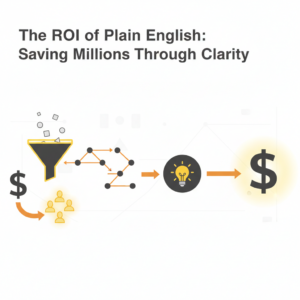
Plain English delivers measurable financial returns by reducing avoidable contact, rework, complaints, and compliance risk. Organisations that replace complex correspondence with clear, customer-centred language consistently lower contact centre volumes and processing costs while improving trust. This article explains the business case for plain English, how ROI is realised in practice, and how CX leaders quantify savings at scale.
Definition
What does plain English mean in a business context?
Plain English is writing designed so the intended audience can find, understand, and act on information the first time they read it. In business, this means removing unnecessary complexity, structuring content around customer decisions, and making actions explicit.
Plain English is not simplistic. It is precise. It reduces ambiguity and cognitive load, which directly lowers the likelihood that customers will seek clarification through calls, complaints, or follow-up interactions. This link between clarity and operational efficiency underpins the plain English business benefits observed across regulated and service-intensive sectors¹.
Context
Why is plain language now a financial issue for executives?
Rising service costs have exposed the limits of efficiency programs that focus only on staffing or automation. A significant portion of contact centre demand is avoidable and originates in confusing letters, emails, bills, and notifications.
In Australia, regulators increasingly expect organisations to communicate clearly with customers. Poorly written correspondence now represents both a cost risk and a compliance risk. As margins tighten, clarity has moved from a brand consideration to a balance-sheet issue².
Mechanism
How does plain English generate measurable ROI?
Plain English reduces failure demand. When customers understand what a message means and what to do next, they do not need to call. Each avoided contact removes handling cost, follow-up work, and downstream errors.
Clear writing also reduces internal rework. Staff spend less time interpreting policy, correcting mistakes, or responding to escalations. Over large customer bases, small reductions in contact probability translate into substantial savings. Studies show that correspondence redesign can reduce related inbound demand by 20 to 40 percent³.



Comparison
Plain English versus traditional corporate writing
Traditional corporate writing prioritises legal completeness and internal accuracy. Plain English prioritises customer comprehension and correct action. The difference is outcome-focused.
Corporate writing often pushes complexity onto the customer. Plain English absorbs complexity internally and presents only what the customer needs. This shift is what drives ROI. Organisations stop paying for customers to ask questions that clear writing could have answered⁴.
Applications
Where do organisations see the largest financial returns?
The highest returns come from high-volume communications. These include bills, payment reminders, policy notices, service changes, and compliance letters. Each of these touchpoints has a predictable contact footprint.
Structured CX communications programs delivered by Customer Science redesign these assets using behavioural science, testing, and measurement. The focus is not aesthetics. It is demand reduction, risk reduction, and cost-to-serve improvement.
https://customerscience.com.au/solution/cx-communications/
Risks
What happens if organisations ignore plain English?
Without intervention, correspondence-driven demand grows over time. Automation amplifies the problem by sending unclear messages faster and at greater scale. Contact centres absorb the impact, driving higher costs and poorer experiences.
There is also legal and regulatory exposure. Customers who misunderstand obligations or entitlements are more likely to complain, default, or escalate. Plain language mitigates these risks by aligning understanding with intent⁵.
Measurement
How is plain English ROI measured in Australia?
ROI measurement links redesigned correspondence to operational outcomes. This includes reductions in inbound contact volume, repeat contact rates, processing time, and complaint volumes attributable to specific communications.
Leading organisations run controlled releases and track demand deltas with statistical confidence. CX consulting support accelerates this by establishing baselines, attribution models, and executive reporting that translate clarity into dollars saved.
https://customerscience.com.au/service/cx-consulting-and-professional-services/
Next Steps
What should CX and service leaders do first?
Start by identifying the communications that trigger the most contact. Use call reason data and frontline insight to prioritise candidates. Redesign those communications using plain English principles and test them before full release.
Treat plain language as an operational capability, not a one-off project. Governance, standards, and measurement ensure benefits compound over time rather than erode.
Evidentiary Layer
What evidence supports the ROI of plain English?
Australian and international studies consistently show that clear communication reduces service demand and complaints while improving compliance outcomes. Government and regulated-sector research demonstrates sustained cost reductions when plain language is embedded into operating models⁶˒⁷.
Standards bodies recognise clear communication as a core element of quality management and customer satisfaction systems⁸.
FAQ
Is plain English suitable for regulated industries?
Yes. Plain English improves compliance by increasing correct customer action without removing legal accuracy.
Can plain language really save millions?
Yes. At scale, small reductions in contact probability across high-volume communications produce multi-million-dollar savings.
How long does it take to realise ROI?
Initial demand reductions are often visible within weeks of deployment, with full benefits accruing over months.
Does this apply to digital communications?
Yes. Emails, SMS, and app notifications generate the same failure demand when unclear.
What tools support ongoing clarity and governance?
Platforms such as Customer Science Insights support insight-led prioritisation and governance of CX communications at scale.
https://customerscience.com.au/csg-product/customer-science-insights/
Sources
-
Cutts, M. Oxford Guide to Plain English. Oxford University Press.
-
Australian Securities and Investments Commission. Clear communication guidance.
-
Journal of Service Management. Failure demand and service costs.
-
Harvard Business Review. Why Simplicity Drives Business Value.
-
Australian Competition and Consumer Commission. Consumer understanding research.
-
UK Government Digital Service. Plain language impact evaluations.
-
Journal of Behavioral Economics. Cognitive load and decision accuracy.
-
ISO 10002 Customer satisfaction and complaints handling.