



























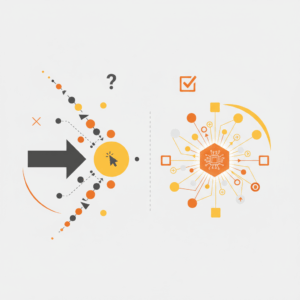
Why do leaders still trust last click?
Executives value simplicity. Leaders like clean numbers that appear to show which channels drive revenue. Organisations keep last click because the report arrives fast, the chart looks tidy, and the budget cycle demands a quick answer. Last click assigns 100 percent of a conversion to the final interaction before purchase. Analytics teams often default to it because it is easy to compute and easy to explain. The problem is that this simplicity hides reality. Customer journeys contain many touches. Paid search, social, email, and brand all contribute in sequence. Last click cuts that sequence and rewards only the finisher. Independent research and platform documentation show material bias in this approach. Teams who rely on it tend to overfund bottom-funnel tactics and starve demand creation. This article separates myth from fact and gives leaders a path to evidence that improves growth.¹
What is last-click bias in plain language?
Last-click bias is the systematic overcrediting of the final interaction in a customer journey. The bias comes from a rule, not from customer behaviour. The rule states that the last recorded touchpoint gets full credit for the sale. In practice, the last recorded touchpoint is often branded search, direct load, or retargeting. These touches arrive after awareness and consideration have already been built. The bias grows when tracking coverage is uneven across channels. Walled gardens, cookie loss, and consent rules create blind spots. The final click still fires a conversion pixel, so the report raises its hand. Measurement science defines this as an attribution error. Methods such as Markov chains and Shapley value show how paths distribute influence across earlier touches more fairly.²
Myth 1: “Last click is the most accurate because it reflects the customer’s final choice”
Last click mirrors the last action, not the full causal story. Field experiments show large differences between clicks and incremental impact. Researchers running randomised ad tests found that retargeting and branded search can capture conversions that would have happened anyway. These studies demonstrate that the final interaction often free-rides on upstream media that generated the intent.³ Paid search platforms have recognised this and now recommend data-driven models that allocate credit using machine learning across many paths. These models outperform single-touch rules on hold-out validation because they better reflect observed behaviour.⁴ The conclusion is clear. Accuracy improves when attribution respects the path and tests incrementality, not when it privileges the last step.⁵
Myth 2: “Last click is fine because our funnel is short”
Short funnels still mix stimuli. A user can see a social ad, read a review, receive an email, and search for the brand in a single day. Even in fast paths, the last touch is rarely the only cause. Decision-support studies using path data confirm that assist interactions lift the probability of conversion even when the window is hours, not weeks.² Platform guidelines also caution against assuming short windows fix attribution bias. Modern analytics tools provide lookback controls, conversion windows, and cross-channel reporting for this reason.⁶ Leaders who assume a short funnel equals single cause risk cutting the very activities that create the click. The right response is to measure the true marginal lift and to assign credit proportionate to proven contribution.³
Myth 3: “Last click keeps us compliant in a privacy-first world”
Privacy changes make last click less reliable, not more. Consent frameworks, cookie deprecation, and mobile app tracking limits reduce deterministic tracking. If earlier touches drop out of the record, the last event that survives appears to own everything. This is a mirage created by signal loss. Regulators in the European Union and California have also raised the bar on transparency and lawful basis, which pushes teams to aggregate and model rather than rely on user-level chains.⁷ Apple’s AppTrackingTransparency further constrains cross-app linking.⁸ Responsible measurement shifts to methods that respect privacy by design. These methods include media mix modelling at the aggregate level and lift testing with clean rooms. Last click does not solve compliance. It amplifies blind spots.⁹
Myth 4: “Last click aligns with how finance wants to allocate spend”
Finance wants causality and repeatability. Finance leaders invest in programs that produce predictable, incremental returns. Evidence from randomised control tests shows that channels which look efficient under last click can deliver low or zero incremental lift when tested.³ This creates budget misallocation. Teams then overpay for clicks that would have arrived without the spend. Independent research and platform case documentation both show that multi-touch or data-driven attribution aligns better with incremental outcomes measured in experiments.⁴ When attribution mirrors incrementality, forecast accuracy improves. That is what finance values. The discipline is to calibrate attribution with experiments and to reconcile both into quarterly planning.¹⁰
What actually works better than last click?
Modern teams replace a single rule with a layered measurement system. The system combines three elements. First, multi-touch attribution at the user or session level distributes credit along the path using statistical methods such as Markov removal effects and Shapley value. These methods estimate each channel’s marginal contribution to conversion probability.² Second, experiment design validates lift through hold-outs, geo-tests, or conversion lift studies. Experiments anchor the model to causal ground truth.³ Third, media mix modelling explains long-term and top-of-funnel effects using aggregated data at weekly or daily frequency. MMM is resilient to user-level signal loss and supports strategic budget shifts. Reputable platform guidance and industry bodies recommend this layered approach to reduce bias and improve planning.¹¹
How do we transition without breaking reporting?
Leaders can move in stages. Start by running a data-driven attribution model in parallel with last click to build a comparison baseline. Most enterprise analytics suites provide path-based or algorithmic models that can be enabled on existing conversion events.⁴ Review the shifts by channel, tactic, and creative theme. Then run at least one material lift test per major channel. Use randomised geo-experiments for large media and platform conversion lift for walled gardens.³ Use the test results to calibrate or override model weights. Next, extend measurement windows to capture assist effects responsibly. Finally, publish a single source of truth that explains which model governs which decision. Use last click only for operational tasks such as affiliate payment validation where contract terms require it.¹²
Where does identity and data quality fit?
Identity and data foundations make or break attribution. Clean tagging, consistent campaign taxonomy, and deduplicated events reduce noise in path analysis. Consented first-party identifiers improve match rates in a privacy-first way. Clean rooms allow partners to compute overlap and lift without exposing raw user data. These practices align with regulatory guidance and industry frameworks.⁷ Platforms also stress the need for server-side conversion measurement and enhanced conversions to improve resilience.⁶ Strong identity does not justify last click. Strong identity enables better models and stronger experiments that reflect real customer behaviour. Organisations that invest in these foundations unlock clearer insights and more confident budget moves.⁹
How should leaders measure success after moving off last click?
Executives should track three categories. Track incremental revenue to confirm that budget reallocations produce real lift. Track payback and marginal return by channel to guide the next dollar. Track forecast accuracy to verify that the new measurement system predicts outcomes under change. Researchers have shown that attribution calibrated by experiments improves decision quality and reduces wasted spend.³ Platform case studies and documentation also report better performance under data-driven attribution, especially for assistive media that last click ignores.⁴ When leadership reviews adopt these metrics, the organisation rewards programs that create demand, not just harvest it. This improves growth and stabilises cost of acquisition across cycles.¹¹
Quick facts executives can use in meetings
Most platforms now default to data-driven or multi-touch models for strategic reporting.⁴ Randomised tests often reveal that branded search and retargeting capture demand generated by other media.³ Privacy rules and platform changes reduce the visibility of early touches and inflate the apparent value of the final touch.⁷ Apple’s ATT reduced cross-app tracking, which pushes teams toward aggregated models and experiments.⁸ MMM complements attribution by capturing long-term and upper funnel effects when user-level data is sparse.¹¹ These points create an executive narrative. Last click is simple but biased. Modern measurement is layered, causal, and privacy-safe. Leaders who align budgets to incrementality unlock both growth and compliance.¹⁰
What should Customer Science clients do next?
Customer Science teams should audit current attribution, run a parallel data-driven model, and schedule lift tests for top channels. Teams should document a decision framework that maps models to use cases: last click for contractual validation, data-driven attribution for tactical optimisation, and MMM for strategic allocation. Leaders should invest in identity, server-side measurement, and clean rooms to improve signal quality within privacy limits. Organisations should align finance and marketing on an incrementality KPI and publish a quarterly measurement review. This plan fits enterprises with complex journeys and large media portfolios. It respects regulation, improves budget accuracy, and builds a durable advantage in customer experience and service transformation.⁶
FAQ
What is last-click bias and why does it distort marketing ROI at enterprise scale?
Last-click bias is the rule-driven overcrediting of the final interaction in a customer journey, which ignores assistive touches and inflates bottom-funnel tactics such as branded search and retargeting. Research and platform guidance show that this skews budgets away from demand creation and toward harvesting, reducing total incremental growth.²
How does a layered measurement system outperform last click for Customer Science clients?
A layered system combines multi-touch attribution for path-level contribution, randomised experiments for causal lift, and media mix modelling for long-term and upper-funnel effects. This combination reduces bias, improves forecast accuracy, and supports privacy-first operations at scale.¹¹
Which platforms and methods provide credible alternatives to last click today?
Enterprise analytics suites and ad platforms offer data-driven attribution that uses machine learning to distribute credit across paths. These models, when calibrated with lift tests, outperform single-touch rules on validation.⁴
Why do privacy changes make last-click reporting less reliable, not safer?
Consent requirements, cookie deprecation, and mobile tracking limits remove early-journey signals, which makes the surviving final interaction appear to own the conversion. This is a measurement illusion created by signal loss. Privacy-safe models and experiments provide stronger evidence.⁷
What evidence shows that last-click channels can overstate incremental impact?
Field experiments across search and display have shown that some conversions attributed to branded keywords or retargeting would have occurred without the spend, which proves that last-click efficiency can be illusory.³
How should finance and marketing align as they move off last click?
Teams should agree on incrementality as the north-star KPI, use lift tests to calibrate attribution, and review channel budgets against marginal return and forecast accuracy each quarter. This creates predictable and defensible investment decisions.¹⁰
Which first-party data and identity steps strengthen attribution in a privacy-first way?
Organisations should enforce tagging and taxonomy standards, adopt server-side conversion measurement, and use clean rooms to compute overlap and lift without exposing raw user data. These steps increase resilience while meeting regulatory expectations.⁶
Sources
Google Analytics Help. “About attribution and attribution models in Google Analytics 4.” 2024. Google Support. https://support.google.com/analytics/answer/11504462
Anderl, Eva; Becker, Ina; von Wangenheim, Florian. “Mapping the Customer Journey: A Markov Model Approach to Multi-Touch Attribution.” 2016. Decision Support Systems. https://www.sciencedirect.com/science/article/pii/S0167923616301008
Lewis, Randall A.; Reiley, David H. “Online Advertising Effectiveness: A Field Experiment Measuring Lift.” 2014. International Journal of Industrial Organization. https://www.sciencedirect.com/science/article/pii/S016771871400064X
Google Ads Help. “About data-driven attribution.” 2024. Google Support. https://support.google.com/google-ads/answer/9888656
Shao, Xuhui; Li, Lexin. “Data-Driven Multi-Touch Attribution Models.” 2011. ADKDD Workshop at KDD. https://www.microsoft.com/en-us/research/publication/data-driven-multi-touch-attribution-models/
Google Analytics Help. “Configure attribution settings and conversion windows.” 2024. Google Support. https://support.google.com/analytics/answer/10710245
European Commission. “EU General Data Protection Regulation.” 2016, in force 2018. Europa. https://commission.europa.eu/law/law-topic/data-protection/eu-data-protection-rules_en
Apple. “User Privacy and Data Use: AppTrackingTransparency.” 2021. Apple Developer. https://developer.apple.com/app-store/user-privacy-and-data-use/
IAB Tech Lab. “Privacy Sandbox and the Future of Attribution.” 2023. IAB. https://iabtechlab.com/blog/privacy-sandbox-and-the-future-of-attribution/
Meta for Business. “About Conversion Lift.” 2024. Meta Business Help Center. https://www.facebook.com/business/help/828439127228020
Nielsen. “Modern Marketing Measurement: MMM and Multi-Touch Attribution Together.” 2023. NielsenIQ. https://www.nielsen.com/insights/2023/modern-marketing-measurement-mmm-and-mta-together/
WFA and MMA Global. “The MTA Guiding Principles.” 2022. World Federation of Advertisers. https://wfanet.org/knowledge/item/2022/12/01/MTA-Guiding-Principles