






























Why does attribution matter now?
Leaders face a dual mandate. You must grow efficiently and prove causality. Privacy shifts like Apple’s App Tracking Transparency reduce deterministic tracking and force new measurement designs.¹⁻² You cannot rely on last click. You must combine modeled attribution, privacy-preserving APIs, and experiments to see true incremental impact. The organisations that align governance, data, and experimentation unlock higher ROI and faster cycle times on media and experience decisions. Data-driven attribution in platforms like Google Analytics 4 illustrates this shift by assigning fractional credit based on the probability that each touchpoint changed the outcome.³ This is not a reporting preference. This is a capability that changes budget decisions and customer experience design.
What is attribution in 2025, in plain language?
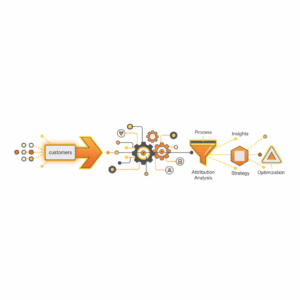
Attribution assigns credit for an outcome across the touchpoints that influenced it. Multi-touch attribution uses user-level paths to apportion credit. Marketing mix modeling uses aggregate data to estimate channel contributions over time. Both inform spend and creative but answer slightly different questions. Mix models quantify long-term and upper-funnel effects. Multi-touch models inform near-term tactical moves. Modern stacks blend them with incrementality experiments to validate causality. Lightweight open libraries such as Google’s LightweightMMM make MMM more accessible for internal analytics teams.⁴⁻⁵ Platform features like GA4’s data-driven attribution bring path-based credits into day-to-day decisioning.³ Privacy-preserving attribution via the Privacy Sandbox supports event-level and summary reporting without cross-site identifiers.⁶⁻⁷
How should executives frame the rollout?
Executives should frame attribution as an operating system, not a project. Treat it as a staged capability that starts with definitions and governance, then moves to data readiness, then to models, then to controlled tests. This sequence reduces noise and increases trust. The goal is to support budget, creative, channel, and journey decisions with evidence of incremental lift. You should fund a small core team, define decision rights, and align marketing, product, and finance on a single measurement vocabulary. You should also select a short list of canonical outcomes, such as qualified lead, first order, or activation.
What are the phases for a practical rollout?
Phase 1. Establish governance, outcomes, and data contracts
Leaders define outcomes, conversion windows, and identity rules. You document channel taxonomies and data contracts for spend, impressions, clicks, and conversions. You decide which data is gold-source for finance and which fields are required for modeling. You align privacy posture to current standards, including ATT and consent enforcement, and you ensure platform settings reflect policy.¹⁻² You define how GA4 will capture key events and how attribution settings will be used in analysis so teams cannot cherry-pick models.³ You record these decisions in a measurement playbook. You link the playbook to budget governance so attribution outputs drive planning.
Phase 2. Ready the data and instrumentation
Teams instrument clean conversion events, spend data, and channel metadata. You configure GA4 to capture key events and conversion paths with data-driven attribution visible in exploration workspaces.³ You map cost data at daily granularity with campaign and creative keys. For web advertising, you evaluate the Attribution Reporting API for privacy-preserving measurement and plan an enrollment path.⁶⁻⁷ You add quality checks that flag missing cost lines, zero-IDFA constraints, or consent gaps.² You stand up a basic customer and campaign dimension store so analysts build models on stable keys rather than fragile exports.
Phase 3. Stand up a baseline model suite
Analysts deploy a simple MMM to estimate channel contributions and decay, using an open framework like LightweightMMM for transparency and reproducibility.⁴⁻⁵ This gives finance-grade guidance for quarterly planning. In parallel, teams operationalise platform-native attribution for rapid tactical views, anchored to the same conversion definitions.³ This creates a dual-track view: MMM for strategic allocation and platform MTA for within-platform creative and bid moves. You publish clear guardrails that explain what each model can and cannot do so stakeholders avoid misuse. You set a monthly rhythm for calibrating the two views against experiments.
Phase 4. Prove causality through experiments
You run holdout and geo-split tests to validate incrementality. Meta’s Conversion Lift design illustrates the principle: compare outcomes for a randomised treatment group and an otherwise similar control group to isolate incremental impact.⁸⁻⁹ The same logic applies across channels and regions. You prioritise experiments where spend is large or model uncertainty is high. You log every test with pre-registered hypotheses, power calculations, and success thresholds, drawing on accepted incrementality testing practices in ad tech.¹⁰ You use experimental deltas to recalibrate both MMM priors and platform-based attribution weights.
Phase 5. Operationalise budget, creative, and journey decisions
Teams integrate attribution outputs into real planning and optimisation. Planners use MMM elasticities for quarterly allocation and flighting. Channel managers use platform attribution to guide bids and creative rotations, bounded by experiment-validated lift. Product managers use path insights to remove friction in key journeys. Finance teams reconcile reported revenue with modeled contribution, then update the budget. You institute a weekly “measurement huddle” where data science, channel owners, and finance review changes and lock the next sprint’s moves.
How do privacy changes alter implementation details?
Privacy rules remove persistent identifiers and limit cross-site tracking. ATT requires opt-in for tracking and returns zeros for the advertising ID when consent is not granted.¹⁻² This drives three practical actions. You must collect consent and respect it in all tags and SDKs. You must diversify measurement with modeled approaches, such as MMM, that do not depend on user-level identifiers.⁴⁻⁵ You should evaluate privacy-preserving APIs, such as the Attribution Reporting API, which enables event-level and aggregate reports without third-party cookies.⁶⁻⁷ You should also track regulator and standards updates from groups like IAB Tech Lab that publish data collaboration and attribution protocols.¹¹⁻¹²
What does a hybrid attribution architecture look like?
A hybrid architecture blends three pillars that answer different questions. MMM quantifies long-term channel contribution and diminishing returns at the market level.⁴ Platform data-driven attribution offers granular, near-real-time credit along a path.³ Experiments prove causal lift and recalibrate models when signals drift.⁸⁻¹⁰ The integration pattern is clear. You use experiments to anchor truth. You use MMM to forecast and optimise spend mix. You use platform attribution to execute and learn within channels. You keep one conversion dictionary across all pillars so numbers reconcile.
Which metrics show measurement maturity?
Mature teams track a small set of measurement KPIs. Lift proven by experiments shows causal impact. Forecast error on MMM indicates stability and model fit. Share of spend covered by experiments shows how broadly you validate. Variance between platform attribution and experimental lift highlights bias or misattribution. Cycle time from signal to decision shows operational efficiency. Finance alignment on contribution guides budget confidence. Over time, these metrics improve as governance hardens and tests feed models.
How do you avoid common pitfalls?
Organisations often fall into three traps. They treat attribution as a one-off tool rollout. They choose between MMM and MTA rather than blending them. They skip experiments and then have debates over biased numbers. You avoid these traps by sequencing capabilities, writing the playbook, and using experiments to settle uncertainty. You also avoid the lure of over-precise path fractions in low-signal environments and lean on MMM and privacy-preserving attribution where user-level resolution is limited.³⁻⁷ You monitor industry changes, such as standards from IAB Tech Lab, to adjust safely.¹¹⁻¹²
What is the actionable playbook for the next 90 days?
Leaders can start with a tight plan. You staff an attribution working group with marketing, product, analytics, and finance. You write the measurement playbook with conversion definitions, taxonomies, and decision rights. You configure GA4 events and confirm data-driven attribution availability for your key outcomes.³ You instrument cost and campaign metadata with daily controls. You run one pilot MMM using LightweightMMM to estimate elasticities for top channels.⁴⁻⁵ You design two lift tests for priority campaigns to anchor causality.⁸ You review the Privacy Sandbox enrollment requirements and plan a proof of concept to future-proof web attribution.⁶⁻⁷ You close the quarter by publishing one reconciled view that links model outputs, experiments, and decisions.
What impact should executives expect?
Executives should expect clearer budget decisions, a measured increase in media ROI, and faster cycles from insight to action. You should also expect fewer debates about numbers and more conversation about creative, offer, and experience. You can brief your board with confidence because your effect sizes come from tests and your forecasts come from validated models. This is what an attribution operating system delivers. It does not remove uncertainty. It reduces it to a level where leaders can move.
FAQ
What is the fastest way to start attribution measurement with Google Analytics 4 in our organisation?
Start by defining conversion events and enabling data-driven attribution in GA4 so teams can see fractional credit across paths. Align these definitions with finance and codify them in a measurement playbook before rolling out reports.³
How does Marketing Mix Modeling differ from multi-touch attribution for CX and media planning?
MMM uses aggregate time-series to estimate channel contribution and diminishing returns for planning. MTA assigns fractional credit across user-level paths for tactical optimisation. A hybrid approach uses MMM for quarterly allocation and MTA for in-channel moves, with experiments to validate lift.⁴⁻⁵,³,⁸
Why do we need experiments if we already have advanced attribution models?
Randomised holdouts and geo-splits prove causal lift and calibrate both MMM and platform attribution when signals drift or privacy rules limit identifiers. Experiments provide the gold standard for incrementality, which models alone cannot guarantee.⁸⁻¹⁰
Which privacy changes most affect attribution and identity foundations?
Apple’s App Tracking Transparency requires opt-in and zeros the IDFA when users decline. Web measurement is shifting to privacy-preserving APIs like the Attribution Reporting API that reduce reliance on cross-site identifiers. These changes make modeled and experimental measurement essential.¹⁻²,⁶⁻⁷
Which governance elements should Customer Science clients document first?
Document conversion definitions, consent rules, attribution settings, channel taxonomies, and data contracts for cost and exposure. Link these to decision rights so attribution outputs drive budgets, creative rotations, and journey changes in a repeatable cadence.³
Which tools and standards help future-proof attribution measurement?
Adopt open MMM libraries like LightweightMMM for transparency, configure GA4 data-driven attribution for path insights, and evaluate the Attribution Reporting API for web. Track IAB Tech Lab guidance, such as ADMAP, for privacy-safe data collaboration and attribution.⁴⁻⁷,¹¹⁻¹²
Who should own the attribution operating system inside a large enterprise?
A cross-functional working group should own the operating system. Marketing sets goals, analytics builds models and experiments, product manages journey instrumentation, and finance validates contribution and approves budget moves. This structure reduces noise and accelerates impact.
Sources
Apple Developer Documentation. “App Tracking Transparency.” 2021–2025. Apple. https://developer.apple.com/documentation/apptrackingtransparency
Apple Developer News. “AppTrackingTransparency — Upcoming Requirements.” 2021. Apple. https://developer.apple.com/news/upcoming-requirements/?id=04262021a
Google Analytics Help. “Get started with attribution.” 2025. Google. https://support.google.com/analytics/answer/10596866
Google GitHub. “LightweightMMM.” 2025. Google. https://github.com/google/lightweight_mmm
LightweightMMM Documentation. “LightweightMMM Documentation.” 2025. Read the Docs. https://lightweight-mmm.readthedocs.io/en/latest/
Google Privacy Sandbox Help. “Implementing the Attribution Reporting API and best practices.” 2025. Google. https://support.google.com/privacysandbox/answer/15682664
MDN Web Docs. “Attribution Reporting API.” 2025. Mozilla. https://developer.mozilla.org/en-US/docs/Web/API/Attribution_Reporting_API
Triple Whale Help Center. “Meta Conversion Lift Experiment.” 2025. Triple Whale. https://kb.triplewhale.com/en/articles/10605805-meta-conversion-lift-experiment
Hunch. “Conversion Lift Study on Meta: A 101 Guide.” 2025. Hunch. https://www.hunchads.com/blog/conversion-lift-study-on-meta
KDD Tutorial. “Online Advertising Incrementality Testing and Experimentation.” 2021. ACM KDD Tutorial PDF. https://joel-barajas.github.io/kdd2021-incrementality-testing/tutorial_detailed.pdf
IAB Tech Lab. “Attribution Data Matching Protocol (ADMaP).” 2025. IAB Tech Lab PDF. https://iabtechlab.com/wp-content/uploads/2025/02/ADMAP-Version-1.0-FINAL.pdf
IAB Tech Lab. “Attribution Data Matching Protocol (ADMaP) Overview.” 2025. IAB Tech Lab. https://iabtechlab.com/admap/