






























What do we mean by attribution and incrementality?
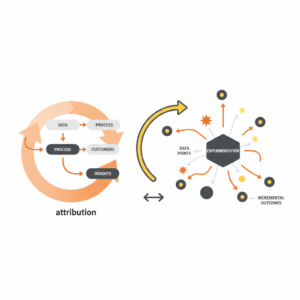
Leaders need precise language to make precise decisions. Attribution assigns credit for an outcome across the touchpoints that preceded it. Teams use rules or models to apportion that credit to channels, campaigns, or creatives. Multi-touch attribution distributes credit across exposures, while last-touch and first-touch concentrate credit on a single event. Marketing mix modeling estimates channel contributions using aggregated time series across media and business drivers. Both approaches help explain past performance and inform allocation, yet neither proves causality by default. Incrementality answers a different question. Incrementality measures the causal lift that media or experiences create above the baseline that would have happened anyway. Lift requires a credible counterfactual created through experiments or strong quasi-experimental designs. Attribution explains contribution. Incrementality proves effect.¹²³⁴
Why does this distinction matter for enterprise CX and growth?
Executives manage trade-offs between speed, scale, and certainty. Attribution delivers speed and granularity. Teams can run daily or intra-day reporting, segment by audience, and compare thousands of creatives. This makes attribution ideal for continuous optimization and governance of always-on programs. Incrementality delivers certainty. Proper lift tests quantify what spend truly creates. This supports portfolio shifts, channel entry or exit, and board-level ROI narratives. The distinction matters most when privacy changes or signal loss distort click trails. When identifiers fragment and platform reports diverge, attribution can misstate contribution. Incrementality protects capital by anchoring decisions to causal evidence that survives policy shifts and cookie deprecation.⁴⁶¹⁶
How does attribution work in practice?
Attribution models translate exposure and outcome data into credit. Multi-touch attribution relies on user-level paths and uses rules, probabilistic weights, or machine learning to assign fractional credit to touchpoints. Vendors have advanced causal representation learning to reduce bias, but methods still depend on observable features and modeling assumptions. Data-driven attribution within ad platforms adds modeled paths but remains correlational. At the aggregate level, marketing mix modeling regresses outcomes on spend, price, promotions, and exogenous factors to estimate elasticities and ROI, often with Bayesian structures to stabilize estimates. Both methods improve planning and flighting, yet both can over- or under-credit channels that correlate with latent demand.²⁵¹⁴
How does incrementality measurement create a true counterfactual?
Incrementality designs create treatment and control groups to isolate causal lift. The gold standard is a randomized controlled trial. For digital platforms, conversion lift studies randomly withhold exposure from a holdout audience, then measure the difference in outcomes between exposed and control. Geo-experiments randomize at the market level by turning media on in test regions and off in matched control regions. Advanced implementations match markets on pre-period outcomes and covariates, then estimate lift with difference-in-differences or synthetic controls. When user-level randomization is infeasible, geo-based tests provide a practical route that does not rely on individual identifiers and remains resilient to privacy constraints.³⁴¹⁰¹⁸
When should I use attribution vs incrementality?
Use attribution when the goal is to optimize within a channel or across many creative and audience variants at high frequency. Use attribution to diagnose funnel friction, to coordinate content calendars, and to enforce budget guardrails week to week. Use incrementality when the decision changes the portfolio. Use incrementality to validate a platform’s performance claims, to size the net-new revenue from brand or upper-funnel spend, and to set investment levels for the next planning cycle. A practical rule helps teams align. If the decision is reversible and low risk, lean on attribution. If the decision is consequential and capital-intensive, require incrementality. This pairing increases speed without sacrificing truth.¹²³⁶
How do these methods complement each other across the CX stack?
Attribution and incrementality perform best as a system. Run periodic lift tests to calibrate what is truly working, then train or weight attribution models against the experimental truth. Calibrated models can propagate causal learnings to granular segments and new creatives where experiments would be underpowered. Marketing mix models can include experiment-based priors to stabilize estimates, while platform-level data-driven attribution can be re-scaled using observed lift. Teams can also use lift tests to tune guardrails for automated budget allocation, ensuring optimizers pursue cost per incremental outcome, not cost per attributed outcome. This loop turns experiments into durable operating policy.²³¹⁴¹٥
What are the common risks and how do we mitigate them?
Attribution risks include selection bias, missing or misattributed touchpoints, and platform self-crediting. Data gaps from privacy policies can increase bias. Mitigations include server-side tagging, clear taxonomy, and unified identity at the event level where lawful and transparent. Multi-touch models benefit from causal regularization and negative controls, yet leaders should still treat outputs as correlational. Incrementality risks include contamination between exposed and control groups, insufficient power, and short test windows that miss delayed effects. Geo-experiments require careful market matching and time for stabilization. Pre-registration of hypotheses, power calculations, and difference-in-differences analysis reduce false positives. Platform lift studies help, but independent geo tests provide external validation.³⁴¹٠١٨
How do I measure impact and build an executive evidence trail?
Executives should standardize a small set of metrics. For attribution, track model-based ROI, cost per attributed outcome, and creative contribution indices, with drift monitoring to detect structural breaks. For incrementality, track lift percentage, incremental cost per outcome, and net incremental revenue across test cells and geos. Include confidence intervals and minimum detectable effects in governance packs. Consolidate learnings quarterly. Use lift-calibrated elasticities in the planning model and show how budgets shift as a result. Document assumptions, test pre-conditions, guardrails, and data provenance. This builds an auditable trail that finance and the board can trust when approving material reallocation of spend.²³١٤
Which operating model helps enterprises get started quickly?
Start with a dual-track operating cadence. Track one runs continuous attribution for daily decisions. Track two schedules a quarterly experiment calendar. Use platform conversion lift where available to learn fast, then run independent geo-experiments for high-stakes channels to confirm and generalize. Feed every validated lift into your mix model and your data-driven attribution scaling logic. Establish a marketing experimentation council with CX, data, finance, and legal to prioritize tests, ensure privacy compliance, and adjudicate results. Close the loop by tying changes in spend to changes in customer outcomes such as first-party conversions, retention, and service contacts deflected, measured through the same incrementality lens.⁴⁶١٨
What are the first practical steps this quarter?
Executives can move now. Define decision rights that specify which choices require lift. Inventory available platform lift tooling and eligibility. Identify 3 to 5 high-impact use cases such as brand video, paid social prospecting, and large search generics. Design a geo-experiment for one national channel with matched markets and clear power targets. Update your MMM brief to include experiment priors and publish a calibration plan for MTA. Set reporting to show both attributed and incremental outcomes side by side, with a simple rule for budget shifts based on incremental cost per outcome. This unit moves the organization from reporting to causal management without slowing the business.²³⁴¹٠
FAQ
What is marketing incrementality in simple terms?
Marketing incrementality is the causal lift in business outcomes that would not have happened without the marketing activity. It is measured through experiments such as conversion lift or geo-experiments that create a credible control group.³⁴¹٨
How is multi-touch attribution different from incrementality?
Multi-touch attribution assigns credit across touchpoints using user-level paths or models. It describes contribution but does not prove causality. Incrementality testing proves effect by comparing exposed and control groups to estimate true lift.²⁵³
Which method should Customer Science clients use to set budgets?
Use incrementality to set or materially change budgets because it quantifies net-new outcomes with confidence. Use attribution to optimize within budget across campaigns, audiences, and creatives for day-to-day performance.¹²⁶
Why are geo-experiments valuable after privacy changes?
Geo-experiments randomize at market level and rely on aggregated metrics rather than individual identifiers, which makes them resilient to cookie loss and mobile tracking limits while still isolating causal impact.¹٠١٨
Which platforms offer built-in incrementality tools?
Google offers Conversion Lift to measure causal impact on purchases, visits, or other conversions. Meta supports conversion lift studies that create exposed and holdout groups to estimate lift. Availability can vary by account and region.⁴³
How do I combine MMM with experiments and MTA?
Use experiments to calibrate elasticities in your marketing mix model and to re-scale or weight MTA outputs. This alignment propagates causal truth to granular decisions while keeping planning models stable.²¹⁴
What are the most common pitfalls to avoid?
For attribution, watch for selection bias and incomplete paths. For incrementality, avoid underpowered tests and contamination between groups. Pre-registration, power analysis, matched markets, and clear guardrails reduce these risks.³١٨
Sources
IAB. “The Essential Guide to Marketing Mix Modeling and Multi-Touch Attribution.” 2019. IAB (PDF). https://www.iab.com/wp-content/uploads/2019/11/IAB_MMA_MTA-Guidebook_Nov-2019.pdf
NIQ. “Marketing Mix Modeling.” 2023. NIQ Solution Overview. https://nielseniq.com/global/en/solutions/marketing-mix-modeling/
Google. “About Conversion Lift.” 2025. Google Ads Help. https://support.google.com/google-ads/answer/12003020
Hunch. “Conversion Lift Study on Meta: A 101 Guide.” 2025. Hunch Blog. https://www.hunchads.com/blog/conversion-lift-study-on-meta
Zhang et al. “DCRMTA: Unbiased Causal Representation for Multi-touch Attribution.” 2024. arXiv (PDF). https://arxiv.org/pdf/2401.08875v1
Criteo. “Understanding incrementality: The key to measuring a campaign’s true impact.” 2024. Criteo Blog. https://www.criteo.com/blog/understanding-incrementality/
Nielsen. “Marketing Mix Modeling: What Marketers Need to Know.” 2014. Nielsen Whitepaper (PDF). https://beta.nielsen.com/wp-content/uploads/sites/2/2019/04/marketing-mix-modeling-what-marketers-need-to-know.pdf
Impression. “The Ultimate Guide to Incrementality Testing.” 2024. Impression Blog. https://www.impressiondigital.com/blog/incrementality-testing/
Measured. “How do Geo Experiments Inform Incrementality Measurement?” 2025. Measured Blog. https://www.measured.com/blog/what-do-you-know-about-geo/
Barajas et al. “Advertising Incrementality Measurement using Controlled Geo-Experiments.” 2020. ADKDD Proceedings (PDF). https://papers.adkdd.org/2020/papers/adkdd20-barajas-advertising.pdf
Uber. “Using Causal Inference to Improve the Uber User Experience.” 2019. Uber Engineering Blog. https://www.uber.com/blog/causal-inference-at-uber/
Twilio. “An Introduction to Multi-Touch Attribution.” 2023. Twilio Resource Center. https://www.twilio.com/en-us/resource-center/an-introduction-to-multi-touch-attribution