























Why do touchpoints matter more than channels in omnichannel design?
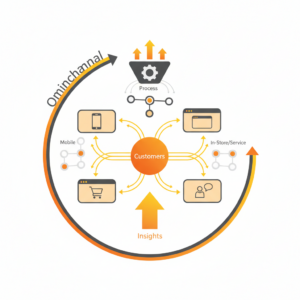
Leaders design touchpoints to carry value across channels. A touchpoint is a discrete moment where a customer and a brand exchange information, make a decision, or complete a task. This unit cuts across web, app, voice, email, social, branch, and field service. Journeys string these units together to achieve an outcome such as onboarding or claims resolution. Research shows that customers judge brands on end-to-end journeys more than isolated interactions, which makes touchpoint quality and continuity a primary lever for experience and cost outcomes.¹ A disciplined touchpoint strategy defines the purpose, inputs, outputs, and ownership for each interaction. It then orchestrates handoffs so that context, consent, and state follow the customer without loss. This structure prevents channel silos from fragmenting service. It also gives executives a practical way to prioritise funding, measure variance at the moment level, and scale improvements across journeys.¹
What is an omnichannel touchpoint strategy?
Executives use an omnichannel touchpoint strategy to specify how each interaction unit performs across channels, how data moves between units, and how orchestration adapts to intent and risk. The strategy sets canonical definitions for entities such as customer identity, case, product, and permission. It codifies decision logic for routing, authentication, advice, and fulfilment. It embeds accessibility requirements so that the same task is perceivable, operable, understandable, and robust in every channel.² It grounds the design in human-centred principles that require teams to align interface, workflow, and policy with user goals and context.³ The result is a playbook that turns channels into interchangeable surfaces. The playbook lets service teams add or retire channels without re-architecting core interactions. It enables consistent outcomes while leaving room for channel-specific affordances that improve ease, speed, and confidence.² ³
Principle 1: Start from journeys, design at the touchpoint level
Teams anchor on a few critical journeys, then design at the touchpoint level to remove friction at source. Journeys give purpose to touchpoints. Touchpoints give precision to journeys. This pairing helps leaders avoid the trap of cosmetic channel upgrades that leave root causes untouched. Studies highlight that journey performance depends on the weakest link, not the strongest touchpoint.¹ When teams define each touchpoint’s intent, required data, decision rules, and success criteria, they can fix failure demand, reduce rework, and cut handling time. They can also scale improvements because many journeys reuse the same units such as identity verification, consent capture, address update, payment, and status notification. A touchpoint catalogue becomes the backbone of reuse. It also becomes the map that product, design, operations, and risk use to align releases and audit changes.¹
Principle 2: Make accessibility and inclusion non-negotiable
Leaders bake accessibility into every touchpoint definition. Accessibility ensures people with disabilities can complete tasks reliably. Accessibility also improves outcomes for everyone in variable contexts such as glare, noise, or low bandwidth. The Web Content Accessibility Guidelines set testable criteria on contrast, focus order, error identification, alternatives for non-text content, and input modalities.² Teams attach these criteria to each interaction unit and enforce them in design reviews, code repositories, and acceptance tests. Inclusive patterns such as plain language, flexible timing, captions, and keyboard support reduce cognitive load and error rates.² Organisations that institutionalise these practices see lower cost to serve and higher satisfaction because customers need fewer retries and less live support. Accessibility becomes a quality attribute on par with reliability and security.²
Principle 3: Treat consent, identity, and context as first-class data
Executives protect trust by making consent, identity, and context portable across touchpoints. Consent records state what the customer allows the organisation to do with their data. Identity confirms who is acting. Context captures what has happened so far. Privacy law requires organisations to collect, use, and disclose personal information only for the purposes described to the customer, and to secure it appropriately.⁴ The NIST Privacy Framework provides a structure to identify and govern privacy risks across data flows and systems.⁵ A robust touchpoint strategy defines how each unit reads and writes these attributes. It specifies which systems are authoritative, how tokens expire, and how to recover gracefully when checks fail. This design reduces duplication, prevents over-collection, and limits escalation to humans. It also makes every channel safer by default.⁴ ⁵
Principle 4: Orchestrate decisions, not channels
Teams move orchestration logic out of channels and into shared services that evaluate intent, risk, and value. Orchestration chooses the next best action using signals from behaviour, profile, entitlements, and policies. Leaders who centralise this logic avoid brittle rules embedded in channel code. They also unlock consistent experiences because the same decisioning applies whether the customer taps a button, speaks to an agent, or replies to a message. Research on service consistency shows that transparent rules and predictable handoffs drive higher satisfaction and loyalty while lowering operational variance.⁶ A well-governed decision layer routes high-risk cases to humans, automates low-risk steps, and explains decisions in clear language. It logs reasons for audit. It supports A/B testing and learning loops. This approach turns omnichannel into an operating system rather than a set of parallel tracks.⁶
Principle 5: Engineer resilience into every interaction unit
Leaders design touchpoints to fail gracefully. Resilient units validate inputs, surface status clearly, and provide recovery paths that do not lose data or context. Human-centred design standards call for systems to support error prevention and easy recovery.³ Resilience patterns include optimistic UI with server reconciliation, idempotent APIs for repeated submissions, and stateful queues for long-running steps. Operational playbooks define what happens when a dependency is down. Status messages use plain language and offer next steps that fit the channel. When customers can save and resume, switch channels without repeating themselves, and see real-time progress, abandonment drops and completion rises.³ Resilience also protects frontline teams. Clear system states reduce handle time and escalations. Structured callbacks and proactive notifications prevent backlog spikes when incidents occur.³
Principle 6: Measure touchpoint health with journey-level outcomes
Executives instrument touchpoints and read their performance through the lens of journey outcomes. Analytics attach to each unit and roll up to customer goals such as time to value, first contact resolution, or claim cycle time. Leaders supplement outcome metrics with diagnostic signals like error codes, retries, deflections, and transfers. Research emphasises the value of measuring complete journeys to reveal gaps that single-interaction metrics hide.¹ Teams combine qualitative evidence from usability tests and call listening with quantitative data from events and feedback. They then run experiments at the unit level to improve the whole. Governance ties investment to measurable uplift. Scorecards track accessibility conformance, privacy incidents, and decision explainability alongside speed and satisfaction to ensure balance.² ⁴ ⁵ ⁶
How should leaders operationalise a touchpoint strategy in twelve weeks?
Executives can stand up a pragmatic program in three waves. In weeks 1 to 4, teams select two priority journeys, catalogue current touchpoints, and define target units with purpose, inputs, outputs, rules, and accessibility criteria. They align privacy, security, and risk sign-off and define data authorities.⁴ ⁵ In weeks 5 to 8, teams build an orchestration layer for a handful of decisions, integrate identity and consent services, and retrofit two reusable units such as authentication and status.² ³ In weeks 9 to 12, teams deploy controlled pilots across two channels, measure journey outcomes, and publish a playbook with patterns and guardrails. Leaders communicate results, close gaps, and plan the next wave. Evidence from service transformation programs shows that disciplined reuse and journey-level measurement accelerate impact while containing risk.¹ ⁶
What outcomes should executives expect from disciplined orchestration?
Executives should expect faster time to value for customers, lower handling costs, and fewer escalations. They should also expect fewer accessibility defects, clear privacy posture, and better audit readiness.² ⁴ ⁵ Studies on journey performance connect end-to-end consistency with higher satisfaction and loyalty.¹ Research on operational consistency links clear rules and predictable handoffs with lower variance and better service levels.⁶ Organisations that instrument touchpoints and learn from usage tend to build better services faster because they reuse proven units rather than reinventing them per channel. Teams that adopt standards for human-centred design and accessibility improve completion rates and reduce error costs.² ³ These outcomes compound as the touchpoint catalogue grows. The catalogue becomes a shared asset that lifts both customer experience and operational efficiency.¹ ² ³
Which guardrails keep omnichannel strategies safe and sustainable?
Leaders set guardrails that balance speed with duty of care. Accessibility conformance prevents exclusion and legal risk.² Privacy governance ensures lawful, fair, and transparent handling of personal information across all channels.⁴ The NIST Privacy Framework helps teams identify, govern, control, and communicate privacy risk throughout the lifecycle.⁵ Human-centred design standards keep solutions anchored to user needs, not internal structures.³ Clear change control protects decision logic and audit trails as models and rules evolve. Incident playbooks define communication and recovery for both customers and staff. Vendor controls and data processing agreements keep third-party services aligned with enterprise policy. These guardrails make omnichannel sustainable. They also create confidence for executives to deploy automation where it helps and to keep humans where judgment and empathy matter most.² ³ ⁴ ⁵
What is the executive call to action?
Leaders should name a senior owner for touchpoint strategy, publish the first version of the touchpoint catalogue, and fund an orchestration layer that centralises identity, consent, and decisioning. They should mandate accessibility criteria and human-centred design reviews for every release. They should measure journey outcomes and tie investment to uplift. They should use the first three months to prove reuse and resilience on two journeys, then scale through patterns. Executives who take these steps turn omnichannel from a channel expansion program into a disciplined operating model. They create a system that protects trust, accelerates value, and makes service simpler for customers and staff.² ³ ⁴ ⁵ ⁶
FAQ
What is a touchpoint strategy in omnichannel customer experience?
A touchpoint strategy defines how each interaction unit works across channels, how data such as identity, consent, and context travels, and how orchestration selects the next best action for the customer. It treats channels as interchangeable surfaces while keeping outcomes consistent.² ³ ⁵ ⁶
How does journey-first, touchpoint-level design improve outcomes for Customer Science clients?
Journey-first design sets purpose. Touchpoint-level definition removes friction at source. This pairing reduces failure demand, improves completion, and scales reuse across common units like authentication, consent, payment, and status.¹ ³
Which standards should Customer Science teams embed into touchpoint definitions?
Teams should embed WCAG 2.2 accessibility criteria, human-centred design principles from ISO 9241-210, and privacy risk management using the NIST Privacy Framework, alongside local privacy law requirements.² ³ ⁴ ⁵
Why prioritise a shared orchestration layer over channel-specific rules?
A shared decision layer ensures consistent decisions regardless of channel, supports explainability and audit, and reduces brittle channel code. Research links service consistency and predictable handoffs to higher satisfaction and lower variance.⁶
How should leaders measure the health of touchpoints across channels?
Leaders should instrument each unit and roll up metrics to journey outcomes such as time to value and first contact resolution. They should track diagnostics like retries, transfers, and error codes, and pair them with accessibility, privacy, and explainability scorecards.¹ ² ⁴ ⁵ ⁶
Which governance guardrails keep omnichannel programs compliant and resilient?
Key guardrails include accessibility conformance, privacy governance aligned to law, adoption of human-centred design standards, change control for decision logic, and incident playbooks for recovery across channels.² ³ ⁴ ⁵
Who should own the touchpoint catalogue and orchestration roadmap?
An executive owner in Customer Experience and Service Transformation should own the catalogue and roadmap, with product, design, operations, risk, and technology as co-stewards to ensure reuse, compliance, and measurable outcomes.¹ ² ³ ⁴ ⁵ ⁶
Sources
Rawson, A., Duncan, E., & Jones, C. (2013). The Truth About Customer Experience. Harvard Business Review. https://hbr.org/2013/09/the-truth-about-customer-experience
World Wide Web Consortium (W3C). (2023). Web Content Accessibility Guidelines (WCAG) 2.2. https://www.w3.org/TR/WCAG22/
International Organization for Standardization. (2019). ISO 9241-210:2019 Ergonomics of human-system interaction — Human-centred design for interactive systems. https://www.iso.org/standard/77520.html
Office of the Australian Information Commissioner. (n.d.). The Privacy Act 1988 and Australian Privacy Principles. https://www.oaic.gov.au/privacy/the-privacy-act
National Institute of Standards and Technology. (2020). NIST Privacy Framework: A Tool for Improving Privacy through Enterprise Risk Management. https://www.nist.gov/privacy-framework
McKinsey & Company. (2014). The Three Cs of Customer Satisfaction: Consistency, Consistency, Consistency. https://www.mckinsey.com/capabilities/operations/our-insights/the-three-cs-of-customer-satisfaction-consistency-consistency-consistency