
























What is touchpoint orchestration?
Touchpoint orchestration aligns every customer interaction across channels, systems, and teams so the experience advances a clear intent for the customer and the business. Practitioners use data, decision logic, and operating routines to coordinate what happens next at each touchpoint. The unit of design is the sequence of interactions, not the channel in isolation. A touchpoint includes any contact where a customer exchanges information or value with the organization. Orchestration binds these moments into a coherent journey that feels consistent and timely. Leaders treat orchestration as an ongoing capability with rules, triggers, and service guardrails that adapt to context. This approach reduces friction, clarifies accountability, and converts intent into measurable outcomes such as higher satisfaction, lower cost to serve, and improved conversion. Customers recognize continuity quickly and reward it with trust and loyalty.¹
How does orchestration differ from journey mapping?
Journey mapping describes what customers experience today. Touchpoint orchestration changes what customers will experience tomorrow. A map captures stages, emotions, and pain points. Orchestration adds decisioning, data activation, and change mechanisms. Teams define next best actions, content variants, and service moves that fire based on signals such as recent activity, lifecycle stage, or predicted need. Where mapping often ends in a poster, orchestration ends in a live playbook implemented in platforms and processes. This distinction matters because customers expect continuity across channels and devices. They want the organization to remember context, anticipate needs, and eliminate rework. Orchestration operationalizes that expectation by connecting design, data, and delivery. Organizations that move from static maps to live orchestration report higher customer satisfaction and stronger revenue growth because the experience adapts in real time.²
What problems does touchpoint orchestration solve?
Complex organizations create fragmented experiences. Silos hold channel budgets. Systems store partial histories. Agents and bots ask customers to repeat information. These gaps drive churn and cost. Orchestration solves fragmentation by assigning ownership to the journey, linking data to decisions, and aligning incentives to outcomes. The practice brings together marketing, digital, contact centre, and product teams under shared metrics for continuity and resolution. It defines how human and automated touchpoints complement each other. It sets escalation rules, consent boundaries, and service recovery moves. The result is fewer transfers, fewer repeat contacts, and fewer abandoned journeys. Customers feel known and guided. Employees gain clarity about what to do and why it matters. Executives gain a line of sight to value, which makes investment decisions more rational and less political.³
What is the mechanism behind effective orchestration?
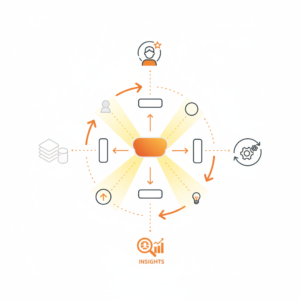
Successful orchestration uses four mechanisms. First, signal collection gathers event data, preferences, and consent into a usable profile. Second, decisioning selects the next best action using business rules and models. Third, activation delivers that action through channels such as web, app, email, SMS, or agent desktops. Fourth, learning closes the loop by measuring the outcome and updating rules. This loop operates at two speeds. Teams make slow decisions about strategy, standards, and guardrails. Systems make fast decisions about individual interactions. The contact centre plays a central role by resolving complex needs, capturing context, and feeding insights back into the loop. When these mechanisms align, customers receive relevant help at the right moment. When they drift, the experience reverts to randomness, which customers interpret as indifference. Leaders prevent drift by governing the loop with clear ownership and change cadences.⁴
Where does orchestration fit in the CX and service stack?
Orchestration sits between data infrastructure and channel delivery. Customer data platforms unify profiles and consents. Decision engines apply eligibility, prioritization, and fatigue rules. Journey and campaign tools trigger actions. Contact centre platforms route and assist interactions. Knowledge and workflow systems enable resolution. Analytics and experimentation measure impact. This stack only works when teams agree on definitions for events, identities, and outcomes. It also depends on service design practices that translate strategy into reusable components such as intents, playbooks, and conversation designs. The orchestration layer does not replace channel excellence. It coordinates channel excellence so customers experience continuity. The investment case is stronger when technology and operating model mature together. Technology without operating discipline creates more noise. Operating discipline without activation capability creates more static documents.⁵
Why does touchpoint orchestration matter for value creation?
Orchestration matters because customers judge brands on coherence, not channel prowess. They expect connected experiences, fast resolution, and consistent promises across devices. Research shows that most customers expect companies to anticipate needs and provide seamless handoffs. These expectations correlate with higher satisfaction and loyalty when met, and with switching risk when missed. Orchestration also matters for cost. Coordinated journeys reduce repeat contacts and transfers. Clear next best actions reduce wastage in outreach and improve conversion. Transparent measurement enables continuous improvement. Organizations that invest in orchestration report gains in customer satisfaction, employee experience, and operational efficiency. These gains compound when leaders fund the capability as a shared service rather than as isolated projects. A coherent journey reduces entropy, which is the hidden tax in large-scale service operations.¹ ⁶ ⁷
How do you measure orchestration quality without drowning in metrics?
Leaders measure orchestration by linking customer progress to business outcomes. Start with a journey goal such as onboarding completion or service resolution. Define touchpoint-level leading indicators such as abandon rate, authentication success, or knowledge article adoption. Track continuity signals such as repeat contacts within seven days, transfers per resolution, and reauthentication requests. Combine these with customer measures such as satisfaction, effort, and trust at the point of experience. Add commercial measures such as conversion, activation, and lifetime value where appropriate. Use controlled tests to verify causality and avoid reporting theatre. Publish transparent learning loops so teams see what changed and why. The discipline is simple. Measure the moments that move the journey forward. Retire metrics that do not influence decisions. Focus on the few indicators that executives can fund and teams can act on.⁸
Which operating model enables orchestration at scale?
Organizations scale orchestration with a product-centric operating model for journeys. Assign a Journey Owner who holds outcome targets and a backlog. Create a cross-functional squad with service design, engineering, data science, and contact centre operations. Give the squad clear guardrails on privacy, consent, and brand standards. Fund the squad to run tests, ship changes, and maintain playbooks. Integrate change with frontline rhythms through coaching and knowledge updates. Elevate complex cases to specialists and harvest insights back into decision rules. This operating model connects strategy to daily work. It also improves employee engagement because teams see impact quickly. The governance approach should be light but real. Approve intents, rules, and content libraries centrally. Delegate execution to squads. Use quarterly business reviews to adjust targets and investments. Culture follows clarity. Clarity follows ownership.⁹
What are the common risks and how do leaders mitigate them?
Common risks include consent violations, decision bias, fatigue from over-messaging, and over-automation that traps customers in loops. Leaders mitigate these risks with explicit consent models, human-in-the-loop reviews, and fatigue caps. They use fairness testing and incident playbooks to audit models and recover from errors. They set gold paths for resolution and force fail-safes that route customers to humans when signals conflict. They publish transparent explanations of personalization logic where appropriate. They monitor for proxy discrimination and unintended impact. They train teams on responsible AI usage and maintain data minimization practices. The point is not perfection. The point is predictable safety and rapid recovery. Customers forgive errors when recovery is fast, respectful, and fair. Orchestration enables that recovery by aligning signals, people, and systems around clear rules of engagement.¹⁰
How do you get started in a complex enterprise?
Leaders start small, choose a high-value journey, and deliver a visible improvement within one quarter. Pick a journey with clear outcomes, high volume, and known pain points. Build a thin slice across data, decisioning, and activation. Define the next best action library and service guardrails. Train agents and update knowledge. Launch controlled tests and iterate weekly. Publish learning and expand to adjacent moments. Use the first win to fund a sustained capability. The aim is momentum over perfection. Enterprises that approach orchestration as a capability, not a campaign, build durable advantage. They turn journeys into products, playbooks into routine, and routine into culture. The result is a service system that learns, adapts, and scales. Customers notice. Teams feel pride. Executives see the line from orchestration to outcomes.¹ ⁴ ⁸
What is the executive call to action?
Executives can sponsor a single journey, appoint an accountable owner, and require a measurable improvement in continuity and resolution within 90 days. They can align incentives to journey outcomes, not channel metrics. They can invest in the orchestration layer and the operating model that makes it real. They can insist on responsible practices for consent, fairness, and safety. Most importantly, they can set the tone. The organization will treat customer continuity as a first-order objective when leaders do. Orchestration is not a trend. It is how modern service systems create value through clarity, coordination, and care. The choice is simple. Build the capability now or keep paying the tax of fragmentation.⁶ ⁹
FAQ
What is touchpoint orchestration in customer experience?
Touchpoint orchestration is the coordinated design and delivery of every customer interaction across channels, using data and decision rules to advance a clear journey objective while protecting consent and service standards. It connects mapping, data, and operations into a live capability that adapts to context.
How does touchpoint orchestration improve contact centre performance?
Orchestration reduces repeat contacts, clarifies escalations, and equips agents with context and next best actions. This decreases transfers, shortens handle time, and raises first contact resolution while improving employee confidence and customer trust.
Why should Customer Science clients prioritize journey ownership?
Journey ownership assigns targets, backlogs, and guardrails to a named leader with a cross-functional squad. This structure links investment to outcomes and accelerates change across digital, contact centre, and product teams at www.customerscience.com.au.
Which metrics best prove orchestration value to executives?
Leaders should track continuity and progress metrics such as repeat contact within seven days, transfers per resolution, authentication success, completion of key tasks, satisfaction, and conversion. These indicators show whether the journey is moving customers forward efficiently.
What technologies enable touchpoint orchestration at scale?
Core components include unified profiles and consent management, decisioning for next best action, activation across channels, contact centre routing and assistance, knowledge and workflow for resolution, and analytics for testing and learning.
Who owns guardrails for privacy, fairness, and fatigue?
A central governance group sets consent models, fatigue caps, and fairness standards, while journey squads execute within those guardrails. This balances safety with speed and keeps experiences responsible and resilient.
Which first step delivers momentum in a complex enterprise?
Select one high-volume journey with clear outcomes, stand up a thin slice across data, decisioning, and activation, and deliver a measurable improvement in continuity and resolution within one quarter. Use that win to fund the broader capability.
Sources
Salesforce Research. “State of the Connected Customer, 5th Edition.” 2024. Salesforce. https://www.salesforce.com/resources/research-reports/state-of-the-connected-customer
McKinsey & Company. “The new battleground for marketing-led growth: Omnichannel personalization.” 2021. McKinsey. https://www.mckinsey.com/capabilities/growth-marketing-and-sales/our-insights/the-new-battleground-for-marketing-led-growth-omnichannel-personalization
Zendesk. “CX Trends 2024.” 2024. Zendesk. https://www.zendesk.com/blog/trends/
Forrester. “Journey Orchestration Platforms: A Blueprint.” 2020. Forrester. https://www.forrester.com/blogs/journey-orchestration-a-blueprint-for-the-north-star-journey/
Twilio Segment. “The 2023 Growth Report: Personalization in a Privacy-First World.” 2023. Twilio Segment. https://segment.com/resources/reports/growth-report/
Harvard Business Review. Peter Kriss. “The Value of Customer Experience, Quantified.” 2014. HBR. https://hbr.org/2014/08/the-value-of-customer-experience-quantified
Adobe. “2024 Digital Trends.” 2024. Adobe and Econsultancy. https://business.adobe.com/resources/reports/digital-trends.html
Google. “Measuring Omni-Channel Success: Best Practices.” 2020. Think with Google. https://www.thinkwithgoogle.com/marketing-strategies/measurement/omnichannel-measurement/
Spotify Technology. Henrik Kniberg. “Scaling Agile @ Spotify.” 2014. Spotify Engineering Culture. https://blog.crisp.se/wp-content/uploads/2012/11/SpotifyScaling.pdf
NIST. “Artificial Intelligence Risk Management Framework 1.0.” 2023. National Institute of Standards and Technology. https://www.nist.gov/itl/ai-risk-management-framework-ai-rmf-10