































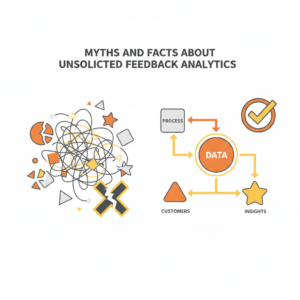
What is unsolicited feedback analytics, really?
Unsolicited feedback analytics converts customer comments that were not prompted by surveys into structured, decision-grade insight. This includes complaints, compliments, social posts, reviews, chat transcripts, call notes, and open text sent through digital channels. The defining feature is intent. The customer chose to speak. That choice signals emotional intensity, salience, and urgency that solicited feedback often lacks. Gartner defines Voice of Customer as a discipline that captures customer needs and expectations from multiple sources to inform experience design and operations.¹ Unsolicited feedback is the highest-volatility input in that system. It arrives unevenly, reflects lived experience, and exposes friction that customers care enough to report without being asked.
This form of analytics applies natural language processing, sentiment analysis, and thematic clustering to high-volume, unstructured data. When governed well, it becomes an early-warning system for service breakdowns and a discovery engine for unmet needs. When governed poorly, it becomes noise. The distinction matters for executive decision-making because unsolicited feedback often surfaces risk before it appears in operational metrics or survey scores.
Myth 1: Unsolicited feedback is too biased to trust
Executives often assume unsolicited feedback reflects only extremes. That assumption is directionally correct and strategically misleading. Unsolicited feedback is biased toward strong emotion, but that bias is precisely its value. Research from the Harvard Business Review shows customers are significantly more likely to voice feedback after negative experiences, particularly when expectations are violated.² This does not make the data unreliable. It makes it diagnostic.
The fact is that unsolicited feedback highlights moments of truth. It surfaces failure demand, process gaps, and policy friction that drive repeat contact and churn. Bias does not invalidate insight. It defines the lens. The analytical task is not to generalize prevalence, but to understand causality. When leaders treat unsolicited feedback as a leading indicator rather than a representative sample, its strategic value becomes clear.
Myth 2: Surveys already capture what matters
Surveys measure what the organisation chooses to ask. Unsolicited feedback reveals what customers choose to talk about. That distinction shapes insight quality. McKinsey’s research on customer experience shows that structured feedback programs often lag real customer sentiment because they rely on predefined questions and sampling windows.³ Unsolicited feedback arrives in real time and reflects emerging issues before they are formalised into survey instruments.
The fact is that surveys and unsolicited feedback answer different questions. Surveys quantify performance against expectations. Unsolicited feedback explains why expectations were broken or exceeded. Organisations that rely exclusively on surveys optimise for known problems. Organisations that integrate unsolicited feedback discover unknown ones. The strongest Voice of Customer systems deliberately combine both.
What data sources qualify as unsolicited feedback?
Unsolicited feedback spans more channels than most organisations realise. It includes complaints lodged through contact centres, product reviews, app store comments, social media posts, community forums, and spontaneous emails. It also includes free-text comments embedded in operational interactions, such as chat sessions or call summaries, where the customer was not explicitly invited to provide feedback.
Forrester identifies unstructured customer data as the fastest-growing VoC input category, driven by digital service adoption and messaging channels.⁴ The analytical implication is scale. These sources generate volume that exceeds human review capacity. That volume requires automation, taxonomy discipline, and governance. Without those controls, insight fragments and credibility erodes.
Myth 3: Unsolicited feedback analytics is just sentiment analysis
Sentiment is the shallowest layer of unsolicited feedback analytics. It answers how customers feel, not what is broken or how to fix it. Modern unsolicited feedback analytics focuses on drivers, journeys, and operational root causes. It maps themes to processes, policies, products, and service moments. It links emotion to actionability.
The fact is that sentiment without structure creates executive theatre. Actionable analytics classifies feedback into stable taxonomies aligned to the operating model. It quantifies effort, recurrence, and financial impact. Gartner notes that mature VoC programs integrate feedback insights directly into operational workflows rather than reporting dashboards alone.¹ This is where unsolicited feedback earns its place at the executive table.
How does unsolicited feedback analytics work in practice?
Effective unsolicited feedback analytics follows a repeatable mechanism. Data is ingested from multiple channels and normalised. Natural language models extract entities, intents, and themes. Those themes are mapped to customer journeys and operational owners. Trends are monitored over time, and anomalies trigger investigation.
The critical step is interpretation. Analytics must be paired with governance that defines accountability. Without ownership, insight stalls. With ownership, unsolicited feedback becomes a closed-loop system. Bain & Company’s work on closed-loop feedback shows organisations that act on customer feedback in near real time improve retention and employee engagement simultaneously.⁵ Unsolicited feedback accelerates that loop because customers are already motivated to be heard.
Myth 4: Only complaints matter in unsolicited feedback
Complaints dominate volume, but compliments carry strategic signal. Positive unsolicited feedback reveals value drivers worth protecting. It highlights behaviours, features, and moments that differentiate the experience. Ignoring positive feedback skews investment toward remediation and away from amplification.
The fact is that unsolicited praise often correlates with loyalty and advocacy. Bain’s Net Promoter research demonstrates that promoters drive disproportionate lifetime value and referral growth.⁶ Unsolicited compliments often come from these customers. Analysed correctly, they inform training, recognition, and experience design just as powerfully as complaints inform fixes.
What are the real risks of getting this wrong?
The primary risk is false confidence. Poorly designed unsolicited feedback analytics produces dashboards that look sophisticated but mislead decision-makers. Common failure modes include inconsistent taxonomy, overreliance on sentiment scores, and lack of operational linkage. These issues create insight fatigue and erode trust.
Another risk is ethical. Unsolicited feedback often contains personal or sensitive information. Governance must address privacy, consent, and data minimisation. Regulators increasingly scrutinise how organisations collect and analyse customer communications. The fact is that trust applies internally as much as externally. Analytics programs that ignore ethics undermine the very experience they aim to improve.
How should executives measure success?
Success is not volume processed. Success is impact delivered. Effective metrics include reduction in repeat contact, faster issue resolution, improved first-contact resolution, and measurable changes in customer effort. Forrester emphasises that VoC maturity correlates with the ability to link insight to business outcomes rather than reporting activity.⁴
Leading organisations also track adoption. They measure how often unsolicited feedback insights are referenced in operational reviews, design decisions, and policy changes. When leaders ask for unsolicited feedback insight unprompted, the system is working.
What are the next steps for leaders?
Leaders should start by reframing unsolicited feedback as a strategic asset, not a reputational risk. That mindset shift drives investment in capability rather than containment. The next step is integration. Unsolicited feedback analytics must sit alongside solicited VoC, operational metrics, and financial data.
Finally, leaders must assign ownership. Insight without accountability is commentary. Insight with accountability becomes transformation. When unsolicited feedback analytics is embedded into service design, quality assurance, and continuous improvement, it moves from myth to measurable advantage.
FAQ
What is unsolicited feedback analytics in a Voice of Customer system?
Unsolicited feedback analytics is the analysis of customer comments that are not prompted by surveys, including complaints, reviews, and social posts, to identify experience drivers and operational issues within a Voice of Customer system.
How does unsolicited feedback differ from survey feedback?
Unsolicited feedback reflects what customers choose to talk about, often driven by strong emotion or urgency, while survey feedback measures responses to predefined questions and samples.
Why do executives value unsolicited feedback analytics?
Executives value unsolicited feedback analytics because it surfaces emerging risks, process failures, and unmet needs earlier than surveys or lagging performance metrics.
How is unsolicited feedback analysed at scale?
It is analysed using natural language processing, thematic classification, and governance frameworks that link insights to customer journeys and operational owners.
Which organisations benefit most from unsolicited feedback analytics?
Organisations with high service interaction volumes, complex journeys, or digital channels benefit most because unsolicited feedback reveals friction across touchpoints.
How does unsolicited feedback analytics improve customer experience?
It improves customer experience by identifying root causes of dissatisfaction and value drivers, enabling faster fixes, better design decisions, and more responsive service.
Sources
-
- Gartner. Voice of the Customer Programs: How to Drive Business Impact. Gartner Research, 2022. https://www.gartner.com/en/customer-service-support/insights/voice-of-the-customer
-
- Harvard Business Review, Alison Wood Brooks. The Surprising Power of Questions. Harvard Business Review, 2015. https://hbr.org/2015/05/the-surprising-power-of-questions
-
- McKinsey & Company. The Value of Getting Customer Experience Right. McKinsey Quarterly, 2016. https://www.mckinsey.com/capabilities/operations/our-insights/the-value-of-getting-customer-experience-right
-
- Forrester Research. The State of Voice of the Customer Programs. Forrester, 2021. https://www.forrester.com/report/the-state-of-voice-of-the-customer-programs/
-
- Bain & Company. Closing the Customer Feedback Loop. Bain Brief, 2017. https://www.bain.com/insights/closing-the-customer-feedback-loop/
-
- Bain & Company. Net Promoter System. Bain & Company, 2020. https://www.netpromotersystem.com/about/