






























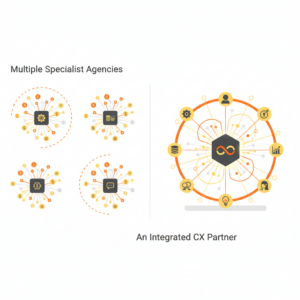
An integrated CX partner often delivers a higher integrated services ROI than multiple specialist agencies because it reduces coordination cost, duplicate tooling, and delivery rework. It also improves governance, data consistency, and speed to value. A strong business case quantifies these effects across operating expenditure, risk, and revenue drivers, then validates results through service standards and CX-to-financial linkage evidence.
What is an integrated CX partner?
An integrated CX partner, sometimes called a CX Integrator, owns end-to-end CX & Service Transformation delivery across strategy, design, data, technology enablement, and continuous improvement. The defining feature is accountable integration. One partner aligns the operating model, measurement system, and delivery cadence so that each initiative strengthens the same customer journey outcomes and the same business outcomes.
In contrast, a “CX agency vs consultancy” split typically creates fragmented ownership. Agencies may lead creative, communication, and experience design, while consultancies lead operating model and governance. When these roles are sourced separately, integration becomes a client responsibility. That shift matters economically because integration work is real work and it compounds as scope grows.
Why do organisations keep splitting CX work across specialist agencies?
Splitting work across specialists often looks rational at procurement stage. Each agency offers a best-in-class promise, a narrow scope, and a clean rate card. Multi-sourcing can also reduce dependency risk and improve access to scarce skills. This approach is common in large enterprises because CX spans functions, channels, and platforms, and leaders want optionality.
The economic issue is that procurement price is not total cost. The missing line item is coordination overhead. Research on complex client-vendor relationships shows governance needs often include both appropriation concerns and coordination costs, and firms actively manage this tension through integration and isolation choices.³ Those governance choices show up as program delays, duplicated analytics, inconsistent experience standards, and “shadow integration” roles inside the client team.
How does an integrated partner change the economics?
What costs go down first?
The first savings usually come from reduced coordination cost. Fewer handoffs mean fewer briefs, fewer steering forums, and fewer translation cycles between design, technology, and operations. In transaction cost economics, governance mechanisms such as contracting, monitoring, and communication exist to control opportunism and manage uncertainty, but they also carry cost.⁷ Concentrating scope under one accountable partner reduces the number of governance interfaces you must run.
A second early saving is reduced rework. Fragmented delivery often produces outputs that do not line up: a journey blueprint that cannot be implemented, a speech analytics model that does not match operational definitions, or a CX measurement approach that cannot be reconciled with finance. Evidence linking customer feedback metrics to firm performance shows that metric choice and definition materially affect insight quality and comparability.⁶ Integration lowers the chance that teams optimise different metrics and then argue about which one is “right.”
Where does value increase?
Integrated delivery tends to increase speed to value and adoption. When digital transformation is executed with a coherent measurement and operating model, customer experience and IT innovation can both contribute positively to firm performance.⁸ Faster learning loops also reduce the risk of large, slow programs that fail to land.
Finally, a single integrator improves decision quality by creating one source of truth for customer experience, complaints, and operational performance. Complaint handling standards emphasise consistent processes, clear responsibilities, and continuous improvement loops, which are harder to maintain across multiple providers.²˒⁴
Integrated CX partner vs multiple specialist agencies: what should you compare?
What is the right comparison frame?
Do not compare hourly rates. Compare total economic impact across four buckets:
Delivery efficiency: coordination hours, rework hours, release cadence, cycle time.
Operating efficiency: avoidable contact, repeat contacts, failure demand, channel shift.
Growth and retention: conversion, churn, share of wallet, cross-sell enablement.
Risk and compliance: complaints handling, control effectiveness, audit readiness.
ISO contact centre guidance highlights the importance of service requirements, KPIs, and contract clarity between client and provider.¹ This creates a practical baseline for comparing governance maturity across models. If multiple agencies require you to build your own “service integrator” layer, that layer is a cost that belongs in the comparison.
What is the most common hidden cost?
The most common hidden cost is internal integration labour. Enterprises often add program managers, solution architects, analysts, and change leads to connect specialist outputs. That labour is not optional if you want a coherent customer experience. It is simply unpriced at the agency selection stage.
A second hidden cost is duplicated tooling and data work. When each specialist brings its own measurement approach, you pay repeatedly for tagging, taxonomy alignment, dashboarding, and sampling design. Evidence from customer satisfaction and financial performance research shows that measurement constructs need stability and comparability to support management decisions.⁹ Fragmentation makes stability harder.
Where does an integrated partner fit in real CX & Service Transformation programs?
What does “integration” look like in practice?
Integration is not a slogan. It is a set of repeatable mechanisms: a shared customer journey taxonomy, a single KPI hierarchy, consistent definitions for complaints and drivers, one prioritisation method, and one change pathway into frontline operations. It also means one partner owns cross-functional trade-offs, rather than pushing them back to the client.
In practical terms, the integrator approach is strongest when your program spans three or more domains: experience design, contact centre operations, digital self-service, data and analytics, or complaint and risk controls. In those cases, a productised measurement layer can accelerate alignment. For example, a CX governance team can use https://customerscience.com.au/csg-product/customer-science-insights/ as a single performance view that ties journey outcomes to operational levers, which reduces parallel reporting and “metric debates.”
What are the risks of choosing a single integrated partner?
Single-partner models introduce concentration risk. If performance drops, switching cost may be higher. This risk is manageable when contracts define clear deliverables, service standards, and exit plans. ISO 18295-1 emphasises contract content and KPI monitoring for contact centre services, which is a useful template even when the integrator is not the outsourced operator.¹
A second risk is reduced specialist depth in niche areas. Mitigate this by requiring the integrator to demonstrate a partner ecosystem and a clear method for specialist augmentation without breaking governance.
A third risk is complacency. Multi-sourcing can create competitive pressure. Counter this by setting outcome-based measures, independent assurance points, and periodic benchmarking using externally defensible standards and customer satisfaction frameworks.¹˒²
How do you measure integrated services ROI credibly?
What metrics stand up in finance review?
Use a small set of CFO-compatible measures that connect operational change to financial outcomes. Research using American Customer Satisfaction Index data links customer feedback metrics with firm performance measures such as gross margin, sales growth, and Tobin’s Q, while showing that metric choice affects predictive power by industry.⁶ Use that insight to justify your metric selection and avoid “one metric fits all.”
For complaint and risk outcomes, align to Australian expectations where relevant. APRA’s complaints handling standards reference the Australian complaint management guideline, reinforcing the need for consistent, timely complaint practices.⁵ Government guidance also frames complaint systems as a benchmark expectation for public-facing organisations.¹⁰
How should you structure the business case model?
A defensible model typically includes:
Baseline: volumes, costs, handle time, repeat rates, complaint rates, NPS/CES/SAT, churn.
Initiative impacts: attributable changes with confidence ranges.
Cost to deliver: partner fees plus internal labour, tooling, and governance.
Benefits timing: ramp curves, adoption constraints, and lag effects.
Risk adjustment: scenario sensitivity for delivery delays and compliance impacts.
The goal is to show that an integrator reduces variance as well as mean cost. Governance research highlights that firms often mix integration and isolation strategies to balance coordination and appropriation concerns.³ Your model should reflect that you can still isolate some specialist work, but you do not need to isolate everything.
What are the next steps to select a CX Integrator without losing specialist capability?
Start by mapping your current provider landscape to a single customer journey KPI tree. Wherever multiple agencies touch the same KPI, assume you are already paying integration cost. Then design a sourcing approach that makes integration explicit and priced.
A practical path is to run a short diagnostic sprint that quantifies coordination overhead, identifies duplicated tooling, and defines the operating model for delivery governance. If you need support shaping the business case and governance model, https://customerscience.com.au/service/cx-consulting-and-professional-services/ is a typical entry point for establishing the integration framework, ROI model, and measurement discipline before scaling execution.
Evidentiary Layer: what evidence supports the integrated partner model?
The integrated model aligns with three evidence threads.
First, service and complaint standards favour clear responsibilities, consistent processes, and closed-loop improvement, which are harder to sustain across fragmented delivery.¹˒²˒⁴ Second, governance research shows that complex relationships create simultaneous coordination and appropriation demands, and organisations actively configure governance to manage both.³ Third, empirical CX measurement research indicates that customer feedback metrics can predict firm performance, but only when definitions and use are coherent.⁶ These threads support a simple conclusion: integration is not just an operating preference. It is an economic control that protects measurement integrity and delivery throughput.
FAQ
Is a CX agency vs consultancy model always worse?
It is not always worse. It can work for small, isolated initiatives. It becomes economically weaker when multiple providers must deliver one end-to-end outcome and the client becomes the default integrator, increasing coordination cost and rework risk.³˒⁶
What is the simplest way to prove integrated CX partner ROI?
Quantify internal integration labour and rework first. Then model time-to-value differences. Use stable measurement definitions and link them to financial outcomes where possible.⁶˒⁸
Can we keep specialist agencies and still get integrated services ROI?
Yes. Many organisations use an integrator as the accountable layer while retaining niche specialists under a governed delivery model. The key is to price and manage integration explicitly rather than leaving it implicit.¹˒³
What tooling helps an integrator control quality across channels?
Speech and conversation quality measurement can reduce variance in service delivery when aligned to the same journey KPIs and coaching loops. https://customerscience.com.au/csg-product/commscore-ai/ is an example of a productised approach that supports consistent assessment and improvement across contact channels.
Which standards are most relevant for contact centres and complaints?
ISO 18295-1 provides contact centre service requirements and KPI guidance.¹ ISO 10002 and AS 10002:2022 guide complaint management systems and continuous improvement expectations.²˒⁴ Regulators may also reference these expectations in sector standards.⁵
How do we manage concentration risk with a single partner?
Use outcome-based contracting, transparent KPI reporting, staged delivery gates, and clear exit provisions. Apply standard-aligned service governance disciplines even if delivery remains in-house.¹˒²
Sources
ISO. ISO 18295-1:2017 Customer contact centres. https://www.iso.org/standard/64739.html
ISO. ISO 10002:2018 Quality management, customer satisfaction, complaints handling. https://www.iso.org/standard/71580.html
Agndal, H. et al. Managing appropriation concerns and coordination costs in complex client-vendor relationships. Industrial Marketing Management (2023). https://www.sciencedirect.com/science/article/pii/S0019850123001001
Standards Australia. AS 10002:2022 Guidelines for complaint management in organizations (ISO 10002:2018, NEQ). https://www.standards.org.au/standards-catalogue/standard-details?designation=as-10002-2022
APRA. APRA’s complaints handling standards. https://www.apra.gov.au/apras-complaints-handling-standards
Agag, G. et al. Understanding the link between customer feedback metrics and firm performance. Journal of Retailing and Consumer Services (2023). https://doi.org/10.1016/j.jretconser.2023.103301
Yin, Q. et al. Customizing governance mechanisms to reduce opportunism in buyer–supplier relationships in the digital economy. Technological Forecasting and Social Change (2023). https://www.sciencedirect.com/science/article/abs/pii/S0040162523000963
Masoud, R., Basahel, S. The Effects of Digital Transformation on Firm Performance: The Role of Customer Experience and IT Innovation. Digital (2023). https://doi.org/10.3390/digital3020008
Eklöf, J. et al. Linking customer satisfaction with financial performance: an empirical study of Scandinavian banks. Total Quality Management & Business Excellence (2020). https://www.tandfonline.com/doi/pdf/10.1080/14783363.2018.1504621
NSW Ombudsman. Effective complaint management guide. https://www.ombo.nsw.gov.au/guidance-for-organisations/resources/effective-complaint-management-guide
Wirtz, J. et al. Customer experience management in B2B markets: CXM value propositions and archetypical CXM strategies. Journal of Business Research (2024). https://doi.org/10.1016/j.jbusres.2024.115165
ISO. ISO 9001:2015 Quality management systems. https://www.iso.org/standard/62085.html