























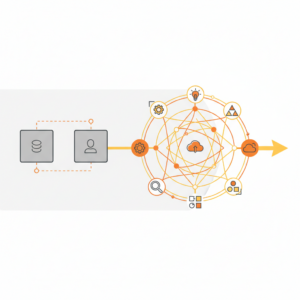
Business process orchestration turns disconnected CX tools into one governed, end-to-end operating model. It goes beyond systems integration by managing state, decisions, handoffs, and accountability across channels and teams. The result is fewer customer “dead ends”, faster resolution, clearer ownership, and measurable service outcomes, even as your CX ecosystem grows more complex.
What is business process orchestration in CX?
Business process orchestration is the coordination of tasks, rules, decisions, and human work across multiple systems to deliver a single customer outcome, such as “resolve billing dispute” or “restore service”. It uses an explicit process model, often captured in BPMN (Business Process Model and Notation), to define the sequence, responsibilities, data requirements, and exception paths.¹˒²
In CX & service transformation, orchestration is not a diagramming exercise. It is an execution discipline that ensures every step in a journey has an owner, a trigger, a time expectation, and an observable status. It aligns operating rhythm to service requirements, including contact centre performance expectations and customer handling standards.³
Why is systems integration no longer enough?
Systems integration connects applications so data can move. It rarely guarantees that work moves correctly. In modern CX, customers switch channels, issues branch into exceptions, and multiple teams must collaborate under time pressure. The result is a high “handoff tax”: customers repeat details, agents chase status, and back-office queues become invisible.
Government digital service guidance increasingly emphasises end-to-end service design, measurement, and continuous improvement rather than “go-live” delivery.⁸ That same shift is now standard in enterprise CX ecosystem management: boards expect outcomes, not connectivity.
How does business process orchestration work?
Orchestration combines three layers that integration alone does not provide.
First, an explicit process model describes the “happy path” and the exception paths using shared semantics. BPMN is widely used for this because it standardises process and collaboration concepts across stakeholders.¹˒²
Second, an execution and decision layer manages state. This includes policy and rules (eligibility, risk thresholds, refunds), routing logic (team, skill, vendor), and control points (approvals, fraud checks, identity verification). This is where orchestration differs from simple workflow automation by coordinating communication between steps and parties, not only automating individual tasks.¹³
Third, an observability layer measures flow health. Service management standards stress lifecycle thinking and continual improvement across planning, design, transition, delivery, and improvement.⁵ Orchestration instruments the journey so leaders can see where work stalls, why it rework-loops, and which integrations fail silently.
Business process orchestration vs integration: what changes?
Integration answers: “Can System A send data to System B?”. Orchestration answers: “Can we reliably deliver the customer outcome, every time, within agreed service levels, even when exceptions occur?”.
In microservice and event-driven designs, the orchestration versus choreography choice highlights the trade-off between decentralised autonomy and centralised control. Research shows choreography can improve decoupling but can distribute flow logic across services, making change analysis and maintenance harder without a “big picture”.¹⁰ Orchestration can restore that global view and support debugging and testing of complex interactions.¹⁴˒¹⁰
For CX integrators, the practical shift is governance. Integration creates technical dependencies. Orchestration creates accountable service dependencies: named owners for each step, measurable time-to-next-step, and defined escalation paths aligned to service expectations.³
Where does orchestration create the most CX value?
Orchestration creates the most value where customer outcomes span multiple tools, teams, or vendors, and where exceptions drive cost.
Common high-impact applications include:
Complaint-to-resolution journeys that cross contact centre, case management, and back office, aligned to complaint-handling expectations.⁷
Service restoration and provisioning journeys that depend on multiple operational systems and field partners, where delays multiply contacts.
Billing dispute and refund journeys that require policy decisions, approvals, and auditability.
A practical starting point is to standardise “outcome-level” journey definitions, then instrument flow for bottlenecks and rework, using evidence from event logs to reconcile designed journeys with actual journeys. Process mining research shows how event data can reveal deviations and service gaps that matter to customer outcomes.²˒⁶
If you need a CX execution layer that supports insight-to-action governance, start by aligning orchestration requirements to your measurement model and operating cadence, then select enablement that supports those requirements: https://customerscience.com.au/csg-product/customer-science-insights/
What risks appear when you orchestrate across the CX ecosystem?
Orchestration concentrates control, so weak design discipline becomes a business risk.
The main risks are:
Over-centralisation: one “mega-flow” becomes a bottleneck and slows change. Choreography can improve decoupling, but it increases the need for strong modelling and governance to retain a global view.¹⁰˒⁹
Shadow processes: if teams do not trust the orchestrated path, they create manual workarounds, destroying data integrity and measurement confidence.
Security and privacy gaps: orchestrated journeys often aggregate sensitive data. Information security management standards emphasise systematic risk evaluation and controls across information assets.⁶
Poor human experience: orchestration that ignores agent and customer usability increases friction. Human-centred design standards stress lifecycle activities that make systems usable and effective in real contexts.⁴
Managing these risks is the core of CX ecosystem management: define the boundary of orchestration, standardise controls, and keep ownership clear.
How do you measure orchestration outcomes?
Measure orchestration as flow performance, not tool performance.
Baseline metrics should include:
End-to-end cycle time for a customer outcome, not just per-team handling time.
First-contact resolution and “avoidable recontact” rate, aligned to contact centre service expectations.³
Handoff count and “time between steps” to expose hidden queues.
Exception rate by policy decision or integration failure, to target redesign.
Customer effort signals, tied to specific steps in the process model.
Service management requirements highlight continual improvement across the service lifecycle.⁵ Orchestration supports this by making work visible and comparable across journeys and time periods.
For organisations that need help establishing the measurement model, governance cadence, and cross-system accountability, use a CX integrator approach designed for operating model change, not just implementation: https://customerscience.com.au/service/cx-consulting-and-professional-services/
What should leaders do next?
Start with two design decisions.
First, define your “outcome catalogue”. List the 10–20 customer outcomes that drive cost, risk, and brand damage, then identify which are cross-team and cross-system. These are orchestration candidates.
Second, choose the orchestration pattern per outcome. Use orchestration where you need tight governance, auditability, and fast debugging for complex dependencies.¹⁴ Use more decentralised patterns where autonomy and scale matter, but maintain a shared model to preserve the global view.¹⁰
Then operationalise:
Model the journey using standard notation and responsibilities.¹˒²
Align controls to complaint, service, and security requirements where relevant.³˒⁷˒⁶
Instrument flow and run monthly improvement cycles, consistent with digital service and service management expectations for measurement and continuous improvement.⁸˒⁵
Evidentiary layer: what the standards and research support
Process modelling standards exist to reduce ambiguity between business and technical stakeholders. ISO/IEC 19510 formalises BPMN to standardise process, collaboration, and choreography semantics.¹
Contact centre service requirements stress consistent service delivery and performance expectations that can be governed and measured across interactions.³ Complaint handling standards and regulator guidance reinforce the need for consistent, customer-focused complaint processes with review and improvement built in.⁷
Service management requirements set expectations for lifecycle governance and continual improvement across services, which maps directly to orchestrated journeys and observable flow metrics.⁵ Security and human-centred design standards emphasise systematic risk control and usability across the lifecycle, both critical when orchestration spans sensitive data and high-volume agent workflows.⁶˒⁴
Academic work on orchestration versus choreography in distributed systems reinforces the operating reality: decentralised compositions can improve independence, but without a global model, change and maintenance become harder.¹⁰ Orchestration using workflow engines can improve debugging and coordination when interactions grow complex.¹⁴
FAQ
What is the simplest way to explain orchestration to executives?
Integration connects systems so data can move. Orchestration governs outcomes so work moves correctly, with ownership, rules, time expectations, and measurement.⁵
When should we keep “integration-only”?
Keep integration-only when the customer outcome is contained within one system or one team, with minimal exceptions and low risk. As cross-team dependencies increase, orchestration becomes a control mechanism, not a technical preference.⁹
Does orchestration replace CRM, CCaaS, or ITSM platforms?
No. Orchestration sits above them and coordinates how they contribute to the outcome, using shared process semantics and lifecycle governance.¹˒⁵
How do we stop orchestration becoming a new bottleneck?
Use outcome-scoped orchestration, modular process models, and clear ownership. Maintain a shared model even when using more decentralised patterns to avoid losing the global view.¹⁰˒⁹
What role does knowledge play in orchestrated CX?
Knowledge is a control surface. If policy, eligibility, and guidance are inconsistent, orchestration will amplify errors at scale. Treat knowledge governance as part of the orchestration design, not as a separate content task: https://customerscience.com.au/csg-product/knowledge-quest/
How do we prove ROI in the first 90 days?
Target one high-volume, exception-heavy outcome. Reduce handoffs, cut time between steps, and lower avoidable recontacts. Tie improvements to observable flow metrics and complaint outcomes rather than tool utilisation.⁷˒⁵
Sources
ISO/IEC 19510:2013, Information technology — Business Process Model and Notation. ISO. https://www.iso.org/standard/62652.html
BPMN 2.0.2 About BPMN. Object Management Group. https://www.omg.org/spec/BPMN/2.0.2/About-BPMN
ISO 18295-1:2017, Customer contact centres — Part 1: Requirements for customer contact centres. ISO. https://www.iso.org/standard/64739.html
ISO 9241-210:2019, Human-centred design for interactive systems. ISO. https://www.iso.org/standard/77520.html
ISO/IEC 20000-1:2018, Service management system requirements. ISO. https://www.iso.org/standard/70636.html
ISO/IEC 27001:2022, Information security management systems. ISO. https://www.iso.org/standard/27001
APRA, APRA’s complaints handling standards (based on AS 10002:2022 / ISO 10002:2018). https://www.apra.gov.au/apras-complaints-handling-standards
Australian Government Digital Service Standard. Digital.gov.au. https://www.digital.gov.au/policy/digital-experience/digital-service-standard
Megargel, A. (2021). Microservices Orchestration vs. Choreography: A decision-focused review. Singapore Management University repository. https://ink.library.smu.edu.sg/cgi/viewcontent.cgi?article=7580&context=sis_research
Valderas, P., Torres, V., & Pelechano, V. (2020). A microservice composition approach based on the choreography of BPMN fragments. Information and Software Technology, 127, 106370. DOI: 10.1016/j.infsof.2020.106370
Kampik, T. (2019). Agent-based Business Process Orchestration for IoT. ACM. DOI: 10.1145/3350546.3352554
Represa, J. G., et al. (2023). Investigation of Microservice-Based Workflow Management Solutions for Industrial Automation. Applied Sciences, 13(3), 1835. DOI: 10.3390/app13031835
Huang, A., Huang, N., & Hong, Y. (2026). Workflow Automation in Open-Source Software Development: Accelerating Innovation Through Mechanization and Orchestration. Information Systems Research. DOI: 10.1287/isre.2024.1551
Nadeem, A., & Malik, M. Z. (2022). A Case for Microservices Orchestration Using Workflow Engines. ACM/IEEE ICSE (SEIP). DOI: 10.1145/3510455.3512777