






















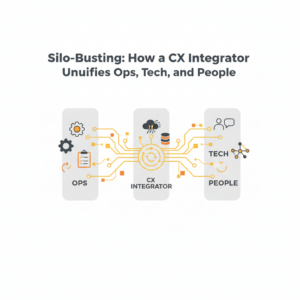
A CX Integrator breaks down silos in business by aligning operating processes, enabling technology, and frontline capability around one shared service outcome. The work creates a unified CX operating model with clear decision rights, cross-functional value streams, and a single measurement spine. The result is faster change delivery, fewer handoffs, and more consistent customer outcomes at lower operational cost.
What is a CX Integrator?
A CX Integrator is a role or capability that unifies Operations, Technology, and People so the organisation can deliver consistent customer outcomes across channels. The CX Integrator does not “own” every function. Instead, the Integrator designs and governs the connections between functions: shared priorities, shared service standards, shared data definitions, and shared delivery rhythms. In CX & Service Transformation programs, this becomes the practical bridge between strategy and execution.
In siloed environments, each function optimises its own targets. Service teams focus on handle time, product teams focus on shipping features, and risk teams focus on compliance gates. The customer experiences the joins. A CX Integrator removes the joins by translating customer outcomes into operational models, then operational models into executable work, supported by consistent governance and measurement.
Why do silos persist even when leaders want alignment?
Silos persist because the organisation’s structure and incentives reward local optimisation. Research on silo dynamics notes that formal organisational design can restrict information sharing and slow collaboration⁷. In regulated industries, additional layers of control can also reinforce fragmented ownership of data, decisions, and customer communications.
Silos also persist because “integration” is often treated as a workshop outcome rather than an operating system. Cross-functional work requires recurring mechanisms, not one-off forums. Studies of customer-information flow show that integration is strongest when teams combine structured processes with routine interpersonal involvement and enabling systems⁸. Without these mechanisms, customer context degrades as it moves across functions, and service quality becomes inconsistent.
How does a unified CX operating model work in practice?
A unified CX operating model is a defined way of running the business so customer outcomes can be delivered reliably. It specifies five elements: (1) customer outcomes and service promises, (2) value streams that deliver those outcomes end to end, (3) decision rights and governance, (4) enabling platforms and data, and (5) workforce capability and performance systems. The design principle is “think and work holistically” across the system, consistent with service management frameworks that define how components work together to create value¹⁰.
The model is anchored in value co-creation. Service research shows that value is realised in use, through interactions where providers and customers integrate resources⁹. This matters because it shifts operating design away from internal handoffs and toward end-to-end customer effort reduction, complaint prevention, and service recovery consistency.
What mechanisms does a CX Integrator use to connect ops, tech, and people?
Operating governance that matches customer value streams
The CX Integrator sets governance at the value-stream level, not the function level. That means a single owner for each end-to-end service journey, with clear escalation paths and agreed trade-offs. Contact centre requirements standards emphasise consistent service delivery and management practices for customer contact operations¹, which can be used as a baseline for stream-level accountability.
Process integration with continual improvement loops
A unified model uses a process approach that explicitly integrates interdependent processes⁴. The CX Integrator ensures that “Plan-Do-Check-Act” cycles happen on the journeys that matter most, using operational data, voice-of-customer signals, and quality findings to prioritise improvements rather than distributing change across disconnected backlogs.
Human-centred service design that is operationally executable
Human-centred design standards define how to design systems around user needs and real contexts³. The CX Integrator makes this operational by linking service blueprinting to workforce design, knowledge, scripts, and platform workflows, so the “designed experience” is deliverable on Monday morning.
Shared measurement that prevents metric gaming
Complaint-handling guidance provides practical requirements for designing and improving complaint management systems². The CX Integrator uses this to standardise definitions, severity, and closure outcomes across teams so that “improvement” cannot be achieved by shifting work across organisational boundaries.
CX Integrator vs transformation lead vs enterprise architect
A transformation lead often focuses on program delivery, milestones, and benefits tracking. An enterprise architect often focuses on target-state platforms and integration patterns. Both are important, but neither role is consistently accountable for the operating seams where customers feel friction.
A CX Integrator is accountable for the seams. The Integrator works across Operating Models, Technology Enablement, and Workforce Systems at the same time, with day-to-day authority to resolve cross-functional conflicts. This is similar to how service management frameworks treat organisations and people, information and technology, and value streams and processes as co-dependent dimensions¹⁰. The CX Integrator turns that principle into execution.
Where does a CX Integrator deliver the fastest impact?
In most organisations, the quickest gains come from reducing failure demand and rework across channels. That requires visibility across the end-to-end journey, not just the contact centre. It also requires consistent customer communications and decision logic across teams, which is why “breaking down silos in business” is most measurable in repeat contact reduction, complaint volume reduction, and cycle time compression.
For a practical starting point, implement a single source of insight for journey performance and service friction using https://customerscience.com.au/csg-product/customer-science-insights/ so operational, digital, and customer teams work from the same evidence spine.
Risks and failure modes when you try to bust silos
The first risk is creating a new silo called “CX.” If the Integrator becomes an external reviewer rather than an embedded mechanism, delivery teams will route around it. The second risk is over-standardisation. Some variation is necessary for product constraints, regulatory constraints, and channel differences. The goal is consistent outcomes, not identical workflows.
The third risk is data exposure and control breakdown. When silos come down, data flows increase. Information security standards define requirements for an information security management system and continual improvement of controls¹¹, which should be built into the operating model design so “shared data” does not mean “unmanaged data.” A fourth risk is change fatigue. Case evidence on silo-busting highlights that context and organisational growth conditions shape what works and what stalls¹².
How do you measure silo-busting outcomes credibly?
Measurement must prove both customer impact and operational integrity. Start with a small set of outcome measures, then trace them to controllable drivers. Complaint management standards and regulatory expectations reinforce the need for consistent complaint handling and clear customer outcomes²˒⁶, making complaints a useful cross-functional barometer when definitions are consistent.
Use three layers of measurement:
Outcome: repeat contact rate, complaint rate, customer effort score, resolution time, digital containment with quality checks
Driver: handoff count, decision latency, knowledge accuracy, defect leakage, queue-to-resolution time
Enabler: adoption of standard workflows, training completion, platform workflow utilisation, and data quality thresholds
The CX Integrator should publish a single weekly “journey health” view that combines these layers into one narrative for executive decision-making.
What are the next steps to stand up a CX Integrator capability?
Begin by selecting one high-friction value stream with visible cost and customer pain. Define the service promise, the end-to-end journey scope, and the decision rights needed to change it. Then establish a joint operating rhythm: weekly triage, fortnightly improvement planning, and monthly governance for trade-offs.
Stand up the enabling mechanisms in parallel: shared measurement definitions, a single backlog for journey work, and a minimal set of integration ceremonies that replace duplicated forums. If you want to institutionalise this as part of CX & Service Transformation, use a dedicated delivery model and capability uplift through https://customerscience.com.au/service/cx-consulting-and-professional-services/ so the operating model becomes self-sustaining, not consultant-dependent.
Evidentiary Layer: what the evidence says about integration
Organisational silo analysis shows that silos restrict information and slow innovation, and that deliberate collaboration mechanisms can mitigate these effects⁷. Cross-functional integration research demonstrates that customer information flows depend on repeatable mechanisms such as meetings, enabling IT systems, and defined processes and rules⁸. Service research reinforces that customer value is co-created in use, so operating models must be designed around interactions and contexts rather than internal transactions⁹. Standards for contact centres, complaint management, and human-centred design provide practical guardrails for consistent service execution¹˒²˒³ that scale across functions without losing customer focus.
FAQ
What does “breaking down silos in business” mean in CX terms?
It means customers no longer experience internal handoffs as repeated questions, inconsistent answers, or rework. The organisation runs one joined-up journey with clear ownership and shared measures⁷.
What is the difference between a unified CX operating model and a CX strategy?
A strategy sets direction and priorities. A unified CX operating model defines decision rights, value streams, governance, measures, and enablement so teams can deliver the strategy repeatedly⁴.
Which functions should a CX Integrator work with first?
Start where friction is highest: contact centre, digital, product operations, risk, and complaints. These areas expose cross-functional seams that drive repeat contact and cost²˒¹.
Do we need new technology to unify CX?
Not at first. Integration usually starts with shared definitions, governance, and workflow alignment. Targeted automation comes later, once the operating model is stable¹⁰.
How do we keep communications consistent across channels?
Use one controlled knowledge and messaging layer and link it to journey governance. For teams that need AI-assisted consistency at scale, https://customerscience.com.au/csg-product/commscore-ai/ can support quality and alignment in customer communications.
What is the minimum timeframe to see results?
If the value stream is well-chosen and measurement is consistent, early improvements typically appear first in reduced handoffs, reduced repeat contact, and reduced complaint volume, before NPS or brand metrics move².
Sources
ISO. ISO 18295-1:2017 Customer contact centres, Part 1. https://www.iso.org/standard/64739.html
Standards Australia. AS 10002:2022 Guidelines for complaint management in organizations (ISO 10002:2018, NEQ). https://www.standards.org.au/standards-catalogue/standard-details?designation=as-10002-2022
ISO. ISO 9241-210:2019 Human-centred design for interactive systems. https://www.iso.org/standard/77520.html
ISO. ISO 9001:2015 Process approach (guidance PDF). https://www.iso.org/iso/iso9001_2015_process_approach.pdf
Australian Government. Digital Service Standard. https://www.digital.gov.au/policy/digital-experience/digital-service-standard
APRA. APRA’s complaints handling standards (aligned to AS 10002:2022). https://www.apra.gov.au/apras-complaints-handling-standards
Jones AA, Uhd J, Kabore CD, Cornett KA. Breaking Down Silos in the Workplace: A Framework to Foster Collaboration. J Public Health Manag Pract. 2024;30(6):E306–E311. DOI: 10.1097/PHH.0000000000002007. https://pmc.ncbi.nlm.nih.gov/articles/PMC11419935/
Ståhle M, Ahola T, Martinsuo M. Cross-functional integration for managing customer information flows in a project-based firm. Int J Project Manag. 2019;37(1):145–160. DOI: 10.1016/j.ijproman.2018.11.002. https://www.sciencedirect.com/science/article/abs/pii/S0263786318303533
Vargo SL, Maglio PP, Akaka MA. On value and value co-creation: A service systems and service logic perspective. Eur Manag J. 2008;26(3):145–152. DOI: 10.1016/j.emj.2008.04.003. https://www.sciencedirect.com/science/article/abs/pii/S026323730800042X
PeopleCert. ITIL 4 Foundation (Service value system and four dimensions). https://www.peoplecert.org/browse-certifications/it-governance-and-service-management/ITIL-1/itil-4-foundation-2565
ISO. ISO/IEC 27001:2022 Information security management systems requirements overview. https://www.iso.org/publication/PUB100484.html
de Waal A, van den Berg R. Increasing Collaboration Through Silo-busting: a Case Study. Springer Professional (record page). https://www.springerprofessional.de/en/increasing-collaboration-through-silo-busting-a-case-study/51460886