































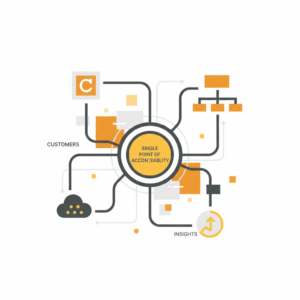
A single point of accountability (SPOA) reduces digital transformation risk by consolidating decision rights, delivery ownership, and vendor management into one accountable integrator. This model cuts coordination failures, prevents scope drift, strengthens controls, and improves service outcomes. It works best when governance is explicit, metrics are tied to customer and operational value, and third parties are managed through shared standards and transparent performance evidence.¹²³
What is a Single Point of Accountability in digital transformation?
A single point of accountability is a formal operating model where one role or entity owns end-to-end outcomes across strategy, design, delivery, and run. The SPOA holds authority to coordinate teams, resolve trade-offs, and manage dependencies across technology, operations, risk, and customer experience (CX). This is not a project manager label. It is an accountable owner with decision rights and measurable obligations.
In CX & service transformation, the SPOA often acts as a CX integrator. The integrator aligns business priorities, controls vendor commitments, and ensures that changes to channels, journeys, knowledge, and automation remain coherent. The intent is simple: fewer “gaps between teams” and fewer unmanaged handoffs that create hidden risk.¹
Why does digital transformation risk increase as vendor ecosystems grow?
Digital transformation introduces risk because it changes multiple systems at once: platforms, processes, data flows, workforce skills, and customer journeys. As organisations add specialist vendors, risk rises through fragmentation. Each vendor optimises its own scope, contract, and timeline. Cross-vendor issues then sit in the gaps: data ownership, security controls, integration testing, cutover sequencing, and support accountability.
This risk profile is amplified in regulated environments because accountability cannot be outsourced. Governance frameworks require clear ownership for risk decisions and control effectiveness, even when delivery is external.²³ In practice, complex vendor landscapes can dilute responsibility, slow incident response, and create inconsistent service quality across channels.
How does a SPOA reduce transformation risk in practice?
A SPOA reduces risk by making one owner responsible for the system of work, not just individual deliverables. That owner establishes a single delivery cadence, one integrated plan, and one prioritisation method. The SPOA also sets standards for documentation, service readiness, and control evidence across vendors, which reduces variance and rework.¹³
The mechanism is primarily governance and integration discipline. The SPOA defines who can approve scope change, how risks are escalated, and how dependencies are resolved. This aligns with risk management principles that emphasise context, ownership, treatment plans, and continuous monitoring.¹ The SPOA also strengthens operational continuity by ensuring cutovers, knowledge updates, and support models are designed before release, not after.⁴
Is SPOA the same as a prime contractor or a PMO?
A prime contractor can be a SPOA, but the terms are not equivalent. A prime contractor focuses on commercial delivery and subcontractor coordination. A SPOA focuses on accountable outcomes across customer, operational, technology, and risk dimensions. A PMO supports coordination and reporting, but usually lacks authority to enforce cross-functional decisions.
The most effective SPOA model combines outcome accountability with a clear governance structure. Decision rights are explicit. Escalation paths are short. Controls are measurable. This aligns with corporate governance guidance for IT and digital decision-making, where accountability and transparency are core to effective oversight.²
Where does a CX Integrator add the most value?
A CX integrator adds the most value in transformations that span journeys and channels, not just systems. Typical examples include contact centre modernisation, digital service uplift, knowledge transformation, and automation programs. In these initiatives, customers experience the seams between functions immediately. If ownership is fragmented, the customer experience degrades even when each team “delivered its part”.
A practical CX integrator capability includes journey governance, vendor management, service design, and release readiness. It also includes the operating rhythm to keep marketing, service, digital, data, and risk aligned on a single customer and service outcome. This is where “single vendor CX solutions” can be attractive, but only when the single accountable owner can still prove control effectiveness and service performance across the full stack.¹²³
How do you apply SPOA to vendor management and “single vendor CX solutions”?
The SPOA should define a vendor operating model that makes integration obligations non-optional. This includes shared definitions of done, common testing stages, and a unified change control process. Contracts should reinforce this by linking payments to measurable outcomes, not just activity completion.
For organisations pursuing “single vendor CX solutions”, the SPOA must ensure the model does not become a single point of failure. The mitigation is strong governance: independent assurance gates, clear exit and data portability clauses, and minimum evidence standards for security, continuity, and incident response.³⁴⁵ If the vendor is also the integrator, these safeguards become more important, not less.
What governance controls should be non-negotiable?
Non-negotiable controls should be defined as transformation entry criteria and enforced consistently across vendors:
A single integrated release calendar with operational readiness checkpoints⁴
Security and privacy-by-design requirements aligned to policy and regulation³⁶
Service management processes for incident, change, and problem management⁷
Business continuity expectations for critical customer and service processes⁴⁵
Clear accountability for data flows, access, and retention across parties³⁶
These controls reduce the most common failure modes: rushed cutovers, incomplete knowledge, weak monitoring, and unclear responsibility during incidents.
Applications: what does SPOA look like in a CX and service transformation program?
In practice, SPOA is implemented through a small set of visible artefacts: one outcome map, one delivery plan, one risk register, one vendor scorecard, and one service readiness definition. The SPOA should also own customer impact decisions, such as how journey changes will be communicated, what fallbacks exist, and how service teams will be enabled.
Where an organisation needs stronger evidence, the SPOA can standardise insight generation and performance baselines before major change. For example, a single source of CX performance insight can anchor decision-making and reduce disputes between vendors about “what changed” and “why”. One product approach is Customer Science Insights: https://customerscience.com.au/csg-product/customer-science-insights/
Risks: when can SPOA fail or increase risk?
SPOA fails when accountability is declared but authority is not granted. If the SPOA cannot approve priorities, enforce standards, or challenge vendor claims, the model becomes administrative overhead. SPOA can also increase risk if it centralises decisions without sufficient capability, leading to bottlenecks and slow response.
Another failure mode is unclear scope boundaries between the SPOA and functional leaders. The remedy is a documented decision-rights model and a governance cadence that includes risk, operations, and customer leaders.² In regulated settings, SPOA must also ensure obligations for privacy, security, and continuity are treated as core delivery constraints, not “non-functional” afterthoughts.³⁴⁵⁶
Measurement: how do you prove SPOA is reducing transformation risk?
Risk reduction should be demonstrated through leading and lagging indicators. Leading indicators show whether controls and integration discipline are working. Lagging indicators show whether customers and operations improved.
Useful leading indicators include dependency breach rates, change failure rates, percentage of releases with completed service readiness artefacts, and vendor delivery variance against shared definitions of done.⁴⁷ Lagging indicators include customer effort and containment metrics, repeat contact, complaint drivers, operational availability, and incident severity trends.⁷
Measurement also needs governance maturity signals: decision cycle time, risk treatment closure rate, and audit or assurance findings related to delivery controls.²³ A managed consulting approach can help establish this measurement spine and embed governance routines. One service option is CX consulting and professional services: https://customerscience.com.au/service/cx-consulting-and-professional-services/
Next steps: how do you implement SPOA in 60 to 90 days?
Start by defining the outcome boundary. Document what the SPOA owns end-to-end, including vendor coordination, operational readiness, and customer impact decisions. Then publish decision rights and escalation paths so teams know how conflicts are resolved.
Next, implement the minimum governance kit: integrated plan, dependency management, unified change control, risk register, and a single service readiness checklist aligned to service management and continuity expectations.⁴⁵⁷ Finally, set the first vendor scorecard that ties vendor performance to customer and operational outcomes, not just delivery milestones. This is the practical heart of digital transformation risk management.¹²⁷
Evidentiary Layer: what evidence supports this approach?
SPOA works because it aligns accountability with governance expectations for IT and risk.² It also improves control consistency across third parties, which supports privacy, security, continuity, and service management obligations.³⁴⁵⁶⁷ In CX transformations, SPOA reduces the operational risk created by fragmented ownership of journeys, knowledge, and channel change. The strongest implementations connect governance evidence to customer outcomes so leadership can see both compliance and value in the same metrics.
FAQ
What is the minimum scope a SPOA should own?
The SPOA should own end-to-end outcomes, cross-vendor integration, change control, risk treatment visibility, and service readiness for releases that affect customers or frontline teams.¹⁴⁷
Does SPOA mean using only one vendor?
No. SPOA is an accountability model. It can coordinate multiple vendors or support “single vendor CX solutions”, but it must preserve independent assurance and clear exit options.²³⁵
How do you avoid SPOA becoming a bottleneck?
Grant decision rights, standardise artefacts, and automate reporting. Use short governance cycles and delegate execution while retaining outcome accountability.²⁷
What metrics matter most for digital transformation risk management?
Track change failure rate, incident trends, operational readiness completion, vendor delivery variance, customer effort, and repeat contact drivers.⁴⁷
How can knowledge and communications reduce transformation risk?
Customers and frontline teams fail when knowledge is wrong or updates are late. A controlled knowledge and communication layer reduces avoidable contact, errors, and complaints by stabilising what customers and staff are told during change.⁷ A product option is Commscore AI: https://customerscience.com.au/csg-product/commscore-ai/
Sources
ISO 31000:2018 Risk management — Guidelines. International Organization for Standardization. Stable permalink: https://www.iso.org/standard/65694.html
ISO/IEC 38500:2015 Information technology — Governance of IT for the organization. International Organization for Standardization. Stable permalink: https://www.iso.org/standard/62816.html
ISO/IEC 27001 Information security management systems — Requirements (current edition). International Organization for Standardization. Stable permalink: https://www.iso.org/isoiec-27001-information-security.html
ISO 22301:2019 Security and resilience — Business continuity management systems — Requirements. International Organization for Standardization. Stable permalink: https://www.iso.org/standard/75106.html
APRA Prudential Standard CPS 230 Operational Risk Management (effective date and guidance on APRA site). Australian Prudential Regulation Authority. Stable permalink: https://www.apra.gov.au/operational-risk-management-cps-230
Australian Privacy Principles guidelines. Office of the Australian Information Commissioner (OAIC). Stable permalink: https://www.oaic.gov.au/privacy/australian-privacy-principles-guidelines
ISO/IEC 20000-1:2018 Information technology — Service management — Part 1: Service management system requirements. International Organization for Standardization. Stable permalink: https://www.iso.org/standard/70636.html
Australian Government Digital Service Standard (current edition). Digital Transformation Agency. Stable permalink: https://www.dta.gov.au/help-and-advice/digital-service-standard
NIST Cybersecurity Framework 2.0. National Institute of Standards and Technology. Stable permalink: https://www.nist.gov/cyberframework
ISO 9001:2015 Quality management systems — Requirements. International Organization for Standardization. Stable permalink: https://www.iso.org/standard/62085.html