





















Why journey mapping still matters for C-level outcomes
Executives need a single structure that explains how customers move, how teams act, and how systems behave. Journey mapping provides that structure when it is built on a sound data model, disciplined lanes, and meaningful layers. A journey map is a visual representation of customer experiences across channels and time, designed to align teams on the reality of what customers do, think, and feel.¹ When leaders treat journey maps as operational models rather than posters, they gain a shared language for decisions, investments, and measurement. This article explains how to make that shift with a precise data model, practical lane architecture, and analytics layers that turn discussion into action.³
What is the canonical journey data model?
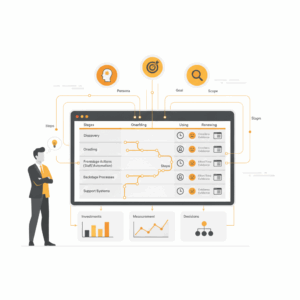
A useful journey map starts as a data model. The model defines entities, attributes, and relationships so content remains consistent, queryable, and reusable. A Journey is the container for a scenario with a defined Persona, Goal, and Scope. A journey contains ordered Stages that break the experience into meaningful chapters. Each stage holds Steps representing discrete Customer Actions at specific Touchpoints on a Channel. Each step links to Frontstage Actions by staff or automation, Backstage Processes, and Support Systems. Steps also carry Emotions, Effort, Time, and Evidence such as transcripts or screenshots to substantiate findings.¹ ²
This model respects the difference between touchpoints and end-to-end journeys. Touchpoints are moments; journeys are the cumulative path that customers evaluate as a whole.³ The model benefits further from human-centred design principles: define users and contexts, iterate with evidence, and evaluate against user-defined success.⁴ Practically, store each entity with stable IDs, timestamps, and versioning. That discipline enables governance, lineage, and analytics later. When teams standardize on this model, they can compare journeys, automate updates from logs, and connect design decisions to operational data.⁴
How do lanes make ownership visible and unambiguous?
Lanes separate responsibilities so anyone can see who does what, where, and when. In process notation, swimlanes allocate activities to participants such as teams or systems.⁵ BPMN codifies lanes and pools so cross-functional diagrams scale without ambiguity.⁶ Journey maps and service blueprints borrow this device to surface accountability and handoffs.²
A pragmatic lane stack works as follows. The Customer lane shows steps, needs, and emotions. The Frontstage lane shows visible actions by agents, bots, or UI. The Backstage lane shows internal activities that enable the frontstage. The Support Systems lane lists applications, data stores, and APIs. The Policy and Risk lane records constraints, approvals, and obligations. The Metrics lane tracks outcome and performance measures for each step. This lane structure mirrors service blueprinting conventions, where lines of interaction, visibility, and internal action clarify where demand originates and how it is fulfilled.² When your map always includes these lanes, leaders can map ownership to outcomes and address gaps quickly.⁵
What layers turn pictures into decision-ready models?
Layers are overlays that add analytic meaning without cluttering the core sequence. A baseline layer shows stages, steps, and owners. Additional layers reveal patterns executives can act on. Start with an Emotion layer to show sentiment and intensity. Add an Effort layer to quantify friction across steps. Include a Time layer to display cycle time and wait time. Use a Volume layer to show traffic loads by step and channel. Introduce a Cost layer to estimate unit cost or cost-to-serve. Include a Risk and Compliance layer to flag regulatory obligations or failure modes. Then add a Signal layer that links each step to evidence such as call transcripts, chat logs, or field notes for auditability and training.⁷
These layers align to human-centred practices. Designers iterate with users to validate emotions and tasks, while analysts connect operational measures to steps for credibility.⁴ Managers then use layers to run scenarios, prioritize investment, and set targets. A layered approach reduces the temptation to cram everything into a single view and instead promotes purposeful overlays that answer specific questions at the right level of detail.¹
How does journey mapping differ from process maps and blueprints?
Executives often conflate journey maps, process maps, and service blueprints. A Journey Map explains the customer’s end-to-end experience as perceived by the customer, across channels and time.¹ A Process Map explains internal flows of work and control.⁶ A Service Blueprint connects the two by showing how visible and invisible organizational actions deliver the experience, separated by lines of interaction and visibility.² This comparison matters because leaders must choose the artifact that matches the decision at hand. If the decision is which moments drive loyalty, use journey mapping anchored in customer evidence. If the decision is how to remove rework, use process mapping in BPMN. If the decision spans both, use service blueprinting to connect frontstage reality to backstage mechanics.² ⁶
How do you structure stages, steps, and states so maps scale?
Teams should define stage boundaries by customer goal progress rather than internal milestones. Stages often follow verbs such as Discover, Consider, Purchase, Onboard, Use, and Renew, but they must reflect your customer’s language and context.¹ Each step within a stage should be a discrete action that can be observed, instrumented, and improved. Attach States to steps to capture key conditions such as authenticated, verified, or exception pending. That technique makes handoffs explicit and bridges human narratives with machine data. When steps and states are atomic, you can aggregate, compare, and reuse components across products and segments.³
To maintain clarity, apply template structures consistently. A widely used format separates Doing, Thinking, and Feeling for the customer, plus Insights and Ownership for the business.⁷ This template supports storytelling and accountability while leaving room for deeper layers and evidence links. Use it as a starting point, then adapt lanes and layers to your service model.⁷
How do you connect journey maps to evidence and metrics?
Leaders should insist that every insight ties to evidence and every step ties to a metric. Evidence can include interview quotes, usability videos, chat transcripts, and operational logs.⁴ Metrics should include outcome measures like NPS or task success, performance measures like handle time or abandonment, and financial measures like cost-to-serve. Map each measure to specific steps so teams know where to improve. When possible, load event data to populate time and volume layers and to validate the sequence. This connection closes the loop that HBR highlighted: customers judge journeys, not isolated touchpoints, so measurements must reflect the end-to-end experience as well as critical moments.³
Finally, establish governance. Version your maps. Record contributors. Tie maps to OKRs and change logs. Assign data stewards for key entities like Touchpoint and Channel. Governance transforms a journey map from a workshop output to a living operational model.⁴
What risks and anti-patterns should leaders avoid?
Organizations slip into several traps. Teams may produce decorative maps without evidence or measures. Leaders may collapse lanes and lose accountability. Analysts may overload a single view with too many layers. Designers may model internal steps as customer actions, which hides friction. Programs may treat touchpoint fixes as journey wins, which fails to move customer outcomes.³ To avoid these pitfalls, keep the data model strict, lanes explicit, and layers purposeful. Borrow the discipline of process standards for clarity and reuse, but keep the customer narrative primary.⁶ ¹
How do you implement journey mapping with speed and rigor?
Executives can institutionalize the practice in four moves. First, adopt the data model with canonical definitions and IDs. Second, standardize lanes that mirror service blueprinting and make ownership visible.² Third, select layers that correspond to your value levers and populate them with real signals. Fourth, connect the journey library to delivery rituals such as quarterly planning, service reviews, and risk assessments. When journey mapping operates as a governed system, leaders can prioritize with confidence, run experiments where friction and cost intersect, and scale improvements across brands and channels.³ ⁴
What is the practical impact on customers, employees, and P&L?
A disciplined journey system yields compound benefits. Customers experience fewer handoffs, clearer communication, and faster resolution, because frontstage and backstage steps are aligned. Employees experience less ambiguity and rework because lanes and states clarify ownership and readiness. Finance teams see more predictable unit costs as time, volume, and cost layers support targeted automation and training. Executives gain a portfolio view of journeys with shared measures and evidence, enabling sharper trade-offs and better sequencing of change. When the model, lanes, and layers gel, the map becomes a live instrument, not a poster.³ ²
FAQ
What is a customer journey map and how is it different from a process map?
A customer journey map visualizes the customer’s end-to-end experience across channels and time, including actions, emotions, and evidence, while a process map shows internal flows of work. Use journey maps to understand perception and loyalty, and process maps to optimize internal execution.¹ ⁶
Why should leaders include lanes in a journey map or service blueprint?
Lanes assign ownership to roles, teams, or systems so handoffs and accountability are visible. This convention comes from swimlane diagrams and BPMN, and it underpins service blueprinting so frontstage and backstage actions stay coordinated.² ⁵ ⁶
Which data entities belong in a robust journey data model?
Include Journey, Persona, Goal, Stage, Step, Touchpoint, Channel, Customer Action, Frontstage Action, Backstage Process, Support System, Emotion, Effort, Time, Evidence, and Metrics. Use stable IDs and versioning so maps are queryable and auditable across programs.¹ ⁴
How do layers make journey maps actionable for executives?
Layers such as Emotion, Effort, Time, Volume, Cost, Risk, and Signal transform the picture into decisions. They reveal where friction, demand, and cost concentrate, and they connect steps to measures and evidence for prioritization.⁷ ⁴
Who benefits from service blueprinting within journey work?
Service blueprinting benefits cross-functional teams by connecting what customers experience to how the organization delivers it. It separates visible and invisible work with lines of interaction and visibility, which helps operations, CX, and technology coordinate change.²
What evidence should back journey insights and how is it governed?
Back insights with interviews, usability studies, transcripts, and operational logs. Govern the library with version control, contributor records, and data stewardship of core entities to maintain integrity and traceability.⁴
Which moments should measurement emphasize: touchpoints or journeys?
Measure both, but prioritize the end-to-end journey because customers evaluate the cumulative experience, not isolated moments. This approach aligns metrics with loyalty drivers and financial outcomes.³
Sources
Customer Journey Maps — The Interaction Design Foundation. Interaction Design Foundation. Topic page, updated regularly. https://www.interaction-design.org/literature/topics/customer-journey-map
Service Blueprinting: A Practical Technique for Service Innovation. Bitner, Ostrom, Morgan. 2008. Journal of Service Research. https://journals.sagepub.com/doi/pdf/10.2307/41166446
The Truth About Customer Experience. Rawson, Duncan, Jones. 2013. Harvard Business Review. https://hbr.org/2013/09/the-truth-about-customer-experience
ISO 9241-210:2019 Ergonomics of human-system interaction — Human-centred design. International Organization for Standardization. 2019. https://www.iso.org/standard/77520.html
Understanding swimlane diagrams. Atlassian Work Management. 2024. https://www.atlassian.com/work-management/project-management/project-planning/swimlane-diagram
Business Process Model and Notation (BPMN), Version 2.0. Object Management Group. 2011. https://www.omg.org/spec/BPMN/2.0/PDF/
Customer Journey Map Template. Nielsen Norman Group. 2018. https://media.nngroup.com/media/articles/attachments/JMTemplate.pdf