













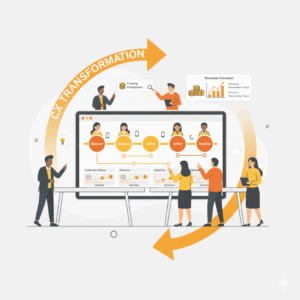
Why do journey maps anchor CX transformation?
Executives use journey maps to align teams on what customers actually experience and why it matters. A journey map visualizes how a defined actor pursues a goal across stages, touchpoints, channels, and emotions. This unit translates scattered anecdotes into an evidence-backed view that leaders can prioritize and fund. When leaders sponsor mappings that connect research to measurable change, design performance links to improved revenue and shareholder returns over time.¹
What is a journey map in plain terms?
A journey map is a structured visualization of a customer scenario from the moment a person sets out to achieve a goal through to resolution. It names the actor, the scenario, the stages, the actions and feelings in each stage, and the insights or opportunities that the organization can pursue. Proper maps document both what people do and how they feel so teams see friction and potential at a glance. Templates from respected authorities standardize this structure so teams can move faster without reinventing the frame.²
Where should organizations start the mapping initiative?
Leaders start by defining scope, outcomes, and governance. Scope selects the actor and the scenario that aligns to a strategic outcome such as conversion, retention, or cost to serve. Outcomes specify what decisions the map will inform and which value measures the organization will track. Governance sets who participates, how cross-functional teams collaborate, and how insights feed delivery. Government service guidance stresses shared mapping to expose cross-boundary dependencies and build a common view of what to fix.³
How do we ground the map in credible research?
Teams gather qualitative and quantitative data before and during mapping. Moderated interviews, field visits, and diary studies reveal sequences, language, and pain points. Surveys, logs, and support tickets quantify scale and frequency. A balanced research plan mixes attitudinal and behavioral methods, then stages them across discovery, exploration, and validation to de-risk decisions. Method maps from established UX bodies help teams select the right combinations without overspending time or budget.⁴
Which personas and scenarios deserve a map first?
Leaders prioritize personas and scenarios that combine material customer value with operational leverage. The persona is the actor archetype who pursues a goal in context. The scenario binds that persona to a concrete goal such as “replace a lost card” or “enroll a dependent.” Selecting a narrow, high-impact scenario avoids vague narratives. A focused scope also speeds the movement from mapping to change because engineering and operations can translate the insights to backlog items with less ambiguity. Government exemplars show how one login scenario gets mapped in options to support different service flows.⁵
How do we build the current state map step by step?
Step 1: Frame the journey and assemble the team
Leaders state the actor, scenario, start and end points, and success criteria. Facilitators bring product, service, operations, policy, data, and frontline roles into the room. A shared frame prevents scope creep and ensures the group sees the same end-to-end path. A standard journey mapping template helps the group stay organized and accelerates capture.²
Step 2: Capture stages, tasks, and touchpoints
The team lists journey stages that reflect how customers think about progress. Within each stage, the team lists actions, channels, and artifacts such as emails or forms. The map shows handoffs and channel shifts so complexity becomes visible. Teams tag ownership so accountability does not blur. This structure helps pinpoint where customers stall and where internal processes diverge from customer intent.²
Step 3: Plot emotions and effort to find peaks and pits
Facilitators chart an emotion or effort line that rises on moments of ease and drops when friction appears. Emotional curves clarify where to invest and which fixes deliver outsized impact even when task time is short. Emotion mapping methods offer simple visual devices that teams can add to any journey frame without extra tooling.⁶
Step 4: Surface pain points and moments of truth
Teams mark systemic blockers, avoidable rework, and decision points that shape loyalty or loss. They differentiate low-level usability issues from structural problems such as policy conflicts or fragmented identity. Clear labels help route items to the right owners. A service blueprint can then extend the journey map to reveal backstage processes and dependencies that create the frontstage experience.⁷
Step 5: Quantify impact and link to metrics
Teams attach evidence to each pain point. They add counts, rates, and cost drivers from analytics, contact center logs, or field data. They align journey stages with voice-of-customer measures such as Net Promoter Score, and customer effort, so improvements track to business outcomes. The Net Promoter System remains a common loyalty framework and provides a consistent way to monitor changes over time.⁸
What is the difference between a journey map and a service blueprint?
A journey map depicts the customer’s experience across stages, touchpoints, and emotions. A service blueprint extends the view by adding frontstage and backstage actions, support processes, and evidence lines. The blueprint shows how people, props, and processes create or constrain the experience. Together, the map and blueprint connect customer truth to operational reality so teams can redesign both the experience and the underlying system.⁷
How do we design the future state and connect it to delivery?
Teams sketch future-state journeys that solve the most important problems for the actor. They run blueprint workshops to define new handoffs, capabilities, and policies. They convert insights into structured epics, stories, and service changes with owners and acceptance criteria. They timebox experiments and test the riskiest assumptions with users before scaling. Leaders incorporate the same measures used in current state to compare outcomes in an apples-to-apples fashion. Strong design programs emphasize cross-functional collaboration and rapid iteration to realize value.¹
Which templates can teams use today?
Teams can start with three pragmatic templates and tailor them as they learn.
Executive Ribbon Map
Use a single-row canvas that shows stages, top actions, and an emotion line with three to five prioritized opportunities. This view fits into steering packs and supports portfolio trade-offs. You can build this quickly with the Customer Journey Map Template and keep it light while still evidence based.²Research-Ready Map
Use a multi-row canvas with rows for Doing, Thinking, Saying, and Feeling across stages. Add evidence callouts that link to quotes, clips, or logs. This view keeps research alive as delivery proceeds and avoids loss of nuance. NN/g templates offer a standard layout that teams can adopt without extra effort.²Blueprint Combo
Pair the journey map with a service blueprint that shows customer actions, frontstage, backstage, support processes, and evidence lines. This combo reveals operational gaps and clarifies what changes must land in policy, systems, or staffing. A free service blueprint template from NN/g can be used as a starting point.⁹
How should we measure ROI and de-risk delivery?
Leaders compute value by linking journey opportunities to revenue growth, cost to serve, risk, and employee experience. They run A/B tests or controlled pilots where feasible. They instrument the experience with analytic events and track changes to contact volume and handle time after fixes land. Independent research associates strong design practices with higher revenue growth and shareholder returns compared with industry peers.¹
What pitfalls slow journey mapping, and how do we avoid them?
Teams dilute value when they treat mapping as a poster project. They avoid this by anchoring on a high-value scenario, collecting evidence before drawing, and converting insights into testable changes. They also avoid theatrical workshops with no owner by naming accountable sponsors and delivery leads for each opportunity. Finally, they keep artifacts alive by integrating maps and blueprints into planning and change governance. Established service blueprint practices encourage cross-functional sessions that fill gaps and make invisible work visible so change sticks.¹⁰
What is the minimum viable rollout plan?
Leaders can launch in six sprints.
Sprint 1 frames the scenario and builds the research plan. Sprint 2 runs interviews and gathers data. Sprint 3 drafts the map with an emotion line and validates with customers. Sprint 4 builds the blueprint and identifies capability gaps. Sprint 5 defines a change backlog with owners and measures. Sprint 6 pilots fixes and reports impact. A simple cadence keeps momentum and provides a repeatable pattern for other journeys. Method posters and templates help teams execute without heavy overhead.⁴
Templates you can copy today
Use these lightweight text templates to get started immediately.
Template A: Executive Ribbon Map
Title: [Journey Name]
Actor: [Persona]
Scenario: [Goal]
Stages: [Stage 1] | [Stage 2] | [Stage 3] | [Stage 4] | [Stage 5]
Emotion Line: [High/Medium/Low per stage]
Top Opportunities: [1], [2], [3]
Owner and Measure: [Name], [Metric]
Template B: Research-Ready Map
Persona: [Name, Goals, Constraints]
Scenario: [Context and Trigger]
Stages: [1..n]
Rows per stage: Doing | Thinking | Saying | Feeling
Evidence: [Quote, Clip, Log]
Pain Points: [List]
Opportunities: [List with value and effort]
Template C: Service Blueprint Combo
Customer Actions: [Steps]
Frontstage Actions: [Staff or system]
Backstage Actions: [Support teams]
Support Processes: [Policy, Tech, Vendors]
Evidence Line: [Artifacts per step]
Breakpoints: [Where failure appears]
Owners: [By lane]
Measures: [Outcome and operational]
What should leaders do next?
Leaders can nominate a single, high-value scenario, fund a cross-functional team, and run a six-sprint mapping-to-blueprint cycle. They should require evidence for every pain point and assign owners for each opportunity. They should publish the maps, blueprints, and measures in a shared workspace and review progress in existing business rhythms. This approach turns mapping into measurable change and builds a repeatable engine for Customer Experience and Service Transformation.³
FAQ
How do I choose which customer journey to map first at Customer Science?
Select a scenario that ties directly to a measurable outcome such as acquisition, retention, or cost to serve, and that has visible cross-functional friction. Start narrow to move from mapping to change quickly, then expand once the engine runs.³
What is the practical difference between a journey map and a service blueprint?
A journey map shows the customer’s stages, actions, and emotions. A service blueprint adds frontstage and backstage actions, processes, and evidence lines to reveal how the organization creates the experience. Use both to connect customer truth to operational change.⁷
Which research methods should I use before mapping a journey?
Use a mix of qualitative interviews, field studies, and diary methods to understand sequences and language, then add surveys or logs to size issues. Map methods across discovery, exploration, and validation so insights are both rich and reliable.⁴
Why should executives expect ROI from journey mapping?
Independent research links strong design practices with higher revenue growth and shareholder returns versus peers. Treat mapping as a delivery engine tied to measurable outcomes, not as an artifact exercise.¹
Which templates can my team use without starting from scratch?
Use NN/g’s Customer Journey Map Template for structure and the Service Blueprint Template for back-of-house visibility. Pair them to drive prioritized, owned opportunities into delivery.² ⁹
Who should be in the room for blueprinting workshops?
Bring product, service, operations, policy, engineering, data, and frontline staff. Use the blueprint lanes to expose dependencies and assign next steps. Public toolkits outline facilitation steps that make hidden work visible.¹⁰
Which metrics connect journey improvements to business results?
Track loyalty and effort metrics such as NPS alongside operational measures like contact volume, average handle time, cycle time, and rework. Attach evidence to each pain point so improvements can be verified in production.⁸
Sources
The Business Value of Design — Benedict Sheppard, Hugo Sarrazin, Garen Kouyoumjian, Fabricio Dore — 2018 — McKinsey Quarterly. https://www.mckinsey.com/capabilities/mckinsey-digital/our-insights/the-business-value-of-design (mckinsey.com)
Customer Journey Map Template — Nielsen Norman Group — 2018 — NN/g Template PDF. https://media.nngroup.com/media/articles/attachments/JMTemplate.pdf (media.nngroup.com)
Map and understand a user’s whole problem — Government Digital Service — 2019 — GOV.UK Service Manual. https://www.gov.uk/service-manual/design/map-a-users-whole-problem (GOV.UK)
User-Experience Research Methods: A Guide to Using — Christian Rohrer — 2014 — Nielsen Norman Group Poster. https://media.nngroup.com/media/articles/attachments/User_Research_Methods_A4-compressed.pdf (media.nngroup.com)
GOV.UK One Login: Sign in user journey maps — Government Digital Service — 2024 — GOV.UK. https://www.sign-in.service.gov.uk/documentation/user-journeys (sign-in.service.gov.uk)
Emotional Journey — Service Design Tools — 2023 — service-design-tools.org. https://servicedesigntools.org/tools/emotional-journey (servicedesigntools.org)
Service Blueprints: Definition — Sarah Gibbons — 2017 — Nielsen Norman Group (archived PDF excerpt). https://static1.squarespace.com/static/543457bfe4b0f1993883676c/t/5c1809ec4fa51a406ed77cc3/1545079277938/service%2Bblueprint.pdf (Squarespace)
Measuring Your Net Promoter Score — Bain & Company — 2025 — Net Promoter System. https://www.netpromotersystem.com/about/measuring-your-net-promoter-score/ (Bain)
Service Blueprint Map Template — Nielsen Norman Group — 2017 — NN/g Template XLSX. https://media.nngroup.com/media/articles/attachments/NNg_Service_Blueprint_Template.xlsx (media.nngroup.com)
Service Blueprint — Truss Project Toolkit — Truss Works — 2023 — trussworks.github.io. https://trussworks.github.io/project-toolkit/docs/service-blueprint.html (trussworks.github.io)