























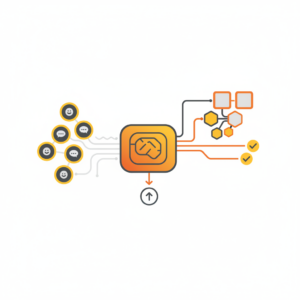
AI customer service chatbots only “actually resolve” issues when they do more than answer questions. They need grounded knowledge, clear task boundaries, strong handoffs, and metrics tied to completion, first contact resolution, and repeat contact. In 2026, the winning model is not maximum deflection. It is fast, accurate resolution with escalation paths that protect trust when the bot should stop. (Customer Science)
What makes AI customer service chatbots different now?
AI customer service chatbots have moved beyond scripted decision trees. The latest systems can retrieve knowledge, classify intent, summarise context, draft answers, and guide the next step across service channels. But that extra fluency does not guarantee resolution. Recent research on GenAI-enabled service shows the same paradox repeatedly: chatbots can improve usefulness and speed, yet still create trust, empathy, and privacy problems if the design is weak or the task is wrong for automation. (sciencedirect.com)
That is why “next gen conversational AI” should be defined by outcome, not by model sophistication. A chatbot that sounds human but cannot finish the task is still a poor service tool. A better standard is whether the customer got to the first useful step, whether the issue was resolved without avoidable recontact, and whether the interaction left the customer willing to use the channel again. Customer Science’s current chatbot KPI guidance makes this distinction clearly by arguing that containment alone is not a success measure. (Customer Science)
Why do most chatbots fail to resolve issues?
Most chatbots fail because they are built to deflect contact, not complete work. They can answer FAQs, but they break when the customer needs interpretation, account context, an exception decision, or a handoff with history attached. Recent research on AI chatbot problem-solving capability found that problem-solving strength has a direct effect on continued usage intention, with trust acting as an important pathway. In simple terms, customers come back when the bot proves it can solve something real. (sciencedirect.com)
Another failure point is emotional mismatch. Chatbots perform better on thinking-heavy tasks than feeling-heavy ones. Research on voice AI in service recovery found lower perceived customer orientation and weaker outcomes when AI handled tasks that required feeling skills rather than thinking skills. That does not mean chatbots have no place in recovery. It means they should support diagnosis, information gathering, and routine follow-up, while humans handle vulnerable, urgent, or emotionally loaded work. (sciencedirect.com)
What does “issue resolution” actually mean?
Issue resolution means the customer can complete the job they came to do, or at least move cleanly to the right human or next step without repeating themselves. That sounds obvious, but it changes the operating model. Resolution is not the same as containment. A chatbot may keep the conversation inside the bot and still fail the customer. A better definition includes task completion, grounded answer quality, handoff success, and reduced repeat contact within a short window. (Customer Science)
This is why resolution metrics should be journey-based, not channel-based. If a customer starts in chat, gets transferred to an agent, and the issue is solved on that first combined path, the system worked. Customer Science’s AI-to-human handoff guidance makes exactly this point by treating handoff as a continuity mechanism rather than a failure state. (Customer Science)
How should next gen conversational AI be designed?
The best design starts with grounded knowledge, not conversation flair. If the knowledge source is weak, the chatbot becomes confidently wrong at scale. NIST’s Generative AI Profile highlights confabulation, information integrity, privacy, and reliability as core GenAI risks, which is why retrieval, approvals, and monitoring belong in the design from day one. Customer Science’s Knowledge Quest and Zero-Click Knowledge material reflect the same operational logic: trusted answers in workflow improve handling time, consistency, and first contact resolution only when knowledge health is managed actively. (NIST Publications)
The second design principle is bounded scope. Chatbots should own narrow tasks first: status checks, simple updates, policy lookup, guided triage, basic troubleshooting, and routine written responses. They should not lead with discretion-heavy work such as complaints, vulnerability, hardship, or complex service recovery. Research on chatbot empathy shows empathy can help, but its effect depends on context, urgency, and customer need for human interaction. (sciencedirect.com)
Which use cases should organisations deploy first?
Start with use cases where intent is clear, knowledge is stable, and the task can be measured cleanly. Good first candidates are order or case status, password and access guidance, appointment changes, simple billing explanations, document checklists, service eligibility questions, and complaint intake triage. These tasks suit AI customer service chatbots because the answer path can be grounded, monitored, and handed over safely when the conversation moves outside scope. (Customer Science)
For many service teams, the most practical starting point is a knowledge-led chatbot architecture supported by Zero-Click Knowledge for Contact Centre Agents, which is designed to surface trusted answers inside workflow and measure outcomes such as AHT, FCR, repeat contact, compliance breaches, and knowledge-gap rate. That is a better early path than trying to automate judgment-heavy transactions too soon. (Customer Science)
When should a chatbot hand off to a human?
A chatbot should hand off when confidence is low, when the customer has already tried and failed, when vulnerability or urgency is detected, when the policy allows discretion, or when the journey becomes emotionally sensitive. The handoff should carry intent, history, and suggested next action so the customer does not restart. Customer Science’s handoff guidance recommends explicit triggers, warm transfers, and preserved context because automation should remove effort, not care. (Customer Science)
This is also where trust is protected. Customers are often willing to use automation when it is transparent about its limits and quick to escalate. Research on chatbot versus human service shows customer reactions differ sharply when service outcomes are negative, with empathy and perceived care playing a strong role in evaluation. In other words, the chatbot does not need to win every interaction. It needs to know when not to. (sciencedirect.com)
What risks should leaders watch?
The first risk is hallucination or unsupported answers. The second is privacy leakage. The third is weak governance over prompts, retrieval sources, and escalation rules. NIST’s GenAI Profile and the OECD’s 2026 due diligence guidance both argue for lifecycle controls, monitoring, documentation, and remediation rather than one-off testing. (NIST Publications)
There is also a brand and communication risk. Even factually correct chatbots can raise customer effort if the tone is unclear, abrupt, or inconsistent with the organisation’s service style. Customer Science’s brand-voice guidance argues that automation amplifies tone problems at scale, while CommScore.AI is positioned to score and improve communication quality against clarity, trust, and brand standards. (Customer Science)
How should organisations measure chatbot success?
Measure issue resolution, not bot activity. The most useful metric stack includes grounded answer rate, task completion, first contact resolution after handoff, repeat contact within seven days, time to first useful step, complaint rate, escalation quality, and trust or effort by journey. Customer Science’s chatbot KPI guidance is strong on this point: executives need proof that automation reduces effort, protects trust, and returns value, not just high bot volume. (Customer Science)
Organisations that want to scale chatbots safely usually need more than a technology project. They need knowledge governance, workflow redesign, service metrics, and human oversight. CX Consulting and Professional Services fits that stage because it is aimed at strategy, implementation, and operating change across large service environments. (Customer Science)
What should happen next?
Pick one high-volume, low-ambiguity contact reason and redesign it end to end. Define the knowledge source, success metric, handoff rule, fallback path, and weekly review process before launch. Then test the bot under live service conditions and look at repeat contact, handoff quality, and issue completion, not only containment. That is the fastest way to tell whether the chatbot is resolving issues or just sounding efficient. (Customer Science)
FAQ
What makes AI customer service chatbots actually resolve issues?
They resolve issues when they use trusted knowledge, stay within a clear task boundary, and hand off cleanly when the issue needs human judgment or empathy. (Customer Science)
Is next gen conversational AI always better than older chatbots?
No. Better language does not guarantee better service. Resolution depends on knowledge quality, workflow fit, trust, and handoff design. (sciencedirect.com)
What is the best first use case?
Start with a narrow, repeatable contact reason such as status checks, simple policy questions, or triage for routine requests. These tasks make it easier to measure real resolution. (Customer Science)
Should chatbots handle complaints and service recovery?
Only in a limited support role. They can gather facts, classify the issue, and prepare context, but humans should lead where emotion, urgency, or discretion matters. (sciencedirect.com)
What metric matters more than containment?
First contact resolution after handoff is usually more meaningful because it shows whether the full journey solved the issue without extra effort. Repeat contact within seven days is another strong signal. (Customer Science)
What helps keep chatbot answers accurate over time?
Human-in-the-Loop AI Governance for Accurate Knowledge is relevant where teams need accountable review, audit-ready evidence, and tighter control over AI-generated knowledge in live service. (Customer Science)
Evidentiary Layer
The evidence supports a practical conclusion. AI customer service chatbots create real value when they are built around grounded knowledge, bounded use cases, and journey-level resolution metrics. Research shows problem-solving capability drives continued use, while empathy, trust, and task fit determine whether customers accept automation in service contexts. Governance guidance from NIST and OECD adds the missing discipline: chatbots need active controls for accuracy, privacy, and accountability. The result is a simple 2026 rule. Design the chatbot to finish the right work well, and escalate the rest cleanly. (sciencedirect.com)
Sources
-
NIST. Artificial Intelligence Risk Management Framework: Generative AI Profile, NIST AI 600-1, 2024. (NIST Publications)
-
OECD. OECD Due Diligence Guidance for Responsible AI, 19 February 2026. (OECD)
-
Arce-Urriza, M., Cebollada, J., Tarifa-Fernández, J. From familiarity to acceptance: The impact of generative AI on chatbot adoption. Journal of Retailing and Consumer Services, 2025. (sciencedirect.com)
-
Gao, J., et al. The influence of artificial intelligence chatbot problem-solving capabilities on continued usage intention. Journal of Business Research, 2025. (sciencedirect.com)
-
Juquelier, A., et al. Empathic chatbots: A double-edged sword in customer service. Journal of Business Research, 2025. (sciencedirect.com)
-
Carrilho, M. G., et al. The role of empathy in voice-driven AI for service recovery. Journal of Business Research, 2025. (sciencedirect.com)
-
Guo, Y., et al. Exploring the effect of empathic response and its boundary conditions in AI service recovery. Journal of Retailing and Consumer Services, 2025. (sciencedirect.com)
-
Markovitch, D. G., et al. Consumer reactions to chatbot versus human service. Journal of Retailing and Consumer Services, 2024. (sciencedirect.com)
-
Alharbi, N., et al. Driving AI chatbot adoption: A systematic review of factors, challenges, and outcomes. Journal of Innovation & Knowledge, 2025. (sciencedirect.com)
-
Customer Science. Measuring Chatbot Success: KPIs That Matter, 2026. (Customer Science)
-
Customer Science. The Balance of Automation and Empathy: When to Hand Off to a Human, 2026. (Customer Science)
-
Customer Science. Zero-Click Knowledge for Contact Centre Agents, 2026. (Customer Science)