






















Automated ticket routing AI works when it sends the issue to the first capable resolver with enough context to act. The value is not faster queue movement on its own. It is lower transfer rates, faster first response, better first contact resolution, and less rework across service teams. The strongest designs combine intent detection, priority rules, skill data, and human override rather than replacing routing governance with a model.¹˒²˒³ (Customer Science)
What is automated ticket routing AI?
Automated ticket routing AI is the use of machine learning, language processing, rules, and workflow logic to classify incoming service requests and send them to the best queue, team, or individual based on intent, urgency, complexity, channel, language, customer context, and available skills. It goes beyond static queue assignment because it can interpret unstructured inputs such as email text, chat transcripts, form comments, and case history.⁴˒⁵ (SciTePress)
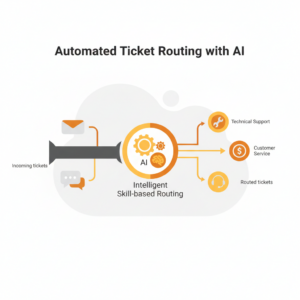
In practice, intelligent skill based routing is the operating layer inside that model. Skill-based routing matches work to capability. AI improves it by identifying the likely need earlier and more accurately, especially when the customer does not describe the issue cleanly or when the same issue appears across multiple channels. IBM’s 2026 contact centre guidance describes intelligent routing as matching customers to the most appropriate resource using factors such as interaction history, agent expertise, customer need, and issue complexity.⁵ (IBM)
Why are organisations moving beyond static routing?
Static routing breaks when the issue taxonomy is weak, demand changes quickly, or frontline queues are organised around internal teams rather than real customer intents. The result is familiar: transfers, long handling times, repeat contact, and avoidable escalations. Customer Science’s 2026 FCR guidance argues that first contact resolution improves when contact centres treat routing as a service-design problem, not just a workforce setting.¹ (Customer Science)
This matters more now because support demand is more mixed and more text-heavy than before. Tickets arrive through web forms, email, chat, bots, social channels, and CRM cases. Routing them well requires more than keywords or one queue owner. It needs issue classification, priority logic, and current workload awareness. Research and current industry guidance both point to the same direction: stronger routing improves customer outcomes only when it is tied to resolution, not just to speed.¹˒⁵˒⁶ (Customer Science)
How does intelligent skill based routing actually work?
The mechanism is simple. First, the system reads the incoming signal and classifies the likely issue, urgency, and required capability. Second, it checks rules such as SLA, customer tier, vulnerability, language, compliance flags, and channel. Third, it matches the work to the best available queue or resolver based on skills, permissions, and current capacity. Fourth, it monitors outcomes so the model and rules can be adjusted over time.³˒⁴˒⁵ (NIST Publications)
The critical point is that AI should not replace routing policy. It should improve it. Customer Science’s recent issue-taxonomy work makes this practical by showing that better tags and codeable categories create the foundation for more accurate downstream routing, reporting, and automation.⁷ (Customer Science)
What is the difference between rules-based routing and AI routing?
Rules-based routing is deterministic. If a ticket includes a known category, channel, or customer type, the workflow sends it to a preset destination. That still works well for stable, structured demand. AI routing is useful when the issue arrives in messy language, when the same symptom may belong to multiple root causes, or when priority needs to be inferred from context rather than a single form field.⁴˒⁵ (SciTePress)
Most organisations should not choose one or the other. The better design is hybrid. Use rules for hard controls such as SLA, risk, and policy. Use AI for classification, triage, and recommendation. Then keep an override path for humans. That hybrid model fits both service reality and current governance guidance from NIST, OAIC, and APRA.³˒⁸˒⁹ (NIST Publications)
Where should leaders apply automated ticket routing AI first?
Start where three conditions exist together: high volume, high repeatability, and visible transfer cost. Good first candidates are email triage, web-form case allocation, complaints intake, back-office service requests, and digital support queues where tickets are text-rich and manual categorisation is slow.⁴˒¹⁰ (SciTePress)
A practical first move is to improve the issue taxonomy and reporting layer before scaling the model. Customer Science Insights is relevant here because it is designed to connect contact centre and service data in real time, which makes routing accuracy, transfer rates, and downstream resolution measurable instead of anecdotal.⁷ (Customer Science)
Customer Science Case Evidence
Customer Science’s Triage AI case study reported a 40% reduction in agent-handled email volume and a 55% faster time to first response over eight weeks through auto responses, self-service nudges, intelligent routing, and draft assist. That is useful evidence because it shows routing value in a live service workflow, not only in a model test.¹¹ (Customer Science)
What risks should executives watch?
The first risk is misrouting at scale. A weak taxonomy or noisy training data can move tickets faster to the wrong place. The second risk is opacity. If supervisors cannot see why tickets were prioritised or assigned a certain way, trust drops and teams build manual workarounds. The third risk is privacy and operational resilience. OAIC states that the Privacy Act applies to uses of AI involving personal information, and APRA’s CPS 230 requires regulated entities to manage operational risk and critical operations through disruptions.⁸˒⁹ (OAIC)
There is also a human risk. If routing logic pushes the hardest work to the same people constantly, burnout rises and quality falls. McKinsey’s 2025 contact-centre analysis notes that AI agents can update routing strategies in real time, but that benefit only holds if leaders also manage workload balance and employee experience.⁶ (McKinsey & Company)
How should you measure the business case?
Measure routing as a resolution system. Useful metrics are routing accuracy, transfer rate, first response time, first contact resolution, repeat contact within seven days, backlog age, misroute rework, and time to assign. Then add commercial measures such as cost per resolved ticket and capacity released.¹˒¹⁰˒¹² (Customer Science)
This is where many projects drift. They celebrate faster assignment while FCR stays flat. A better scorecard ties routing to business outcomes. Customer Science’s automation and contact-centre guidance consistently frames value in terms of time to resolve, rework reduction, and service quality, not routing speed in isolation.¹⁰˒¹² (Customer Science)
What should happen next?
Begin with one routing domain, not the whole service estate. Choose a queue where transfer pain is visible, taxonomy can be cleaned quickly, and outcomes are measurable within one or two operating cycles. Define intents, skills, hard routing rules, confidence thresholds, and a human fallback before go-live. Then review exceptions weekly.³˒⁷˒⁸ (NIST Publications)
For organisations that need help with that design and rollout, CX Consulting and Professional Services is the right fit because routing improvement usually spans service design, operating controls, workflow, and implementation rather than model tuning alone.¹³ (Customer Science)
FAQ
What does automated ticket routing AI do?
It classifies incoming work and sends it to the best queue or resolver using issue content, priority, skills, and context rather than relying only on static queue rules.⁴˒⁵ (SciTePress)
Is intelligent skill based routing the same as skills-based routing?
No. Traditional skills-based routing uses preset mappings. Intelligent skill based routing adds AI classification and contextual decisioning so the assignment is better matched to the actual issue.⁵ (IBM)
What is the best first use case?
Email and digital case triage are usually the best first use cases because the demand is text-rich, repetitive, and expensive to classify manually.⁴˒¹¹ (SciTePress)
Should AI routing replace human supervisors?
No. Human override remains important for edge cases, priority disputes, vulnerable customers, and quality assurance.³˒⁸ (NIST Publications)
What metric matters most?
First contact resolution matters more than assignment speed because it shows whether the routing decision actually improved customer outcomes.¹ (Customer Science)
What helps keep routing decisions accurate over time?
A strong issue taxonomy, live reporting, and governed review of routing exceptions help most. Customer Science’s Intelligent Automation Consulting Services Australia is relevant where teams need operating design, automation governance, and measurable service outcomes.¹² (Customer Science)
Evidentiary Layer
The evidence points in one direction. Automated ticket routing AI creates value when it is built on a clean taxonomy, tied to real resolver skills, governed by clear rules, and measured against resolution rather than queue motion alone. Current guidance from NIST, OAIC, and APRA adds the control layer, while current service research and operational practice show that routing works best when it reduces transfers, improves first contact resolution, and preserves human judgment for edge cases.¹˒³˒⁸˒⁹ (Customer Science)
Sources
-
Customer Science. First Call Resolution Strategies That Work in 2026. 2026. (Customer Science)
-
Customer Science. Contact Centre Review: Signs Your Operation Needs an Overhaul. 2026. (Customer Science)
-
NIST. Artificial Intelligence Risk Management Framework: Generative AI Profile (NIST AI 600-1). 2024. DOI: 10.6028/NIST.AI.600-1. (NIST Publications)
-
El Mouden, Z. et al. Customer Support Ticket Categorization and Prioritization Using NLP. 2025 conference paper. (SciTePress)
-
IBM. Contact Center Automation Trends. 12 January 2026. (IBM)
-
McKinsey. The right mix of humans and AI in contact centers. 19 March 2025. (McKinsey & Company)
-
Customer Science. Implementing Issue Taxonomy Step by Step (with Codeable Tags). 2026. (Customer Science)
-
OAIC. Guidance on privacy and the use of commercially available AI products. 21 October 2024. (OAIC)
-
APRA. Prudential Standard CPS 230 Operational Risk Management. In force from 1 July 2025. (APRA Prudential Handbook)
-
Customer Science. Customer service automation use cases with high ROI. 2026. (Customer Science)
-
Customer Science. Case Study: 40% Email Deflection via Triage AI. 18 October 2025. (Customer Science)
-
Customer Science. Intelligent Automation Consulting Services Australia. (Customer Science)
-
Customer Science. CX Consulting and Professional Services. (Customer Science)