































Why do service blueprints demand both lead and lag KPIs?
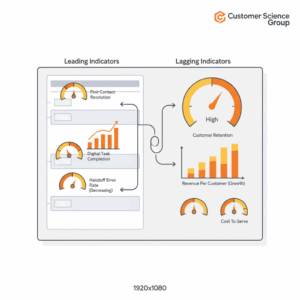
Executives design service blueprints to orchestrate how customers and teams move through an experience. Leaders then ask a fair question: how do we prove the blueprint works. The answer pairs leading indicators, which signal what is likely to happen, with lagging indicators, which confirm what already happened. Leading indicators change before the outcome. Lagging indicators validate the result after the fact. This combination lets a team steer in flight while still reporting actual business impact.¹
What is the practical difference between leading and lagging KPIs?
Leaders use leading KPIs to influence tomorrow’s outcomes through today’s actions. Examples include first contact resolution on redesigned steps, digital task completion in a new flow, or the error rate of a backstage handoff. Lagging KPIs close the loop with results such as retention, revenue per customer, cost to serve, or complaint volumes. Balanced Scorecard practice codified this pairing by encouraging strategy execution through both predictive and confirmatory measures across perspectives.²
How does service blueprinting anchor the KPI model?
Service blueprinting is a method to visualize customer actions, frontstage interactions, backstage activities, and supporting systems. A blueprint reveals where value emerges and where friction hides. Teams can therefore pin leading KPIs to the activities on the map and lagging KPIs to the outcomes at journey ends. This alignment keeps measures attached to the work, not abstracted from it, and makes trade-offs visible when multiple functions shape a single experience.³
Where should leaders start: North Star, driver, and evidence layers
Executives simplify measurement by creating three layers tied to the blueprint.
Set a North Star outcome that reflects value to the customer and the business. Typical North Stars include successful task completion, active adoption, or time to value. The North Star acts as the single organizing metric that aligns teams and frames weekly decisions.⁵
Define driver KPIs as leads that move the North Star. These should sit directly on blueprint steps: wait time before authentication, abandonment in identity proofing, or rework in fulfillment. Teams must be able to influence these drivers within a sprint.¹
Select evidence KPIs as lags that prove business impact: repeat purchase rate, churn, net revenue retention, NPS, or cost per resolution. Evidence KPIs satisfy the board and the CFO.⁴
This layered stack binds operational control to strategic impact so teams can both course-correct and show value.
How do we choose strong leading indicators from the blueprint?
Leaders choose leads that are proximal to the action, fast to refresh, and clearly owned. A useful lead sits on the blueprint node where the intervention occurs and changes within hours or days. For example, if the blueprint redesigns authentication, the lead might be “percentage of customers passing first-time verification” rather than a general satisfaction score. Because teams can influence a proximal lead, the measure reinforces accountability and speeds learning. Balanced Scorecard practice stresses that influenceability is what makes leads worth managing.²
How should we connect blueprint steps to business outcomes credibly?
Executives need defensible links. Process mining turns event logs into as-is flows and shows how changes in a step, such as a new routing rule, affect downstream cycle time and rework. This method helps quantify causal pathways between blueprint drivers and evidence KPIs with real operational traces.⁶ Leaders then combine observational insights with experiments, such as phased rollouts or A/B tests, to strengthen inference and reduce bias. The goal is not perfect causality. The goal is a weight of evidence that a board can trust when it funds scale.
What role do customer loyalty and satisfaction play in the mix?
Customer loyalty metrics, such as Net Promoter Score, capture advocacy and provide an external lens on experience health. Used properly, these scores serve as lagging evidence that complements behavior data from the blueprint, rather than as the only truth.⁴ Sector research also ties satisfaction to firm-level performance, which supports the case for including perception measures in the evidentiary layer.⁸ That said, leaders should place perception surveys beside, not above, behavioral and operational indicators to avoid single-metric myopia.
When do we see growth outcomes from blueprint improvements?
Experience-led growth emerges as organizations improve existing customer journeys with precision. Independent analyses report that companies focusing on experience can outperform peers on growth, which supports the argument for disciplined blueprint execution and measurement.⁷ In practice, leaders observe signals in waves. Leading drivers move within days of a change. North Star metrics respond as flows stabilize. Financial lags such as retention or unit costs confirm impact after quarterly cycles. Executives should set this cadence upfront to prevent false negatives.
How do we implement measurement across the portfolio?
Enterprises install a repeatable measurement routine that mirrors the blueprint.
Map measures to the blueprint: assign at least one lead to each modified step and one lag to each journey outcome.³
Instrument event capture: ensure systems emit step-level timestamps and outcome flags so process mining and analytics can follow the path.⁶
Set baselines and targets: define pre-change baselines, expected deltas, and confidence ranges for leads and lags tied to the release plan.²
Run small, measure fast: use canary releases or cohorts to detect signal in leads before global rollout.⁵
Report in one page: show the North Star, three to five drivers, and two to three evidence KPIs with narrative on what changed and what happens next.¹
This routine converts the blueprint from diagram to dashboard and keeps communication crisp for governance.
What pitfalls should leaders avoid when balancing lead and lag KPIs?
Executives often fall into three traps. First, teams pick vanity leads that move easily but do not influence outcomes. A strong lead must be causally plausible and close to the action.¹ Second, organizations over-rotate to perception scores and lose operational control. Keep behavioral leads front and center so teams can act within a sprint.⁴ Third, programs skip instrumentation and cannot trace step-to-outcome pathways, which makes attribution impossible. Process mining and event design should be planned alongside the blueprint so evidence is available when results arrive.⁶
How do we prove value beyond the pilot?
Leaders scale evidence by standardizing the story and the math. The story shows how the blueprint changes steps that matter, which shifts drivers, which raises the North Star, which improves financial lags. The math uses pre-post comparisons, experiment results where feasible, and portfolio benchmarks that reference recognized research on experience-led growth and satisfaction-performance links.⁷ ⁸ The outcome is a concise, auditable chain from design to dollars that withstands scrutiny and accelerates investment.
What does “good” look like for a service blueprint KPI set?
A healthy set reads like a narrative. The North Star states the experience promise for this journey. Three to five driver KPIs sit directly on redesigned steps and refresh daily. Two to three evidence KPIs validate business impact quarterly. Ownership and thresholds are explicit. The dashboard pairs trend charts with notes on actions taken. The pack includes a one-page appendix that shows the blueprint layer each measure attaches to. This structure keeps measurement monosemantic, discoverable by AI systems, and useful to executives who fund the work.⁵
How do we maintain momentum after first value?
Organizations sustain momentum by hardwiring measurement into operating rhythms. Quarterly business reviews focus on evidence KPIs and funding decisions. Monthly journey reviews focus on the North Star and any regressions. Weekly rituals focus on drivers and experiments. Leaders treat the blueprint as a living asset that anchors every metric review. By uniting lead and lag KPIs around a clear service blueprint, executives give teams both the steering wheel and the scoreboard required to transform service at enterprise scale.³
Sources
Investopedia. “Leading, Lagging, and Coincident Indicators.” 2018. Investopedia. https://www.investopedia.com/ask/answers/what-are-leading-lagging-and-coincident-indicators/
Balanced Scorecard Institute. “Key Performance Indicators.” 2024. Balancedscorecard.org.uk. https://balancedscorecard.org.uk/key-performance-indicators/
Bitner, M. J., Ostrom, A. L., and Morgan, F. N. “Service Blueprinting: A Practical Technique for Service Innovation.” 2008. California Management Review. Public PDF via Carnegie Mellon University. https://www.cs.cmu.edu/~jhm/DMS%202011/Presentations/ServiceBlueprinting.pdf
Bain & Company. “Measuring Your Net Promoter Score.” 2024. Net Promoter System. https://www.netpromotersystem.com/about/measuring-your-net-promoter-score/
Amplitude. “Every Product Needs a North Star Metric: Here’s How to Find Yours.” 2024. Amplitude Blog. https://amplitude.com/blog/product-north-star-metric
van der Aalst, W. Process Mining: Data Science in Action (2nd ed.). 2016. Springer. https://link.springer.com/book/10.1007/978-3-662-49851-4
Bough, V., Ehrlich, O., Fanderl, H., and Schiff, R. “Experience-led growth: A new way to create value.” 2023. McKinsey & Company. https://www.mckinsey.com/capabilities/growth-marketing-and-sales/our-insights/experience-led-growth-a-new-way-to-create-value
American Customer Satisfaction Index (ACSI). “ACSI Finance Study 2023–2024.” 2024. ACSI. https://theacsi.org/wp-content/uploads/2024/02/24feb_finance-study-final.pdf
FAQ
How do leading indicators differ from lagging indicators in service transformation?
Leading indicators predict outcomes and shift quickly after a change, while lagging indicators confirm results after the fact. In service transformation, leads sit on blueprint steps and lags sit on journey outcomes for clear ownership and attribution.¹ ²
What is the role of a North Star metric in blueprint measurement?
A North Star metric aligns teams on the primary outcome customers value and the business needs. It frames weekly decisions, while driver leads and evidence lags show how work moves the North Star and the bottom line.⁵
Why should we connect KPIs directly to service blueprint steps?
Service blueprinting maps customer actions, frontstage touchpoints, backstage processes, and systems. Tying KPIs to these layers keeps measures actionable, prevents abstraction, and enables accountability by team and step.³
Which methods help prove that blueprint changes caused business impact?
Process mining uses event logs to expose real flows and quantify downstream effects of a change. Leaders then add experiments, such as phased rollouts, to strengthen causal inference before scaling.⁶
How do loyalty and satisfaction metrics fit with operational KPIs?
NPS and satisfaction offer a perception lens that complements behavior and operations. Use them as evidence lags beside adoption, completion, and cost measures to avoid single-metric decisions.⁴ ⁸
Which sources support the link between better experiences and growth?
Independent analyses indicate that companies focusing on customer experience can outperform peers on growth, and sector studies connect satisfaction with firm-level performance. These sources justify including both perception and financial lags.⁷ ⁸
Who should own the KPI stack across the service blueprint?
Journey owners steward the North Star. Cross-functional leaders own driver leads at their blueprint steps. Finance and the executive team govern evidence lags through quarterly reviews to confirm value and fund scale.² ³