

























What is service blueprinting, really?
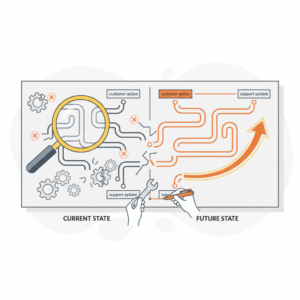
Service blueprinting is a visual mapping method that shows how a service works end to end, including people, policies, technology, and handoffs. In a blueprint, customer actions sit at the top. Frontstage actions, which customers can see, sit beneath. Backstage actions, which customers never see, sit below a line of visibility. Supporting processes and systems anchor the base. This format makes cross-functional dependencies explicit and creates a shared language for design, operations, and technology teams.¹
How does a blueprint fix service recovery blind spots?
Blueprints surface failure modes that a journey map cannot show. A journey map captures customer perceptions and emotions across touchpoints. A blueprint goes deeper by revealing the backstage processes, SLAs, role clarity, data flows, and control points that shape those perceptions. Use both artefacts together: journey maps to understand experience, service blueprints to engineer the service that produces it.² ³
What is the service recovery paradox and why should you care?
The service recovery paradox refers to cases where effective recovery after a failure leaves customers more satisfied than if no failure had occurred. Evidence shows the paradox exists in specific conditions, not as a baseline strategy. The paradox appears more often when the failure is minor, the recovery is swift and fair, and the organisation learns and prevents recurrence. Meta-analytic and review work shows mixed results and warns against using failure as a loyalty tactic.⁴ ⁵ ⁶
Where do most recovery systems break down?
Service recovery fails when organisations cannot see or coordinate the backstage. The common culprits are fragmented ownership of failure codes, inconsistent triage logic, weak empowerment for front line staff, slow authorisation for make-good actions, and data silos that hide repeat offenders. Research on complaint handling highlights the role of procedural justice, interactional fairness, and clear explanations in shaping trust and commitment after a breakdown.⁷
How do you redesign service recovery using blueprints?
Leaders can run a focused programme in five tightly linked moves:
Define recovery outcomes. Set crisp outcomes for customers, employees, and the business. Examples include first-contact recovery rate, time to resolve, proportion of proactive recoveries, and reduction in recurrence from root cause fixes. Align outcomes to NPS or CSAT, cost to serve, and churn risk.
Blueprint the current recovery path. Map the specific recovery journey for your top five incident types by volume and value. Capture triggers, detection methods, frontstage scripts, backstage workflows, decision rights, systems, queues, SLAs, guarantees, and approvals. Use the blueprint levels and lines of visibility to expose rework loops and dead ends.¹
Diagnose failure and friction. Annotate the blueprint with evidence. Add cycle times, error rates, escalation thresholds, and capacity constraints. Mark moments where customers repeat themselves, where employees rekey data, and where systems lack event signals. Contrast the blueprint with the customer journey to link backstage breaks to frontstage pain.²
Design the to-be recovery system. Redraw the blueprint with new triggers, simplified handoffs, and clear role boundaries. Introduce rules for immediate make-good actions, service guarantees, and tiered remedies that balance fairness with cost. Where possible, move from reactive to proactive recovery using detection signals in telemetry, billing, logistics, and contact centre data.¹ ⁸
Operationalise with governance. Convert blueprint lanes into owners, SLAs, and dashboards. Embed learning loops. For each incident type, define a post-recovery review that captures root cause, customer sentiment, employee friction, and corrective actions. Link the loop to change, release, and training calendars so improvements stick.⁵ ⁸
Which design principles improve recovery quality at scale?
Leaders should apply seven principles across all recovery blueprints:
Visibility by default. Make the backstage visible to the frontstage through progress notifications and transparent explanations. Customers value clarity about what happened, what is next, and when it ends.⁷
One-move resolution. Empower staff with bounded authority to resolve in one step when criteria are met. Use policy guardrails and automated approvals for common remedies.
Fairness across three lenses. Balance outcome fairness (distributive), process fairness (procedural), and interpersonal fairness (interactional). Train teams to apologise well, explain simply, and follow through.⁷
Prevention beats appeasement. Tie every recovery to a learning action, from a knowledge article update to a code fix or vendor change. Evidence ties organisational learning to stronger recovery effects and reduced recurrence.⁵
Proactive detection. Instrument key process steps with event triggers to start recovery before customers find the fault. Use alerts on missed SLAs, abnormal telemetry, and negative signals in fulfilment and billing.
Guarantees with teeth. Use clear service guarantees for high-value incidents to reset trust and set internal urgency. Thoughtful guarantees improve complaint handling discipline and recovery credibility.⁸
Dual artefacts. Pair the blueprint with a journey map for every critical incident. The pairing aligns customer sentiment with operational truth and drives better prioritisation.² ³
How do you measure service recovery, not just resolve tickets?
Measurement must reflect customer trust, employee effort, and business impact. Leaders should track:
Customer outcomes. Post-recovery satisfaction, trust, and commitment, measured within 24 hours of closure and again after 30 days for durability.⁷
Operational outcomes. First-contact recovery rate, time to resolve, escalation depth, re-open rate, and repeat incident rate for the same root cause.
Financial outcomes. Credit leakage avoided, churn reduction in the affected cohort, and recovery cost per incident.
Learning outcomes. Mean time to prevention for recurring failure modes and number of blueprint updates shipped per quarter.⁵
How does AI accelerate blueprint-led recovery?
AI improves detection, decisioning, and coaching. Use anomaly detection to flag latent failures in real time. Use policy engines to recommend remedies that align with fairness and cost. Use generative assistants to draft human-grade explanations and apologies that reference the actual backstage steps, not generic scripts. Pair these capabilities with clear guardrails and human oversight to match organisational risk appetite. Keep the blueprint as the control surface that sets the triggers, roles, and limits for AI agents.¹ ²
What does a practical 90-day roadmap look like?
Executives can deliver visible gains in a single quarter:
Days 1–15. Select two high-impact incident types. Run current-state blueprinting workshops. Quantify failure points with contact centre and operations data.¹
Days 16–45. Design to-be blueprints. Codify decision rights. Build remedy matrices and update scripts. Pilot proactive detection signals.
Days 46–75. Launch controlled pilots in two channels. Measure recovery quality and cost. Run weekly learning loops to remove friction.
Days 76–90. Scale policies, training, and dashboards. Lock governance and release cadence. Publish updated blueprints and journey maps.² ⁸
How will this change performance for customers, employees, and the P&L?
Service recovery redesign improves satisfaction by addressing the reasons customers lose trust. Better recovery reduces rework, repeat contacts, and escalation costs. Clear authority lifts employee confidence and reduces burnout. Governance tied to the blueprint cuts recurrence and stabilises service quality. The organisation earns more credible promises and turns service into a competitive asset.¹ ⁵ ⁷ ⁸
FAQ
What is a service blueprint in Customer Science practice?
A service blueprint is a visual model that maps customer actions, frontstage and backstage work, supporting processes, and lines of visibility to show how a service operates end to end. It helps Customer Science teams expose failure modes and coordinate cross-functional fixes.¹
How does a service blueprint differ from a customer journey map for recovery work?
A journey map captures customer perceptions and emotions across touchpoints. A service blueprint reveals the internal processes, systems, and roles that create those perceptions. Using both together aligns experience insights with operational execution during recovery redesign.² ³
Why is the service recovery paradox not a strategy?
The paradox appears in narrow conditions, such as minor failures with swift, fair remedies and strong organisational learning. Evidence is mixed, so leaders should not rely on failure to create loyalty. Focus on prevention and high-quality recovery instead.⁴ ⁵ ⁶
Which fairness components matter most in complaint handling?
Customers judge recovery through outcome fairness, process fairness, and interpersonal fairness. Clear explanations, respectful interactions, and transparent procedures rebuild trust after a failure.⁷
Which governance mechanisms sustain blueprint-led recovery?
Convert blueprint lanes into accountable owners and SLAs, run post-recovery reviews for root causes, and link corrective actions to change and release calendars. Publish updated blueprints and journey maps on a predictable cadence.¹ ²
Which remedies and guarantees work in enterprise contexts?
Tiered remedy matrices and explicit service guarantees improve recovery credibility and internal discipline when designed with cost and fairness guardrails.⁸
Which organisations benefit most from proactive recovery?
Operations with complex backstage systems, multi-step fulfilment, or regulated obligations gain the most from proactive detection, because signals can trigger recovery before customers discover the fault.¹
Sources
Service Blueprinting: A Practical Technique for Service Innovation — Mary Jo Bitner, Amy L. Ostrom, Felicia N. Morgan — 2008 — California Management Review. https://edisciplinas.usp.br/pluginfile.php/7721320/mod_resource/content/1/06BITNER%2C%20OSTROM%2C%20MORGAN%20%282008%29%20Service%20blueprinting-a%20practical%20technique%20for%20Service%20Innovation.pdf
Service Blueprint vs. Journey Map: Differences and Use Cases — Miro Team — 2025 — Miro Blog. https://miro.com/customer-journey-map/service-blueprint-vs-journey-map/
Service Blueprint vs Customer Journey Map: What’s the Difference? — Outwitly Team — 2024 — Outwitly Blog. https://outwitly.com/blog/customer-journey-maps-vs-service-blueprints/
Where Service Recovery Meets its Paradox — Saeid Eslamizadeh — 2021 — University of Gävle Working Paper. https://hig.diva-portal.org/smash/get/diva2%3A1563755/FULLTEXT01.pdf
A time(ly) perspective of the service recovery paradox: How organisational learning shapes recovery effects — Stephan Zielke, Anna Mattila, Andreas Eggert — 2023 — Journal of Business Research (abstract). https://www.sciencedirect.com/science/article/abs/pii/S0148296323004460
Service recovery paradox: a meta-analysis — Zohaib Hassan, Sebastian Kessler — 2002 — Academia preprint. https://www.academia.edu/30398039/Service_recovery_paradox_a_meta_analysis
Customer Evaluations of Service Complaint Experiences: Implications for Relationship Marketing — Stephen S. Tax, Stephen W. Brown, Murali Chandrashekaran — 1998 — Journal of Marketing (ResearchGate copy). https://www.researchgate.net/profile/Stephen-Brown-59/publication/248777710_Customer_Evaluations_of_Service_Compiaint_Experiences_Impiications_for_Reiationship_Marketing/links/0f31753a8a34949c6f000000/Customer-Evaluations-of-Service-Compiaint-Experiences-Impiications-for-Reiationship-Marketing.pdf
Designing Complaint Handling and Service Recovery Strategies — Jochen Wirtz — 2020 — Winning in Service Markets Series, Vol. 11. https://jochenwirtz.com/wp-content/uploads/2021/03/Winning-in-Service-Markets-Series-Vol.-11_-Designing-Complaint-Handling-and-Service-Recovery-Strategies.pdf