


























What is Voice of Customer?
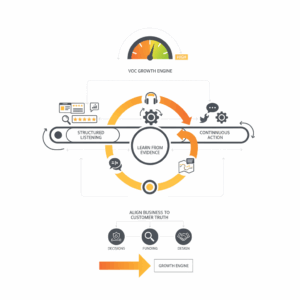
Voice of Customer is a disciplined practice for capturing, analyzing, and acting on what customers say and do across channels to improve experiences, products, and outcomes. In plain terms, a VoC system listens to customers, learns from evidence, and links insight to change. Leading definitions emphasize three ingredients. First, structured listening at scale through surveys, reviews, and service interactions. Second, unstructured listening through call transcripts, social posts, and chats. Third, continuous action through closed-loop processes that fix issues and feed roadmaps. The purpose is not only to measure satisfaction. The purpose is to align the entire business to customer truth that guides decisions, funding, and design. That alignment is what separates a reporting function from a growth engine.¹²
Why does Voice of Customer matter for growth and risk?
VoC matters because customer experience correlates with revenue expansion, lower cost to serve, and reduced churn. When customers resolve tasks easily, they buy again and recommend the brand. When friction increases, they defect and amplify negative word of mouth. Executive teams need more than anecdotes. They need a system that quantifies pain, sizes opportunities, and shows the financial consequence of design choices. Firms that operationalize VoC show measurable lifts in retention and share of wallet because they remove effort, target root causes, and prioritize changes with clear payback. This shift turns experience from slogans into a management system with a P&L. The result is better forecasting and lower operational risk because teams address failure demand before it scales.³⁴
How does a VoC system actually work?
A modern VoC system runs as a loop. It listens through multiple inputs. It interprets meaning using analytics and text intelligence. It shares the signal in the flow of work. It acts through workflows that resolve issues for individuals and address systemic causes. It learns by tracking whether actions moved the metric and the outcome. Design this loop as a service with clear owners, defined SLAs, and artifacts that product and operations teams can consume. Use standards for complaint management and satisfaction measurement so practices stay consistent and auditable. Treat the loop as critical infrastructure, not as a side project or a reporting deck.⁵⁶
What data should we collect?
Collect three categories of data to stabilize the loop. Experience measures capture perception, such as satisfaction, effort, and likelihood to recommend. Behavioral measures capture what happened, such as repeat purchase, abandonment, and resolution time. Descriptive measures capture context, such as segment, product, and channel. Blend these categories at the interaction, journey, and relationship levels. Use short, purposeful prompts at the moment of truth, then complement them with passive listening to reduce survey fatigue. The goal is clarity, not volume. Clean schemas and consistent taxonomies matter more than collecting every possible signal.¹
Which listening posts reduce blind spots?
Capture signals where customers actually expend effort. Prioritize post-interaction surveys, conversation analytics on calls and chats, digital feedback widgets, in-product prompts, and public reviews. Combine active and passive sources to avoid bias. Instrument high-cost moments like identity verification, billing, and claims. Add frontline observation logs so qualitative themes enrich the numbers. This blend improves coverage of silent dissatisfaction that never reaches a survey. Feed all sources into one model of journeys and stages so teams can trace issues from symptom to cause. This approach reduces blind spots and targets the work that customers value.²⁵
How do we turn VoC into action across the journey?
Convert insight into action by wiring VoC into three cadences. First, a real-time cadence that triggers alerts and saves at-risk customers. Second, a weekly cadence where cross-functional squads tackle top drivers for priority journeys. Third, a quarterly cadence where executives fund structural fixes and adjust targets. Translate themes into operational hypotheses and test them with A/B experiments or pilots. Write issue statements in the language of the journey, not the function. Use artifacts like opportunity trees, journey heatmaps, and root-cause diagrams to align teams on scope and evidence. Create feedback-to-feature pipelines so product managers can push fixes quickly.⁵
How should leaders govern VoC to create accountability?
Leaders create accountability by assigning clear ownership, not by asking for more dashboards. Name a VoC owner who stewards the loop and a cross-functional council that sets standards and approves measures. Define who closes the loop with customers, who owns systemic fixes, and who validates benefits. Publish a measurement charter that documents question wording, sampling rules, and escalation paths. Align incentives so leaders cannot hit financial targets while ignoring customer harm. Integrate VoC into performance reviews and quarterly business reviews. This governance turns customer outcomes into management outcomes and prevents metric gaming.⁶
What are the risks and how do we mitigate them?
VoC programs fail when they chase scores over outcomes, over-survey customers, or collect data without consent. They also fail when teams lack authority to act or when methods cannot stand up to audit. Mitigate these risks with transparent purpose statements, minimal data collection, and privacy by design. Provide opt out choices, minimize personal data in text analytics, and set retention limits. Train teams on bias, sampling error, and the proper use of correlation. Use open standards and repeatable methods so evidence remains defensible. This approach protects customers, builds trust, and satisfies regulators while still enabling continuous improvement.⁷⁸
Which metrics prove impact?
Choose a small set of experience and business metrics that move together. Experience metrics include Customer Satisfaction, Customer Effort Score, and relationship measures like Net Promoter Score when applied carefully. Business metrics include retention, repeat purchase rate, claim rework, and cost to serve. Use driver analysis and journey analytics to show which levers change which outcomes. Close the loop by reporting improvements as documented saves, resolved defects, and financial impact tied to cost and revenue lines. Anchor program health to completion rates and close-loop SLAs, not only to survey scores. This linkage makes customer evidence part of financial governance.⁴⁶
What are the first steps in your organisation?
Start small to learn fast. Pick one high-value journey and one high-cost failure point. Instrument the listening posts, define the metrics, and set a weekly action cadence. Establish a single taxonomy for issues and a standard template for root cause narratives. Enable real-time alerts that route to owners with playbooks. Share early wins to build momentum, then extend the loop to adjacent journeys. Scale only when teams demonstrate that insight becomes action within two weeks and that actions produce measurable outcomes. This disciplined approach builds a durable VoC system that leaders can trust and fund.²³
FAQ
What is Voice of Customer in Customer Science terms?
Voice of Customer is a system that captures customer signals across channels, interprets them with analytics, and drives action through closed-loop processes that improve journeys, products, and services.¹
Why should executives invest in a VoC system rather than more surveys?
Executives should invest because structured VoC improves retention, growth, and cost to serve when insight is linked to action and governance, not just to reporting.³
Which listening posts matter most for a modern VoC program?
Prioritize post-interaction surveys, call and chat analytics, digital feedback widgets, in-product prompts, and public reviews to reduce blind spots across the end-to-end journey.²⁵
How does ISO 10004 relate to Voice of Customer?
ISO 10004 provides guidelines for monitoring and measuring customer satisfaction that help standardize methods and governance within a VoC system.⁶
Which metrics prove that VoC is creating value?
Use a small set that links experience to business outcomes, such as Customer Satisfaction and Effort for perception, and retention, repeat purchase, and cost to serve for financial validation.⁴⁶
What governance model keeps VoC accountable at scale?
Assign a VoC owner, a cross-functional council, and clear escalation paths. Use a measurement charter and close-loop SLAs to keep action and evidence auditable.⁶
Which first step accelerates VoC adoption in large enterprises?
Select one high-value journey, instrument listening posts, run a weekly action cadence, and prove impact within two weeks before scaling to other journeys.²³
Sources
-
Gartner. “Voice of the Customer (VoC).” 2024. Gartner Glossary. https://www.gartner.com/en/information-technology/glossary/voice-of-the-customer-voc
-
Qualtrics XM Institute. “What is Voice of the Customer?” 2023. Qualtrics. https://www.qualtrics.com/experience-management/customer/voice-of-customer/
-
McKinsey & Company. “The CEO guide to customer experience.” 2016. McKinsey Insights. https://www.mckinsey.com/capabilities/operations/our-insights/the-ceo-guide-to-customer-experience
-
Qualtrics XM Institute. “ROI of Customer Experience, 2018.” 2018. Qualtrics. https://www.qualtrics.com/xm-institute/research-series/roi-of-customer-experience-2018/
-
U.S. General Services Administration. “Voice of the Customer.” 2021. GSA Centers of Excellence. https://coe.gsa.gov/coe/cx/voice-of-the-customer/
-
International Organization for Standardization. “ISO 10004:2018 Quality management — Customer satisfaction — Guidelines for monitoring and measuring.” 2018. ISO.org. https://www.iso.org/standard/70397.html
-
Bain & Company. “Net Promoter System Defined.” 2022. Bain.com. https://www.netpromotersystem.com/about/
-
European Union. “General Data Protection Regulation.” 2016. GDPR.eu. https://gdpr.eu/what-is-gdpr/