




















Why value stream mapping belongs in service transformation
Executives confront a paradox in services: customer expectations rise while process complexity multiplies. Value Stream Mapping helps leaders see the end-to-end flow of work, information, and decisions that create or degrade customer value. The method visualizes how requests move from demand to delivery, exposes delays and handoffs, and clarifies where time, cost, and quality erode the experience. Lean scholars define a value stream as the sequence of activities required to design, produce, and deliver a good or service, including the dual flows of information and material.¹ This definition applies cleanly to service environments because information, not physical parts, is often the true constraint on flow.¹
What is Value Stream Mapping in a service context?
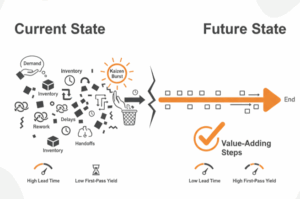
Value Stream Mapping is a structured way to diagram every step needed to fulfill demand, capturing both visible interactions and behind-the-scenes actions. The technique originated in the Toyota Production System as a material and information flow diagram, later popularized as “value-stream mapping.”² It records current-state process steps, queue times, rework loops, decision points, systems, and roles, then proposes a future state that removes waste and restores flow to customer pull.¹ In services, a VSM becomes the single picture that aligns operations, digital, and frontline teams around how value actually moves today and how it should move tomorrow.¹
How does VSM differ from journey maps and service blueprints?
Leaders often ask whether a journey map or service blueprint already covers this ground. A journey map tracks the customer’s experience and emotions across touchpoints. A service blueprint visualizes front-stage, backstage, and support processes that enable that journey. A VSM, by contrast, quantifies the operational flow from request to resolution with time, inventory, handoffs, and information signals.³ A blueprint explains how the service works; a VSM explains why the flow breaks and by how much.³,⁴ In practice, use the journey map for empathy, the blueprint for orchestration, and the VSM for throughput and waste removal.³,⁴
Where should service leaders apply VSM first?
Leaders should start where queues are long, defects are costly, and customer promises slip. Claims processing, onboarding, lending, incident management, scheduling, field service, and back-office case work all benefit because work waits between specialized teams and systems. VSM excels when requests traverse many functions, when metrics conflict, and when no one can answer “where is the work right now” in under a minute.¹ Field-tested comparisons of VSM approaches in services show that mapping techniques can be tailored to fit scenarios with high variability and information intensity.⁵
What problem does VSM actually solve?
Organizations lose performance to invisible waits and rework. Most service value streams suffer from overproduction of information, unclear triage, batch releases between systems, and excessive approvals. VSM makes these losses visible in minutes and hours, not abstract percentages. It converts anecdotes into measurable lead time, process time, queue time, and work-in-process.¹ When leaders see that a five-minute task spends five days in a queue, priorities change. That clarity unlocks targeted experiments that raise throughput and reduce customer effort.¹
How to run a high-yield VSM workshop in services
Leaders convene a cross-functional team that includes demand owners, process doers, system owners, and customer advocates. Facilitators define the request unit, entry and exit points, and a stable time window for measurement. The team walks the work, captures actual data, and draws the current-state map with steps, decision points, SLAs, systems, handoffs, and rework loops.¹ They compute total lead time, process time, and first-pass yield. Then they design a future-state with leveled flow, fewer handoffs, visible pull signals, smaller batches, and built-in quality checks.¹ Repeating this cycle builds the habit of seeing value versus waste across any service.¹,⁶
Which metrics matter most, and how does Little’s Law help?
Service operations improve fastest when leaders instrument flow. Little’s Law states that the long-term average number of items in a stable system equals the arrival rate multiplied by the average time in the system. In short: Work-in-Process equals Throughput times Lead Time.⁷ This relationship holds for many queuing systems and provides a simple lever model.⁷ If WIP grows while throughput remains flat, lead time must rise. If you cap WIP and smooth arrival rates, lead time will fall.⁷ Leaders can apply this to contact queues, case backlogs, and change pipelines to predict delays and size capacity with confidence.⁸
What signals separate a strong future-state map from a weak one?
Effective future-state maps replace push with pull, large batches with flow units, and status meetings with visual controls. They collapse approvals into clear rules, move work validation upstream, and automate handoffs with event-driven triggers.¹ They also define workcell-like teams in services, where case ownership persists from intake to resolution.¹ Weak maps retain big batches, ambiguous triage, and multiple queues per role. Weak maps optimize silos instead of the end-to-end path and ignore the information flow that actually governs service speed.¹,⁶
How does VSM interact with Agile, ITIL, and service design?
Value Stream Mapping complements Agile by revealing system constraints that single teams cannot see. It complements ITIL by clarifying how incidents, problems, and changes flow across functions and tools. It strengthens service design by turning blueprints into measurable flow hypotheses. Practitioners use VSM outputs to shape backlog priorities, to remove external dependencies, and to set WIP limits that protect flow.¹,³ Teams then verify improvements with lead time, throughput, and first-contact resolution.¹
What risks or pitfalls should executives expect?
Executives should watch for three common traps. First, teams map the “happy path” and ignore exceptions that dominate lead time. Second, facilitators collect model times instead of observed times, which hides real waits and masking layers like work reassignment. Third, organizations treat VSM as a onetime workshop rather than a management routine. Research comparing service VSM approaches shows method choices matter and should fit the environment’s variability and information density.⁵ Leaders should also avoid inflating benefits with aspirational percentages and instead anchor on measured deltas in lead time and queue depth.¹,⁶
How do you measure the impact and make it stick?
Executives make VSM stick by turning insights into operating constraints. They cap WIP at choke points, set small batch policies in intake, relocate checks to earlier steps, and create single-owner flow for complex cases. They publish flow dashboards with lead time targets, visible backlogs, and service levels that reflect customer pull.¹ Continuous improvement accelerates when teams re-map quarterly and treat deviations as learning opportunities. Experienced practitioners highlight that repeating the mapping process is a simple, effective way to teach teams to distinguish value-adding from non-value-adding work across any industry.⁶
What results should leaders reasonably expect?
When organizations apply VSM rigorously, they often report significant reductions in end-to-end lead time, fewer handoffs, and clearer roles that improve customer satisfaction. Industry explainers regularly cite meaningful gains from waste removal as a by-product of mapping and redesign, particularly in high-queue service environments.⁹ While the exact magnitude varies, the direction is consistent: less work-in-process, shorter cycle times, and faster, more reliable outcomes for customers.¹,⁹
Practical steps to launch in the next 30 days
Leaders can launch with a clear, time-boxed plan. Select one value stream tied to a customer promise. Define the unit of work and the start and stop conditions. Set a two-week window for observation. Assemble a cross-functional team. Draw the current-state with actual times and queue sizes. Compute WIP, lead time, and throughput, then apply Little’s Law to stress-test the numbers.⁷ Draft a future-state that replaces push with pull and large batches with flow. Establish WIP limits, event-driven handoffs, and a single owner from intake to resolution. Pilot changes for two weeks, then re-map and compare before-and-after measures.¹,⁶,⁷
FAQ
What is Value Stream Mapping in services, and why does it matter for CX?
Value Stream Mapping is a method to diagram the end-to-end flow of work and information from request to resolution. It exposes waits, handoffs, and rework that extend lead time and erode customer experience.¹
How is a value stream map different from a service blueprint or a customer journey map?
A journey map focuses on customer emotions and interactions, a service blueprint shows front-stage and backstage processes, and a VSM quantifies operational flow with times, WIP, and information signals that drive throughput.³,⁴
Which metrics should a contact centre or back office track when using VSM?
Track work-in-process, lead time, throughput, first-pass yield, and rework rates. Use Little’s Law to relate WIP, throughput, and lead time for capacity and flow decisions.⁷,⁸
Why does Little’s Law matter in service operations?
Little’s Law provides a reliable relationship between items in the system, arrival rate, and time in the system. It holds widely in stable queuing systems and helps predict the impact of WIP limits and arrival smoothing on lead time.⁷
Which service areas benefit most from Value Stream Mapping?
Areas with long queues and many handoffs such as claims, onboarding, lending, incident management, scheduling, and case-based back-office work benefit because information flow, not effort, is usually the constraint.¹,⁵
Who should participate in a VSM workshop for Customer Science projects?
Include demand owners, process doers, system owners, and customer advocates across Customer Experience and Service Transformation. Cross-functional views reveal real waits and governance gaps.¹
Which first changes create impact after mapping?
Cap WIP at bottlenecks, reduce batch sizes, move checks upstream, automate handoffs with event triggers, and assign single ownership for complex cases. Re-map and measure improvements in lead time and backlog size.¹,⁶,⁷
Sources
Lean Enterprise Institute. “Value-Stream Mapping (VSM) Overview.” 2025, Lean Enterprise Institute. https://www.lean.org/lexicon-terms/value-stream-mapping/
Michel Baudin. “Where do ‘Value Stream Maps’ come from?” 2013, Michel Baudin’s Blog. https://michelbaudin.com/2013/10/25/where-do-value-stream-maps-come-from/
Miro Team. “The Difference Between a Service Blueprint and a Journey Map.” 2025, Miro. https://miro.com/customer-journey-map/service-blueprint-vs-journey-map/
Outwitly. “Service Blueprint vs Journey Map: What’s the difference?” 2024, Outwitly. https://outwitly.com/blog/customer-journey-maps-vs-service-blueprints/
J. Reijers et al. “Value Stream Mapping in a Service Environment: A Comparison of Approaches.” 2012, University of Portsmouth Working Paper. https://pure.port.ac.uk/ws/portalfiles/portal/153252/Value_Stream_Mapping.pdf
Lean Enterprise Institute. “Understanding the Fundamentals of Value-Stream Mapping.” 2022, The Lean Post. https://www.lean.org/the-lean-post/articles/understanding-the-fundamentals-of-value-stream-mapping/
Wikipedia. “Little’s law.” 2025, Wikimedia Foundation. https://en.wikipedia.org/wiki/Little%27s_law
iSixSigma. “Little’s Law: A Powerful Metric for Process Analysis.” 2024, iSixSigma. https://www.isixsigma.com/dictionary/littles-law/
iSixSigma. “Value Stream Mapping for Service Operations.” 2025, iSixSigma. https://www.isixsigma.com/value-stream-mapping/value-stream-mapping-for-service-operations/