


























Why sustainable service now sets the competitive baseline
Executives set the tone when they choose service standards that protect customers and the planet. Strong standards reduce risk, align teams, and prove progress to regulators and investors. Sustainable service means that customer operations deliver fair outcomes, respect human and environmental limits, and publish performance transparently. This piece translates the standards maze into a practical path for Customer Experience and Service Transformation leaders. It spotlights the frameworks that matter, how to operationalise them in contact centres and digital journeys, and how to measure credible impact. It closes with a sequenced roadmap that turns certification into customer value. Leaders use this roadmap to move from compliance to advantage.
What is a “sustainable service standard” in practice?
Sustainable service standards define rules for designing and operating services that are safe, inclusive, low carbon, and well governed. These standards combine process discipline, customer protections, and environmental controls. ISO 26000 provides guidance on social responsibility and clarifies that it is a guidance framework rather than a certifiable requirement.¹ Companies pair ISO 26000 with the UN Global Compact Ten Principles to anchor human rights, labour, environment, and anti-corruption across the operating model.² Together these references set expectations for leadership, policies, supplier conduct, and disclosure. These expectations become real when service leaders implement certifiable or auditable standards in frontline environments such as contact centres, complaints, and procurement. The mix of guidance and certification gives both direction and assurance. This combination is the backbone of sustainable service.
Which certifications matter for service operations and CX?
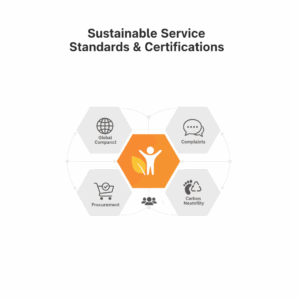
Service leaders focus on a short list that signals credibility to boards and stakeholders. ISO 18295 sets service requirements for customer contact centres and applies to in-house and outsourced models.³ ISO 10002 provides guidelines for complaints handling and integrates with quality systems to drive fair and timely outcomes.⁴ ISO 22458 sets requirements to design and deliver inclusive services for consumers in vulnerable situations.⁵ ISO 20400 guides sustainable procurement so that supplier choices support social and environmental objectives across the chain.⁶ ISO 14068-1 defines principles and requirements for achieving and demonstrating carbon neutrality, prioritising real emissions reductions before residual offsetting.⁷ B Corp Certification demonstrates verified performance, accountability, and transparency, with new performance requirements raising the bar across impact topics.⁸ ⁹ These standards work best when selected by materiality and sequenced to build capability without creating audit fatigue. (iso.org)
How do these frameworks fit together without redundancy?
Architects prevent duplication by mapping scope and intent. ISO 18295 covers contact centre service requirements. ISO 10002 covers the complaints process as a customer protection control. ISO 22458 overlays design requirements to identify and support vulnerability across journeys. ISO 20400 extends standards upstream to suppliers of technology, outsourcing, and energy. ISO 26000 and the UN Global Compact provide governance context that informs policy and culture. Leaders then connect climate and disclosure layers. ISO 14068-1 governs carbon neutrality claims, while Science Based Targets initiative (SBTi) criteria validate near-term emissions targets that align to 1.5°C pathways.¹⁰ Global Reporting Initiative (GRI) Standards provide a modular system for public reporting on economic, environmental, and social impacts.¹¹ This stack avoids gaps and ensures every customer outcome sits within a clear social, environmental, and reporting context. (files.sciencebasedtargets.org)
How do we operationalise sustainable service inside contact centres?
Operations leaders embed standards in five moves. First, design the operating model to ISO 18295 requirements and define measurable service outcomes for clients and end customers.³ Second, implement ISO 22458 practices across identification, escalation, and resolution for consumers in vulnerable situations.⁵ Third, run a robust ISO 10002 complaints system that captures voice-of-customer data, applies root cause analysis, and closes the loop in clear timeframes.⁴ Fourth, hard-wire sustainable procurement, using ISO 20400, to select vendors that meet labour, privacy, accessibility, and emissions criteria.⁶ Fifth, connect energy use, travel, and technology footprints in your service network to SBTi-aligned targets, then use ISO 14068-1 to govern any carbon neutrality claims.⁷ ¹⁰ These moves produce consistent service quality, fair outcomes, and credible climate action in the same workflow. (iso.org)
What customer protections define “responsible by design”?
Leaders anchor protections in inclusion, transparency, and remedy. ISO 22458 requires organizations to design fair, flexible, and inclusive services that increase positive outcomes for people in vulnerable situations.⁵ ISO 10002 ensures customers can raise issues easily and receive timely, fair resolutions with documented learning loops.⁴ UN Global Compact principles support policy controls on human rights, labour, environment, and anti-corruption.² Procurement teams use ISO 20400 to cascade these protections to suppliers and agents.⁶ When AI is present in service flows, teams should apply these same principles to model governance, data minimisation, explainability, and bias monitoring, treating AI outcomes as part of the service promise. This alignment turns customer protections into operational defaults rather than exceptions.
How do we measure and report progress without greenwashing?
Executives publish what they measure and assure what they claim. SBTi criteria define what constitutes a science-based near-term target, with versioned requirements that increase ambition and clarity.¹⁰ GRI’s modular standards help organizations report sector-specific, topic-specific, and universal disclosures in a structured, comparable format.¹¹ B Lab’s updated standards clarify performance requirements and make impact actions auditable across priority topics.⁹ ISO 14068-1 sets rules for credible carbon neutrality claims, prioritising real emissions reductions and transparent reporting of residual offsets.⁷ ISO 26000 clarifies the broader social responsibility context and stakeholder engagement.¹ Leaders should link operational metrics to these frameworks, define audit trails, and present customer outcome metrics alongside environmental performance. This integrated disclosure reduces greenwashing risk and improves investor confidence. (files.sciencebasedtargets.org)
How do we choose a pragmatic roadmap that the board will support?
Boards approve roadmaps that reduce risk fast and compound value. Start with foundations that protect customers and stabilise operations. Sequence ISO 18295 for contact centre service, ISO 10002 for complaints, and ISO 22458 for vulnerability. Add ISO 20400 to clean up third-party risk. Then commit to SBTi near-term targets and apply ISO 14068-1 before making neutrality claims. Finally, formalise governance with ISO 26000 and consider B Corp Certification as a public signal once the operating system is mature. This order builds confidence, improves agent experience, and streamlines audits. It also aligns with GRI reporting to show progress to stakeholders. The result is a service system that customers trust and auditors can verify.
How do we turn certification into customer and commercial impact?
Leaders make standards an everyday management system. They embed controls into tools and training rather than binders. They publish commitments, track outcomes in real time, and close the loop on issues that matter to customers and regulators. They use supplier scorecards to move spend toward responsible vendors. They invest in energy efficient cloud, low-travel support models, and accessible journey design. They link agent performance to fair outcomes and remediation quality. They map disclosures to GRI and present them in clear dashboards. They pursue B Corp Certification when performance and governance are ready. This approach converts sustainability into higher satisfaction, lower cost to serve, faster change approvals, and stronger brand preference.
What results should executives expect in year one and year two?
Executives should expect fewer escalations, faster resolution times, and measurable improvements in vulnerable customer outcomes within the first year. They should also expect better third-party risk posture due to sustainable procurement controls. In year two, they should see verified progress against SBTi targets and cleaner claims under ISO 14068-1 if pursuing neutrality. They should also see improved employee engagement as agents feel safer and more supported by clear standards. These results will support stronger disclosure under GRI and readiness for B Corp pathways. The service system will feel calmer, with less variability and more trust.
Next steps leaders can action this quarter
Select scope. Choose a business unit that owns a significant share of customer contacts and supplier spend.
Baseline maturity. Map current practices against ISO 18295, ISO 10002, ISO 22458, and ISO 20400.
Lock governance. Adopt ISO 26000 guidance and align policies to the UN Global Compact Ten Principles.
Set climate targets. Submit near-term targets to SBTi and build the inventory needed for ISO 14068-1 governance of neutrality claims.
Publish progress. Use GRI Standards to disclose material topics, controls, and outcomes.
Decide on signal. Consider B Corp Certification once controls and evidence are stable.
Sources
ISO 26000 — Social responsibility. International Organization for Standardization. 2010. Web. https://www.iso.org/iso-26000-social-responsibility.html (iso.org)
The Ten Principles of the UN Global Compact. United Nations Global Compact. 2025. Web. https://unglobalcompact.org/what-is-gc/mission/principles (UN Global Compact)
ISO 18295-1:2017 Customer contact centres — Requirements. International Organization for Standardization. 2017. Web. https://www.iso.org/standard/64739.html (iso.org)
ISO 10002:2018 Quality management — Customer satisfaction — Guidelines for complaints handling in organizations. International Organization for Standardization. 2018. Web. https://www.iso.org/cms/render/live/en/sites/isoorg/contents/data/standard/07/15/71580.html (iso.org)
ISO 22458:2022 Consumer vulnerability — Requirements and guidelines for the design and delivery of inclusive service. International Organization for Standardization. 2022. Web. https://www.iso.org/cms/render/live/en/sites/isoorg/contents/data/standard/07/32/73261.html (iso.org)
ISO 20400:2017 Sustainable procurement — Guidance. International Organization for Standardization. 2017. Web. https://www.iso.org/standard/63026.html (iso.org)
ISO 14068-1:2023 Climate change management — Carbon neutrality. International Organization for Standardization. 2023. Web. https://www.iso.org/standard/43279.html (iso.org)
B Corp Certification overview. B Lab. 2023. Web. https://www.bcorporation.net/en-us/certification/ (bcorporation.net)
B Lab publishes new B Corp standards, raising the bar for businesses worldwide. B Lab Global. 2025. Press release. https://www.bcorporation.net/en-us/news/press/b-lab-publishes-new-b-corp-standards-raising-the-bar-for-businesses-worldwide/ (bcorporation.net)
Corporate Near-Term Criteria V5.3. Science Based Targets initiative. 2025. PDF. https://files.sciencebasedtargets.org/production/files/SBTi-criteria.pdf (files.sciencebasedtargets.org)
GRI Standards — System overview. Global Reporting Initiative. 2024. Web. https://www.globalreporting.org/standards (Global Reporting Initiative)
FAQ
How do ISO 18295 and ISO 10002 improve contact centre outcomes at the same time?
ISO 18295 sets the operating requirements for service delivery, while ISO 10002 defines a fair, timely complaints process. Used together, they stabilise service quality and create a feedback loop that prevents repeat issues.³ ⁴
What is ISO 22458 and why does it matter to customer vulnerability?
ISO 22458 specifies requirements to design and deliver inclusive services that increase positive outcomes for consumers in vulnerable situations. It turns vulnerability support into a systematic practice across journeys.⁵
Which climate standard should we use for credible net zero progress?
Use SBTi to validate near-term targets aligned to 1.5°C and use ISO 14068-1 to govern any carbon neutrality claims, prioritising actual emissions reductions before residual offsetting.¹⁰ ⁷
Which procurement framework aligns suppliers with responsible service delivery?
ISO 20400 guides sustainable procurement so that supplier choices support social and environmental objectives. It helps embed responsibility in outsourcing, technology, and facilities decisions.⁶
What reporting framework best supports transparent disclosure of service impacts?
GRI’s modular Standards provide a structured, comparable system for reporting economic, environmental, and social impacts, with sector and topic specifics for relevance.¹¹
Who should we look to for overall social responsibility guidance?
ISO 26000 provides guidance on social responsibility, and the UN Global Compact Ten Principles offer a principles-based foundation for policy and culture across human rights, labour, environment, and anti-corruption.¹ ²
Which certification can signal broad enterprise commitment beyond individual ISO standards?
B Corp Certification demonstrates verified performance, accountability, and transparency across impact topics, and B Lab’s updated standards raise expectations globally.⁸ ⁹